Key takeaway: This precalculus conic sections worksheet provides 26 printable problems on circles, parabolas, ellipses and hyperbolas. Problems 1 to 5 write equations of circles, problems 6 to 10 handle parabolas, problems 11 to 17 cover ellipses and hyperbolas, and problems 18 to 26 identify conics and model real settings. Standard G-GPE.A.1 anchors the circle work. The PDF includes an answer key, and about 60 minutes is enough.
These 26 problems cover the four conic sections in order: circle equations and completing the square, parabolas from a focus and directrix, ellipses and hyperbolas from their foci, and identifying a conic from a general equation (G-GPE.A.1, G-GPE.A.2, G-GPE.A.3).
The last six are applications: a satellite dish, a whispering gallery, a sprinkler, a navigation system, a garden and a fountain. Every problem has a full worked solution in the answer key.
Precalculus Conic Sections Worksheet: problems 1–5
1. Write the equation of a circle
Write the equation of the circle with the given center and radius.
- center \((0,\ 0)\), radius \(7\)
- center \((3,\ -2)\), radius \(5\)
- center \((-4,\ 1)\), radius \(\sqrt{7}\)
2. Center and radius from an equation
State the center and radius of each circle.
- \((x+4)^{2}+(y-1)^{2}=49\)
- \(x^{2}+(y-5)^{2}=36\)
- \((x-2)^{2}+(y+3)^{2}=20\)
3. Circle through a point
A circle has its center at \(C(1,\ 2)\) and passes through \(P(4,\ 6)\). Find its equation.
4. Circle from a diameter
The segment from \(A(-2,\ 3)\) to \(B(6,\ 7)\) is a diameter of a circle. Write the equation of the circle.
5. Complete the square: circles
Write each equation in standard form and name the center and radius.
- \(x^{2}+y^{2}-8x+6y+9=0\)
- \(x^{2}+y^{2}+10x-4y+13=0\)
- \(x^{2}+y^{2}+2x-6y-15=0\)
Precalculus Conic Sections Worksheet: problems 6–10
6. Parabola from focus and directrix
Find the equation of the parabola with focus \((0,\ 3)\) and directrix \(y=-3\).
7. Focus and directrix from an equation
For each parabola, find \(p\), the focus and the directrix.
- \(y^{2}=16x\)
- \(x^{2}=-20y\)
8. Equal distances
Show that \(P(4,\ 2)\) lies on the parabola with focus \(F(0,\ 2)\) and directrix \(y=-2\) by comparing two distances.
9. Parabola with a shifted vertex
A parabola has vertex \((2,\ 1)\) and focus \((2,\ 4)\). Write its equation and its directrix.
10. Parabola opening left
Find the equation of the parabola with focus \((-3,\ 0)\) and directrix \(x=3\).
Precalculus Conic Sections Worksheet: problems 11–15
11. Ellipse features
For \(\frac{x^{2}}{25}+\frac{y^{2}}{9}=1\), find \(a\), \(b\), \(c\), the vertices, the co-vertices and the foci.
12. A vertical ellipse
For \(\frac{x^{2}}{16}+\frac{y^{2}}{25}=1\), find the vertices and the foci. Which axis is the major axis?
13. Ellipse from its foci
An ellipse has foci \((\pm 3,\ 0)\). The sum of the distances from any point on it to the foci is \(10\). Write its equation.
14. A shifted ellipse
For \(\frac{(x-2)^{2}}{36}+\frac{(y+1)^{2}}{20}=1\), find the center, vertices, foci, and the sum of the distances from a point on the ellipse to the foci.
15. Hyperbola features
For \(\frac{x^{2}}{16}-\frac{y^{2}}{9}=1\), find the vertices, foci and asymptotes.
Precalculus Conic Sections Worksheet: problems 16–20
16. A vertical hyperbola
For \(\frac{y^{2}}{9}-\frac{x^{2}}{16}=1\), find the vertices, foci and asymptotes.
17. Hyperbola from its foci
A hyperbola has foci \((\pm 5,\ 0)\). The absolute difference of the distances from any point on it to the foci is \(8\). Write its equation.
18. Identify an ellipse
Complete the square to write \(4x^{2}+9y^{2}-16x+18y-11=0\) in standard form. Name the conic, its center, and its foci.
19. Identify a hyperbola
Complete the square to write \(x^{2}-4y^{2}+6x+16y-23=0\) in standard form. Name the conic, its center, and its asymptotes.
20. Identify a parabola
Complete the square to write \(y^{2}-6y-8x+25=0\) in standard form. Find the vertex, focus and directrix.
Precalculus Conic Sections Worksheet: problems 21–25
21. Satellite dish
A satellite dish has a parabolic cross-section 8 feet wide and 2 feet deep. Place the vertex at the origin with the dish opening upward. Write an equation for the cross-section and find how far above the vertex the receiver should sit (at the focus).
22. Whispering gallery
A whispering gallery is an ellipse-shaped hall 100 feet long and 60 feet wide. Write its equation with the center at the origin and the long axis along the \(x\)-axis. Then find how far apart the two focus points are.
23. Sprinkler coverage
A sprinkler at \((20,\ 30)\) waters a circular region of radius \(15\) feet (coordinates in feet). Write the equation of the boundary. Is the flower at \((24,\ 38)\) watered? Is the bench at \((35,\ 45)\) watered?
24. Navigation stations
Two radio stations at \((-5,\ 0)\) and \((5,\ 0)\), measured in miles, send signals. A ship is exactly \(6\) miles closer to one station than to the other, so it lies on a hyperbola with these foci. Write the equation of the hyperbola, then find the \(y\)-coordinate of the ship when \(x=6\) and \(y>0\).
25. Elliptical garden
Priya outlines an elliptical garden 24 feet long and 18 feet wide by looping a string around two stakes and keeping it taut with a pencil. How far apart should the stakes be, and how long must the loop be around the stakes? Give the stake distance to the nearest hundredth.
Precalculus Conic Sections Worksheet: problems 26–26
26. Circular fountain
The edge of a circular fountain is modeled by \(x^{2}+y^{2}-12x-16y+75=0\), in feet, with the entrance at the origin. Find the center and radius, then find the shortest distance from the entrance to the edge of the fountain.

Which problems build the circle skills?
Start with problem 1, where a center and radius give an equation directly. Problem 3 adds a twist: a circle centered at \(C(1,2)\) passes through \(P(4,6)\), so you find the radius from the distance. In problem 4, the endpoints of a diameter give the center as their midpoint. Then problem 5 completes the square on \(x^{2}+y^{2}-8x+6y+9=0\).
How do parabolas and ellipses differ in practice?
Problem 6 pairs the focus \((0,3)\) with the directrix \(y=-3\). Problem 9 shifts the vertex to \((2,1)\), so the equation needs \((x-2)\) and \((y-1)\). By contrast, ellipse problems start with \(a\), \(b\) and \(c\). In problem 11, \(\frac{x^{2}}{25}+\frac{y^{2}}{9}=1\) has \(c=4\). Problem 12 flips the axes, so the larger denominator sits under \(y^{2}\).
What do the hyperbola and identification problems add?
Problems 15 and 16 ask for vertices, foci and asymptotes. Problems 18 to 20 give general equations, and you complete the square to name each conic. Problem 18, \(4x^{2}+9y^{2}-16x+18y-11=0\), becomes an ellipse. Meanwhile, problem 19 produces a hyperbola because the squares have opposite signs.
How are the real-world problems set up?
A satellite dish in problem 21 is 8 feet wide and 2 feet deep, so place the vertex at the origin. Problem 22 models a whispering gallery 100 feet long and 60 feet wide. Finally, problem 26 rewrites a fountain’s equation to find its radius.
How should you check this worksheet?
Test every equation with one known point. For a circle, substitute the center plus the radius. For a parabola, measure both distances. After that, compare with the key and take the quiz to see whether the identification step is now automatic.

Printable PDF · Worksheet
Precalculus Conic Sections: Parabolas, Ellipses and Hyperbolas worksheet
Download the PDF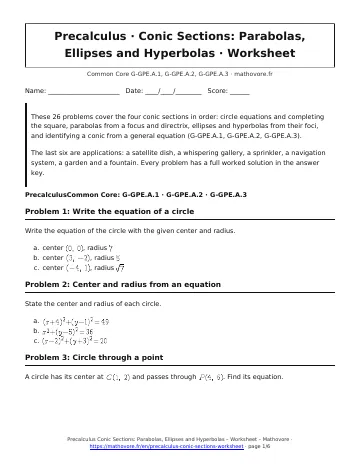
See every chapter on the Precalculus math page.