Key takeaway: This precalculus matrices worksheet provides 23 printable problems that cover the full arc of matrix skills. Problems 1 to 7 read, add, subtract and scale, problems 8 to 15 multiply, problems 16 to 19 find determinants and inverses, and problems 20 to 23 apply matrices to stores, markets and codes. Standard N-VM.C.8 supports the products. The PDF carries the figures and the key, and about an hour is a fair target.
These 23 problems practice matrices at the Precalculus level, aligned with Common Core N-VM.C.6 through N-VM.C.10: reading and organizing data in matrices, adding and scaling, multiplying \(2\times 2\) and \(3\times 3\) matrices, and using determinants and inverses.
The last problems apply matrices to sales, inventory and coded messages. Work from easiest to hardest and show every row-by-column calculation.
Precalculus Matrices Worksheet: problems 1–5
1. Dimensions and entries
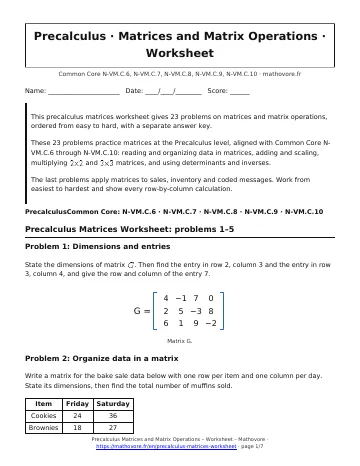
State the dimensions of matrix \(G\). Then find the entry in row 2, column 3 and the entry in row 3, column 4, and give the row and column of the entry 7.
2. Organize data in a matrix
Write a matrix for the bake sale data below with one row per item and one column per day. State its dimensions, then find the total number of muffins sold.
| Item | Friday | Saturday |
|---|---|---|
| Cookies | 24 | 36 |
| Brownies | 18 | 27 |
| Muffins | 30 | 21 |
3. Add matrices
Find \(A+B\).
4. Subtract matrices
Find \(C-D\).
5. Scalar multiples
Using \(A\) and \(B\) from the Add matrices problem, find \(3A\) and \(-2B\).
Precalculus Matrices Worksheet: problems 6–10
6. Combine operations
Using \(A\) and \(B\) from the Add matrices problem, find \(2A-3B\).
7. Solve for unknowns
Find \(x\) and \(y\).
8. Is the product defined?
For each pair, decide whether \(AB\) is defined. If it is, give the dimensions of \(AB\).
- \(A\) is \(2\times 3\) and \(B\) is \(3\times 4\)
- \(A\) is \(3\times 2\) and \(B\) is \(3\times 2\)
- \(A\) is \(1\times 3\) and \(B\) is \(3\times 1\)
- \(A\) is \(3\times 1\) and \(B\) is \(1\times 3\)
9. Multiply 2 × 2 matrices
Find \(PQ\).
10. Multiply a 2 × 3 by a 3 × 2
Find \(RS\) and state its dimensions.
Precalculus Matrices Worksheet: problems 11–15
11. Matrix times a column
Find the product of the \(2\times 2\) matrix and the \(2\times 1\) column.
12. Compare AB and BA
Find \(AB\) and \(BA\). Then state whether \(AB=BA\).
13. Identity and zero matrices
Let \(I\) be the \(2\times 2\) identity matrix and \(O\) the \(2\times 2\) zero matrix. Find each result.
- \(AI\)
- \(A+O\)
- \(AO\)
- \(-A+A\)
14. Check the distributive property
Show that \(A(B+C)=AB+AC\) for the matrices below by computing both sides.
15. Multiply 3 × 3 matrices
Find \(XY\).
Precalculus Matrices Worksheet: problems 16–20
16. Find determinants
Find the determinant of each matrix.
17. Find k for a singular matrix
A square matrix with no inverse is called singular. Find every value of \(k\) that makes the matrix singular.
18. Find a 2 × 2 inverse
Find the inverse of each matrix.
19. Verify an inverse
Show that \(B\) is the inverse of \(A\) by computing \(AB\) and \(BA\).
20. School store revenue
Aisha runs the school store. The sales matrix \(S\) shows the number of pencils, erasers and notebooks sold on Monday and Tuesday. Pencils cost \$0.50, erasers \$0.75 and notebooks \$2.25. Multiply to find the revenue for each day.
Precalculus Matrices Worksheet: problems 21–23
21. Farmers market inventory
Mei sells apples, pears and peaches by the crate at a farmers market. Matrix \(A\) shows the crates on hand Saturday and Sunday morning. Matrix \(B\) shows the crates delivered on each of those days. Find the total crates available each day, then the amounts needed if she doubles those totals next month.
22. Encode and decode a message
Priya encodes the number pair \((7,12)\), written as a column, by multiplying on the left by the key matrix \(K\). Find the coded column. Then find \(K^{-1}\) and use it to decode the result.
23. Does the matrix have an inverse?
Noah claims that the matrix \(N\) has an inverse because all of its entries are positive. Decide whether Noah is right, and explain using the determinant.

Which problems build the basics?
Problem 1 asks for the dimensions of matrix \(G\) and two chosen entries. Problem 2 turns bake sale data into a matrix, so decide what each row and column means. Problems 3 to 6 then add, subtract and scale using the same matrices \(A\) and \(B\), which saves time. Problem 7 solves for the unknowns \(x\) and \(y\) by matching entries.
How do the multiplication problems progress?
Problem 8 asks only whether a product is defined and what its dimensions would be. Problems 9 to 11 compute small products, including a matrix times a column. Problem 12 compares \(AB\) with \(BA\), and the answers differ. Next, problem 13 uses the identity and zero matrices, and problem 14 checks \(A(B+C)=AB+AC\) by computing both sides. Problem 15 scales up to a \(3\times 3\) product.
What do the determinant and application problems add?
Problem 17 asks for every \(k\) that makes a matrix singular, so set \(ad-bc=0\) and solve. Problem 19 verifies an inverse by computing both \(AB\) and \(BA\). In problem 20, a sales matrix times a price matrix gives the revenue for the school store. Problem 22 encodes the pair \((7,12)\) with a key matrix. Finally, problem 23 tests Noah’s claim that positive entries guarantee an inverse.
Write the dimensions beside every product before you multiply.
How should you review your work?
Mark each miss as size error, arithmetic slip or concept gap. Redo the size errors first, since they take seconds to fix. Then study the key, and test yourself with the quiz.

See every chapter on the Precalculus math page.