


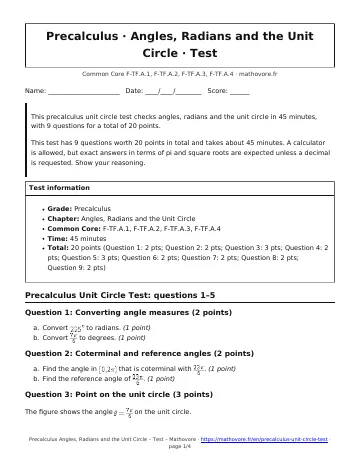
This precalculus unit circle test checks angles, radians and the unit circle in 45 minutes, with 9 questions for a total of 20 points.
This test has 9 questions worth 20 points in total and takes about 45 minutes. A calculator is allowed, but exact answers in terms of pi and square roots are expected unless a decimal is requested. Show your reasoning.
- Grade: Precalculus
- Chapter: Angles, Radians and the Unit Circle
- Common Core: F-TF.A.1, F-TF.A.2, F-TF.A.3, F-TF.A.4
- Time: 45 minutes
- Total: 20 points (Question 1: 2 pts; Question 2: 2 pts; Question 3: 3 pts; Question 4: 2 pts; Question 5: 3 pts; Question 6: 2 pts; Question 7: 2 pts; Question 8: 2 pts; Question 9: 2 pts)
Precalculus Unit Circle Test: questions 1–5
Question 1: Converting angle measures (2 points)
- Convert \(225^{\circ}\) to radians. (1 point)
- Convert \(\frac{7\pi}{6}\) to degrees. (1 point)
Question 2: Coterminal and reference angles (2 points)
- Find the angle in \([0,2\pi)\) that is coterminal with \(\frac{23\pi}{6}\). (1 point)
- Find the reference angle of \(\frac{23\pi}{6}\). (1 point)
Question 3: Point on the unit circle (3 points)
The figure shows the angle \(\theta=\frac{7\pi}{6}\) on the unit circle.
- Write the exact coordinates of \(P\). (1 point)
- Find \(\tan\frac{7\pi}{6}\). (1 point)
- Find \(\sin(-\frac{7\pi}{6})\). (1 point)
Question 4: Arc length of a sector (2 points)
A pizza slice is a sector with radius 15 in.
- Write the central angle in radians. (1 point)
- Find the length of the curved crust, to two decimal places. (1 point)
Question 5: Angular and linear speed (3 points)
A Ferris wheel of radius 50 ft makes one full revolution every 8 minutes.
- Find its angular speed in radians per minute. (1 point)
- Find the linear speed of a rider in feet per minute, to two decimal places. (1 point)
- Find how far a rider travels in 20 minutes, to two decimal places. (1 point)
Precalculus Unit Circle Test: questions 6–9
Question 6: Solving trigonometric equations (2 points)
Solve each equation for \(\theta\) in \([0,2\pi)\).
- \(\cos\theta=-\frac{\sqrt{3}}{2}\) (1 point)
- \(\tan\theta=1\) (1 point)
Question 7: Even and odd (2 points)
- Find the exact value of \(\tan(-\frac{5\pi}{4})\). (1 point)
- Decide whether \(f(x)=x^{2}\sin x\) is even, odd or neither, and justify. (1 point)
Question 8: Periodicity of sine (2 points)
The graph shows \(y=\sin x\) and \(\sin\frac{\pi}{6}=\frac{1}{2}\).
- State the period of \(y=\sin x\). (1 point)
- Find \(\sin\frac{13\pi}{6}\) and \(\sin(-\frac{7\pi}{6})\). (1 point)
Question 9: Unit circle coordinates (2 points)
The angle \(\theta\) lies in Quadrant II and \(\cos\theta=-\frac{8}{17}\).
- Find \(\sin\theta\). (1 point)
- Find \(\tan\theta\). (1 point)

How to use this precalculus unit circle test
Take this precalculus unit circle test without notes, then grade it with the test answer key out of 20 points.

See every chapter on the Precalculus math page.