
Key takeaway: This precalculus matrix systems worksheet gathers 24 printable problems on writing, solving and interpreting systems with matrices. Problems 1 to 8 build determinants and inverses, problems 9 to 12 solve systems, problems 13 to 18 transform points and areas, and problems 19 to 24 apply everything to stores, markets, sprites and lots. Standard N-VM.C.12 anchors the geometry. The PDF ends with a key, and one sitting of roughly sixty minutes suffices.
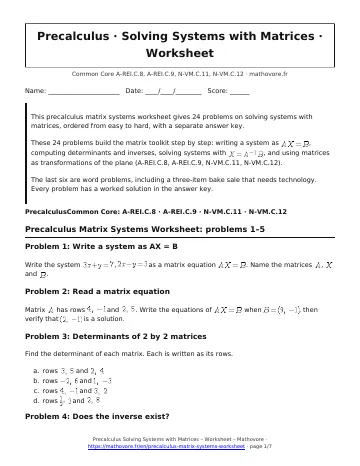
These 24 problems build the matrix toolkit step by step: writing a system as \(AX=B\), computing determinants and inverses, solving systems with \(X=A^{-1}B\), and using matrices as transformations of the plane (A-REI.C.8, A-REI.C.9, N-VM.C.11, N-VM.C.12).
The last six are word problems, including a three-item bake sale that needs technology. Every problem has a worked solution in the answer key.
Precalculus Matrix Systems Worksheet: problems 1–5
1. Write a system as AX = B
Write the system \(3x + y=7\), \(2x – y=3\) as a matrix equation \(AX=B\). Name the matrices \(A\), \(X\) and \(B\).
2. Read a matrix equation
Matrix \(A\) has rows \(4,\ -1\) and \(2,\ 5\). Write the equations of \(AX=B\) when \(B=(9,\ -1)\), then verify that \((2,\ -1)\) is a solution.
3. Determinants of 2 by 2 matrices
Find the determinant of each matrix. Each is written as its rows.
- rows \(3,\ 5\) and \(2,\ 4\)
- rows \(-2,\ 6\) and \(1,\ -3\)
- rows \(4,\ -1\) and \(3,\ 2\)
- rows \(\frac{1}{2},\ 3\) and \(2,\ 8\)
4. Does the inverse exist?
Decide whether each matrix has an inverse. Explain using the determinant.
- rows \(6,\ 9\) and \(2,\ 3\)
- rows \(5,\ 2\) and \(3,\ 1\)
- rows \(-4,\ 8\) and \(1,\ -2\)
- rows \(7,\ 1\) and \(0,\ 3\)
5. Inverse with determinant 1
Find the inverse of the matrix with rows \(3,\ 5\) and \(1,\ 2\).
Precalculus Matrix Systems Worksheet: problems 6–10
6. Inverses and the identity
Find the inverse of each matrix (rows listed) and show that \(AA^{-1}=I\) for part (a).
- rows \(4,\ 3\) and \(2,\ 2\)
- rows \(5,\ 2\) and \(-3,\ 4\)
- rows \(1,\ 2\) and \(3,\ 5\)
7. Are these inverses?
Matrix \(A\) has rows \(2,\ 3\) and \(1,\ 2\). Matrix \(C\) has rows \(2,\ -3\) and \(-1,\ 2\). Multiply \(AC\) and \(CA\) to decide whether \(C=A^{-1}\).
8. Solve with a given inverse
The inverse of the matrix with rows \(2,\ 5\) and \(1,\ 3\) has rows \(3,\ -5\) and \(-1,\ 2\). Use it to solve \(2x+5y=7\), \(x+3y=4\).
9. Solve a system with the inverse
Solve \(3x+4y=10\), \(2x+3y=7\) by writing \(AX=B\) and using \(A^{-1}\).
10. Determinant 11
Solve \(5x-2y=4\), \(3x+y=9\) with the inverse matrix.
Precalculus Matrix Systems Worksheet: problems 11–15
11. A fractional solution
Solve \(4x+y=3\), \(6x+2y=5\) with an inverse matrix.
12. When the determinant is zero
For each system, find \(\det A\), then decide whether the system has one solution, none or infinitely many.
- \(x+2y=3\), \(2x+4y=6\)
- \(x+2y=3\), \(2x+4y=7\)
13. Apply a matrix to a point
Matrix \(P\) has rows \(2,\ 0\) and \(0,\ 3\). Matrix \(R\) has rows \(0,\ -1\) and \(1,\ 0\). Find
- \(P\) times \((4,\ -1)\)
- \(R\) times \((2,\ 5)\)
- \(R\) times \((-3,\ 1)\)
14. Shear the unit square
A shear matrix \(S\) has rows \(1,\ 2\) and \(0,\ 1\). Find the images of the vertices \((0,\ 0)\), \((1,\ 0)\), \((1,\ 1)\), \((0,\ 1)\) of the unit square shown, and sketch the image.
15. Build the matrix from two images
A matrix sends \((1,\ 0)\) to \((0,\ 1)\) and \((0,\ 1)\) to \((-1,\ 0)\), as shown. Write the matrix, then find the image of \((3,\ 2)\).
Precalculus Matrix Systems Worksheet: problems 16–20
16. Reflections
Matrix \(T\) has rows \(1,\ 0\) and \(0,\ -1\). The point \((5,\ 4)\) is plotted.
- Find the image of \((5,\ 4)\).
- Describe the transformation.
- Find \(\det T\) and explain what the sign tells you.
17. Area scale factor
Let \(A\) have rows \(3,\ 1\) and \(2,\ 4\).
- Find the area scale factor.
- A triangle has area \(6\). What is the area of its image?
- A region maps to an image of area \(35\). What was its area?
18. Negative determinant
Matrix \(B\) has rows \(1,\ 2\) and \(3,\ 1\). A triangle of area \(4\) is transformed by \(B\). Find the area of the image and state what the sign of \(\det B\) means.
19. School store prices
At the school store, Ethan buys 3 pens and 2 notebooks for \(\$7.25\). Maya buys 2 pens and 5 notebooks for \(\$11.25\). Write a matrix equation and use the inverse to find the price of one pen and one notebook.
20. Farmers market
At a farmers market, 4 pounds of apples and 3 pounds of pears cost \(\$19.00\). Also, 3 pounds of apples and 2 pounds of pears cost \(\$13.50\). Use \(X=A^{-1}B\) to find each price per pound.
Precalculus Matrix Systems Worksheet: problems 21–24
21. Bake sale with three items
At a bake sale, Priya sells cookies, brownies and muffins at three prices. Day 1: 4 cookies, 3 brownies and 2 muffins earn \(\$17.00\). Day 2: 2 cookies, 5 brownies and 1 muffin earn \(\$15.50\). Day 3: 1 cookie, 2 brownies and 6 muffins earn \(\$20.50\). Write \(AX=B\) and use technology to find \(A^{-1}\) and each price.
22. Scaling a game sprite
A game designer enlarges a rectangular sprite measuring 5 units by 4 units with the matrix with rows \(3,\ 0\) and \(0,\ 2\). Find the new dimensions and show that the area changes by \(|\det|\).
23. Mapping a triangular lot
A surveyor transforms a triangular lot with vertices \((0,\ 0)\), \((4,\ 0)\) and \((0,\ 3)\) using the matrix with rows \(2,\ 1\) and \(-1,\ 3\). Find the image vertices. Then find the area of the image two ways.
24. Undo a transformation
Matrix \(H\) has rows \(2,\ 1\) and \(1,\ 1\). A point \(P\) is sent to \((11,\ 8)\) by \(H\). Find \(P\), and explain why the area of the figure is unchanged.

Which problems prepare the matrix tools?
To begin, \(3x+y=7\) and \(2x-y=3\) become \(AX=B\) in problem 1. Next, problem 3 finds determinants, for example 2 for rows \(3,5\) and \(2,4\). A zero determinant means no inverse in problem 4, so spot those matrices quickly. After that, rows \(3,5\) and \(1,2\) get inverted in problem 5, and problem 7 multiplies two matrices to test whether they are inverses.
How do the solving problems progress?
Because problem 8 hands you the inverse, only the multiplication remains. Then problem 9 asks you to build everything, from \(A\) to \(A^{-1}\), for \(3x+4y=10\) and \(2x+3y=7\). Meanwhile, the determinant rises to 11 in problem 10, which brings fractions into play. A half appears in the answer to problem 11. Finally, problem 12 compares systems with one solution, none and infinitely many.
What do the transformation problems ask?
A stretch and then a rotation act on a point in problem 13. Likewise, a shear in problem 14 sends the unit square to a parallelogram. Next, problem 15 builds a matrix from two image points. Area scale factors fill problems 17 and 18, where a negative determinant still scales area by its absolute value.
Where do the applications appear?
Store and market purchases in problems 19 and 20 become two-variable systems. Moreover, problem 21 raises the size to three items. Last, problem 24 undoes a transformation by applying the inverse of \(H\).
How should you review your work?
Check every solution by substituting back into both equations. Next, sort misses into inverse errors and setup errors. Redo the setup errors first, because a wrong matrix ruins every later step. Then take the quiz.

See every chapter on the Precalculus math page.