Key takeaway: This precalculus vectors test contains nine questions for 20 points and fits a 45-minute class period. You will work with component form, magnitude, direction, unit vectors, the dot product, a plane in crosswind and two forces. Show your work, and give exact values before decimals. Standards N-VM.A.2 and N-VM.B.4 shape the questions, and each answer needs the right units where a context appears.
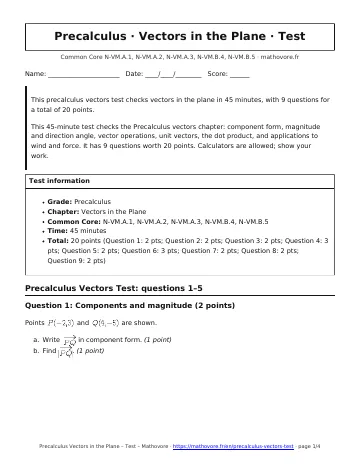
This 45-minute test checks the Precalculus vectors chapter: component form, magnitude and direction angle, vector operations, unit vectors, the dot product, and applications to wind and force. It has 9 questions worth 20 points. Calculators are allowed; show your work.
- Grade: Precalculus
- Chapter: Vectors in the Plane
- Common Core: N-VM.A.1, N-VM.A.2, N-VM.A.3, N-VM.B.4, N-VM.B.5
- Time: 45 minutes
- Total: 20 points (Question 1: 2 pts; Question 2: 2 pts; Question 3: 2 pts; Question 4: 3 pts; Question 5: 2 pts; Question 6: 3 pts; Question 7: 2 pts; Question 8: 2 pts; Question 9: 2 pts)
Precalculus Vectors Test: questions 1–5
1. Components and magnitude (2 points)
Points \(P(-2, 3)\) and \(Q(4, -5)\) are shown.
- Write \(\vec{PQ}\) in component form. (1 point)
- Find \(|\vec{PQ}|\). (1 point)
2. Magnitude and direction (2 points)
Let \(\vec{v}=\langle -3,\ 3\sqrt{3}\rangle\).
- Find \(|\vec{v}|\). (1 point)
- Find the direction angle of \(\vec{v}\) from \(0^{\circ}\) to \(360^{\circ}\). (1 point)
3. Combining vectors (2 points)
Let \(\vec{u}=\langle 2, -5\rangle\) and \(\vec{v}=\langle -4, 3\rangle\). Find each vector.
- \(3\vec{u}+2\vec{v}\) (1 point)
- \(\vec{u}-2\vec{v}\) (1 point)
4. Parallelogram rule (3 points)
The figure shows vectors \(\vec{a}\) and \(\vec{b}\) drawn from the origin.
- Read the components of \(\vec{a}\) and \(\vec{b}\), then find \(\vec{a}+\vec{b}\). (1 point)
- Find \(\vec{a}-\vec{b}\). (1 point)
- Find \(|\vec{a}+\vec{b}|\) exactly. (1 point)
5. Unit vector (2 points)
Let \(\vec{v}=\langle -9, 12\rangle\).
- Find \(|\vec{v}|\). (1 point)
- Find the unit vector in the direction of \(\vec{v}\). (1 point)
Precalculus Vectors Test: questions 6–9
6. Dot product and angle (3 points)
Let \(\vec{u}=\langle 2, 4\rangle\) and \(\vec{v}=\langle -1, 3\rangle\).
- Find \(\vec{u}\cdot\vec{v}\). (1 point)
- Find \(|\vec{u}|\) and \(|\vec{v}|\). (1 point)
- Find the angle between \(\vec{u}\) and \(\vec{v}\). (1 point)
7. Perpendicular vectors (2 points)
Find the value of \(k\) for which \(\langle k, 5\rangle\) is perpendicular to \(\langle 10, -4\rangle\). Show that the dot product is 0 for your value.
8. Airplane and wind (2 points)
A plane has an airspeed of 240 mph heading due north. A wind blows due east at 70 mph (see figure). Find the plane’s ground speed and the direction of its path, measured east of north to the nearest tenth of a degree.
9. Two forces (2 points)
Two forces of 20 pounds each act on an object. \(\vec{F_{1}}\) points along the positive x-axis and \(\vec{F_{2}}\) is at \(120^{\circ}\) from it (see figure). Find the magnitude and direction angle of the resultant force.

How can you manage your time on this test?
Questions 4 and 6 carry 3 points each, so give them extra minutes. Meanwhile, the short items 1, 2 and 5 should take about four minutes each. Keep a few minutes at the end to check every direction angle against a sketch.
What does question 2 test?
The vector \(\langle-3,3\sqrt{3}\rangle\) has magnitude 6. Because it points up and left, the direction angle is \(120^{\circ}\). Many students answer \(-60^{\circ}\), which ignores the quadrant.
Which precalculus vectors test question uses the dot product?
Question 6 gives \(\vec{u}=\langle2,4\rangle\) and \(\vec{v}=\langle-1,3\rangle\). Compute the dot product first, then both magnitudes. As a result, the cosine equals \(\frac{1}{\sqrt{2}}\), and the angle is \(45^{\circ}\).
How do the wind and perpendicular questions differ?
Question 7 sets a dot product equal to zero and solves for \(k\). Question 8 adds a 240 mph northward airspeed to a 70 mph eastward wind. The resultant speed is 250 mph, because the legs form a right triangle.
Which steps help after you finish the vector test?
Compare your answers with the key and highlight every lost point by type. Then redo the dot product question using a different pair of vectors. Finally, explain aloud why a zero dot product means a right angle.

See every chapter on the Precalculus math page.