Key takeaway: This precalculus complex identities volume worksheet offers 28 printable problems that split into two halves. Problems 1 to 18 practice powers of \(i\), conjugate products and factoring over the complex numbers, and problems 19 to 28 apply sphere volume and Cavalieri’s principle. Standards N-CN.C.8 and G-GMD.A.2 apply, and the PDF includes a full answer key. Allow about 60 minutes, and keep a calculator for the rounded volumes.
These problems practice extending polynomial identities to the complex numbers (N-CN.C.8): powers of \(i\), conjugate products, and factoring sums of squares such as \(x^{2}+4=(x+2i)(x-2i)\). They also build an informal argument for the volume of a sphere with Cavalieri’s principle (G-GMD.A.2).
The last six problems are word problems with spheres, cylinders, and cross-sections. Give exact answers first, then decimals where asked.
Precalculus Complex Identities Volume Worksheet: problems 1–5
1. Powers of i
Simplify each power.
- \(i^{5}\)
- \(i^{10}\)
- \(i^{27}\)
- \(i^{100}\)
2. Expand a conjugate product
Expand \((x+3i)(x-3i)\) and simplify.
3. Factor sums of squares
Factor each expression over the complex numbers.
- \(x^{2}+25\)
- \(x^{2}+49\)
- \(y^{2}+1\)
4. Leading coefficients
Factor each expression over the complex numbers.
- \(4x^{2}+1\)
- \(9x^{2}+16\)
- \(49y^{2}+4\)
5. Irrational constant
Factor \(x^{2}+7\) over the complex numbers.
Precalculus Complex Identities Volume Worksheet: problems 6–10
6. Factor out a common factor
Factor completely over the complex numbers.
- \(2x^{2}+18\)
- \(5x^{2}+45\)
- \(3x^{2}+75\)
7. Solve over the complex numbers
Solve each equation.
- \(x^{2}+36=0\)
- \(x^{2}+12=0\)
- \(4x^{2}+9=0\)
8. Write a polynomial from its zeros
The complex plane shows the two zeros of a quadratic with leading coefficient 1.
Write the quadratic in standard form.
9. Fourth-degree difference
Factor \(x^{4}-16\) completely over the complex numbers.
10. Another fourth-degree difference
Factor \(x^{4}-81\) completely over the complex numbers.
Precalculus Complex Identities Volume Worksheet: problems 11–15
11. Cubic with a common factor
Factor completely over the complex numbers.
- \(x^{3}+4x\)
- \(x^{3}+x\)
12. Factor by grouping
Factor \(x^{3}-2x^{2}+4x-8\) completely over the complex numbers and list all its zeros.
13. Products of conjugates
Multiply.
- \((3+2i)(3-2i)\)
- \((5+i)(5-i)\)
- \((6+7i)(6-7i)\)
What pattern do the answers follow?
14. Numbers as conjugate products
Write each number as a product of two complex conjugates.
- \(41\) (use \(25+16\))
- \(85\) (use \(81+4\))
- \(65\) (use \(64+1\))
15. Evaluate at complex values
Let \(p(x)=x^{2}+4\). Find \(p(2i)\), \(p(-2i)\), and \(p(1+i)\).
Precalculus Complex Identities Volume Worksheet: problems 16–20
16. Identities with complex numbers
Use an identity to expand each product.
- \((z+2i)^{2}\)
- \((2+i)^{2}\)
17. Complete the square, then factor
Factor \(x^{2}-2x+5\) over the complex numbers. The plane shows where its zeros should be.
18. Another quadratic
Factor \(x^{2}+6x+13\) over the complex numbers and state its zeros.
19. Volume of a sphere from radius or diameter
Find the exact volume of each sphere and a decimal rounded to the nearest hundredth.
- radius \(3\) cm
- diameter \(10\) in.
20. Volume of a hemisphere
A hemisphere has radius \(6\) ft. Find its volume in terms of \(\pi\).
Precalculus Complex Identities Volume Worksheet: problems 21–25
21. Cylinder minus cone
A cylinder and a cone both have radius \(4\) in. and height \(4\) in. Find the volume of the cylinder with the cone removed. Compare it with a hemisphere of radius \(4\) in.
22. Matching cross-sections
A sphere of radius \(5\) cm is cut by a plane \(3\) cm above its center. The hemisphere on the left of the figure shows this cut, and the cylinder with the cone removed on the right is cut at the same height.
- Find the radius and area of the circular cross-section of the sphere.
- Find the area of the ring cut from the cylinder with the cone removed.
23. Leaning stack of coins
Mei stacks 30 coins, each with radius \(0.5\) in. and thickness \(0.1\) in., then pushes the stack into a lean without moving any coin out of its level.
- Find the volume of the straight stack.
- What is the volume of the leaning stack? Explain.
24. Melted ice cream
A scoop of ice cream is a sphere of radius \(1.5\) in. It melts into a cylindrical cup of radius \(1.5\) in. How deep is the melted ice cream? Assume the volume does not change.
25. Tennis ball can
A can holds three tennis balls stacked so they just fit: each ball has radius \(1.5\) in., and the can has the same radius. How much empty space is in the can?
Precalculus Complex Identities Volume Worksheet: problems 26–28
26. Spherical water tank
A town water tank is a sphere with radius \(12\) ft. Find its volume to the nearest tenth of a cubic foot, and the number of gallons it holds to the nearest gallon (1 cubic foot is about 7.48 gallons).
27. Basketball volume
A men’s basketball has a diameter of about \(9.5\) in. Find the volume of air in it to the nearest tenth of a cubic inch.
28. Sphere and cylinder ratio
Show that a sphere of radius \(r\) has \(\frac{2}{3}\) the volume of the smallest cylinder that holds it (radius \(r\), height \(2r\)). Check with \(r=3\).

Which problems start the complex factoring?
Problem 1 asks for \(i^{5}\), \(i^{10}\), \(i^{27}\) and \(i^{100}\), so you reduce each exponent by cycles of four. Next, problem 2 expands \((x+3i)(x-3i)\). Problems 3 and 4 then factor expressions like \(x^{2}+25\) and \(4x^{2}+1\). Problem 5 raises the stakes with \(x^{2}+7\), where the constant is not a perfect square.
How do the longer factoring problems differ?
In problem 6, pull out the common factor of 2 before you factor \(2x^{2}+18\). Problems 9 and 10 use \(x^{4}-16\) and \(x^{4}-81\), which split twice: first as a difference of squares, then as a sum. Problem 12 requires grouping, because \(x^{3}-2x^{2}+4x-8\) hides the factor \(x-2\). Problems 17 and 18 complete the square on \(x^{2}-2x+5\) and \(x^{2}+6x+13\).
What do the volume problems ask?
Problem 19 uses a radius of 3 centimeters and then a diameter. Problem 20 gives a hemisphere with radius 6 feet. After that, problem 21 subtracts a cone from a cylinder with radius 4 inches. Problem 24 melts a scoop of radius 1.5 inches into a cup of the same radius, so you solve for the height. Finally, problem 28 proves the sphere holds \(\frac{2}{3}\) of its cylinder.
Tip: write the formula first, then substitute. Doing so catches the common mistake of squaring the radius instead of cubing it.
How should you review this sheet?
Sort your errors into two piles, algebra slips and geometry slips. For algebra, expand every factored answer to test it. For geometry, check that you cubed the radius. Then compare with the key and attempt the quiz without notes.

Printable PDF · Worksheet
Precalculus Complex Factorization and Volume of a Sphere worksheet
Download the PDF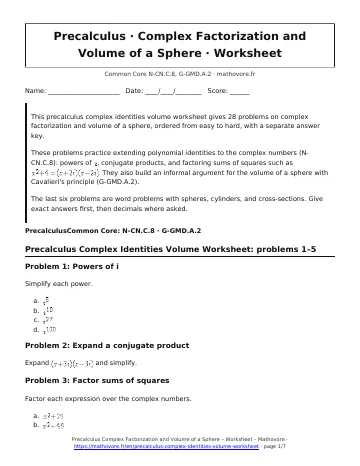
See every chapter on the Precalculus math page.