


This precalculus expected value decisions quiz asks 10 multiple-choice questions on expected value and decisions, and each answer comes with a short explanation.
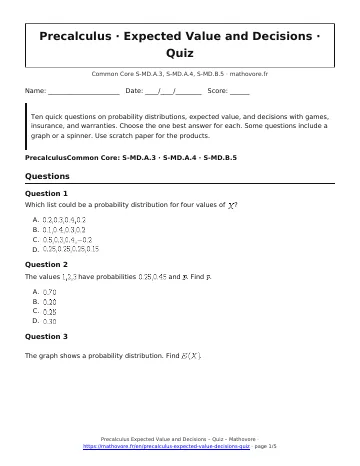
Ten quick questions on probability distributions, expected value, and decisions with games, insurance, and warranties. Choose the one best answer for each. Some questions include a graph or a spinner. Use scratch paper for the products.
The graph shows a probability distribution. Find \(E(X)\).
A spinner has four equal sections. Find the expected prize.
A $200 item has a \(10\%\) chance of being lost this year. Insurance costs $15. The graph compares the expected cost of each option. Which is cheaper by expected value?
🎉 Quiz complete!
How does this quiz work?
Read each question, choose one answer among A, B, C and D, then check it: a short explanation appears after every answer. Your score out of 10 is shown at the end, and you can restart the quiz as often as you like.
What should you review before the quiz?
Reread the key facts of the lesson and the worked example. If a question is hard, go back to the matching part of the lesson, then try the quiz again. Write your work on scrap paper: most mistakes come from skipping a step, not from the idea itself.
Remember:
- In a probability distribution, every probability is between 0 and 1 and the total is exactly 1.
- Theoretical probabilities come from equally likely outcomes; empirical probabilities are relative frequencies from data.
- Expected value = sum of (value times probability); it need not be a possible outcome.
- A game is fair when its expected net result is 0; negative means a long-run loss for the player.
- To choose between options, compare expected values and also consider the risk of a large loss.
How to use this precalculus expected value decisions quiz
Retake this precalculus expected value decisions quiz until every answer is right, then move on to the worksheet and the test.

See every chapter on the Precalculus math page.