


This worksheet gives 20 problems on cross sections of right rectangular prisms and pyramids, aligned with Common Core standard 7.G.A.3. The first problems name the shape of a slice that is parallel or perpendicular to the base.
The later problems find lengths and areas of cross sections, including triangles and trapezoids from pyramids, and end with word problems about a loaf of bread, a layer cake, a museum model, an ice block, and a cut pyramid. Draw each slice before computing.
Problem 1: Slicing a cube
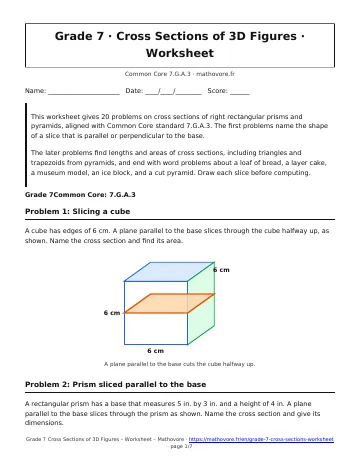
A cube has edges of 6 cm. A plane parallel to the base slices through the cube halfway up, as shown. Name the cross section and find its area.
Problem 2: Prism sliced parallel to the base
A rectangular prism has a base that measures 5 in. by 3 in. and a height of 4 in. A plane parallel to the base slices through the prism as shown. Name the cross section and give its dimensions.
Problem 3: Which face is the slice parallel to?
A rectangular prism is 12 in. long, 8 in. wide, and 6 in. tall. A plane parallel to one of its faces makes a rectangular cross section with an area of 48 in². Which face is the plane parallel to? Show the areas of all three kinds of faces.
Problem 4: Name the cross section
Name the cross section made by each slice.
- A rectangular prism cut by a plane parallel to its base
- A rectangular prism cut by a plane perpendicular to its base and parallel to a side face
- A rectangular pyramid cut by a plane parallel to its base
- A rectangular pyramid cut by a plane perpendicular to its base that passes through the apex
Problem 5: A slice is a smaller copy
A rectangular pyramid has a base that is 10 ft by 4 ft. A plane parallel to the base slices the pyramid, and the cross section is a rectangle that is 7.5 ft long. Find its width, its area, and the fraction of the pyramid’s height that is above the slice.
Problem 6: Vertical slice of a prism
A rectangular prism is 10 cm long, 4 cm wide, and 6 cm tall. A plane perpendicular to the base and parallel to the 4 cm by 6 cm end slices the prism as shown. Name the cross section and find its area.
Problem 7: Slice parallel to the front face
A rectangular prism is 9 in. long, 4 in. deep, and 5 in. tall. A plane parallel to the 9 in. by 5 in. front face slices through the prism, as shown. Name the cross section, give its dimensions, and find its area.
Problem 8: Pyramid sliced parallel to the base
A rectangular pyramid has a 12 in. by 8 in. base and a height of 10 in. A plane parallel to the base cuts the pyramid halfway up, 5 in. above the base. Find the dimensions and the area of the cross section.
Problem 9: Two slices through the apex
A rectangular pyramid has a 9 in. by 5 in. base and a height of 7 in. Two vertical planes pass through the apex. Plane P is parallel to the 9 in. side of the base. Plane Q is parallel to the 5 in. side of the base. For each plane, name the cross section and find its area.
Problem 10: Slice through the apex
A rectangular pyramid has a 10 ft by 6 ft base and a height of 8 ft. A plane perpendicular to the base passes through the apex and is parallel to the 10 ft side. Name the cross section, give its base and height, and find its area.
Problem 11: Cut a pyramid near the base
A rectangular pyramid has a base that is 20 ft by 12 ft and a height of 8 ft. A plane parallel to the base cuts the pyramid 2 ft above the base. The front view is shown. Find the dimensions and the area of the cross section.
Problem 12: Always, sometimes , or never
Write true or false for each statement, and fix each false statement.
- A plane parallel to the base of a rectangular prism gives a rectangle.
- A plane perpendicular to the base of a rectangular prism can give a triangle.
- A plane through the apex of a rectangular pyramid, perpendicular to the base, gives a triangle.
- A plane parallel to the base of a rectangular pyramid gives a rectangle the same size as the base.
Problem 13: Work backward from the area
A vertical plane passes through the apex of a rectangular pyramid and cuts a triangle with an area of 30 ft² and a base of 10 ft. Find the height of the pyramid.
Problem 14: Slice across a diagonal
A rectangular prism has a 6 in. by 8 in. base and a height of 5 in. A plane perpendicular to the base cuts through two opposite corners of the base. The diagonal of the base measures 10 in. Name the cross section and find its area.
Problem 15: Slicing a loaf
Liam has a loaf of bread shaped like a rectangular prism that is 12 in. long, 4 in. wide, and 5 in. tall. He slices it perpendicular to its length into slices that are 1 in. thick. Find the number of slices, the area of the face of one slice, and the volume of one slice.
Problem 16: Layer cake
Priya bakes a rectangular cake that is 12 in. long, 8 in. wide, and 3 in. tall. She slices it with a plane parallel to the base to make two equal layers. (a) Name the cross section and find its area. (b) Find the volume of one layer. (c) She then cuts each layer with vertical planes into 3 equal columns along the 12 in. side and 2 equal columns along the 8 in. side. Find the dimensions and volume of one piece, and the total number of pieces.
Problem 17: Museum pyramid model
A museum model of a pyramid has a rectangular base that is 24 cm by 18 cm and a height of 20 cm. A plane parallel to the base cuts the model halfway up. (a) Find the dimensions of the cross section. (b) Find its area. (c) What fraction of the base area is the area of the cross section?
Problem 18: Ice sculpture block
Aisha has a block of ice shaped like a rectangular prism that is 36 in. long, 24 in. wide, and 18 in. tall. She considers three cuts with a wire: Cut 1 is parallel to the base. Cut 2 is parallel to the 36 in. by 18 in. side. Cut 3 is parallel to the 24 in. by 18 in. end. (a) Find the area of each cross section. (b) How many square inches larger is the biggest cross section than the smallest? (c) A 2 in. thick slab is cut off using the cut with the biggest cross section. Find the volume of the slab.
Problem 19: Trapezoid cross section
A vertical plane perpendicular to the base of a pyramid misses the apex, as shown. The cross section is a trapezoid with parallel sides of 6 ft and 3 ft and a height of 5 ft. Find its area.
Problem 20: Cutting a square pyramid
A square pyramid has base sides of 12 in. and a height of 9 in. A plane parallel to the base cuts it 3 in. above the base. The cross section is a square whose sides are as long as the base sides times the fraction of the height that remains above the cut.
- Find the side length of the cross section.
- Find the area of the cross section and the area of the base.
- The cross section has what fraction of the area of the base?

See every chapter on the Grade 7 math page.