



This grade 4 add subtract lesson explains adding and subtracting multi-digit numbers in one printable page, with definitions, a method and a worked example.
The standard algorithm adds or subtracts whole numbers one place value at a time, starting with the ones and moving left. When a column adds to 10 or more, regroup (carry) to the next place; when the top digit is too small, regroup (borrow) from the next place. For example, 4,785 + 2,639 = 7,424.
Grade 4 Add Subtract Lesson: key facts
- Line up digits by place value before you add or subtract.
- Work from the ones column to the left.
- Regroup (carry) when a column adds to 10 or more.
- Regroup (borrow) when the top digit is too small to subtract from.
- Check a difference by adding it to the subtracted number.
What is the standard algorithm for adding and subtracting?
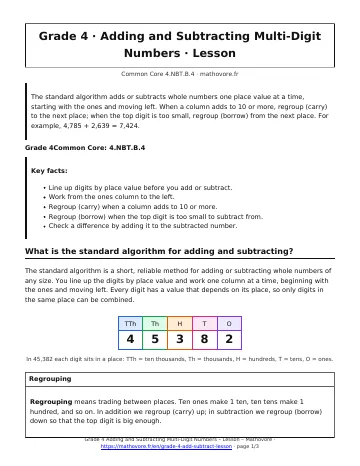
The standard algorithm is a short, reliable method for adding or subtracting whole numbers of any size. You line up the digits by place value and work one column at a time, beginning with the ones and moving left. Every digit has a value that depends on its place, so only digits in the same place can be combined.
Regrouping means trading between places. Ten ones make 1 ten, ten tens make 1 hundred, and so on. In addition we regroup (carry) up; in subtraction we regroup (borrow) down so that the top digit is big enough.
How do you add multi-digit numbers?
- Write the numbers so the ones are in one column, the tens in the next, and so on.
- Add the ones. If the total is 10 or more, write the ones digit and regroup the tens digit to the next column.
- Move left one place at a time, adding any regrouped amount.
Example: \(3{,}758 + 2{,}646\). Ones: 8 + 6 = 14, write 4, regroup 1. Tens: 5 + 4 + 1 = 10, write 0, regroup 1. Hundreds: 7 + 6 + 1 = 14, write 4, regroup 1. Thousands: 3 + 2 + 1 = 6.
How do you subtract multi-digit numbers?
Subtract the bottom digit from the top digit in each column. If the top digit is smaller, regroup 1 from the next place to the left: it becomes 10 in the column you are working on.
Example: \(5{,}204 – 2{,}867\). The ones digit 4 is smaller than 7 and the tens digit is 0, so regroup from the hundreds. The 2 hundreds become 1 hundred and 10 tens; then 1 ten becomes 10 ones. Now 14 − 7 = 7 and 9 − 6 = 3. In the hundreds, 1 is smaller than 8, so regroup 1 thousand: 11 − 8 = 3. Finally 4 − 2 = 2.
How can you check your answer?
Addition and subtraction undo each other. To check a difference, add the answer to the number you subtracted; you should get the starting number. To check a sum, subtract one addend from the sum.
Remember that a sum should be larger than each addend and a difference should be smaller than the starting number. Use this to catch careless slips.
Adding and Subtracting Multi-Digit Numbers: frequently asked questions
What is the standard algorithm for addition?
It is the column method. Line up digits by place value, add from the ones to the left, and regroup (carry) whenever a column adds to 10 or more.
Why do we regroup when subtracting?
If the top digit in a column is smaller than the bottom digit, you cannot subtract. Trading 1 from the next place gives 10 more in this place, so the subtraction can be done.
How do you subtract when there are zeros?
Move left to the first nonzero digit and regroup from it. Each zero in between becomes 9, and the column you started in gets 10 more.
How can I check a subtraction problem?
Add the difference to the number that was subtracted. If the sum equals the starting number, the answer is correct.
Do I need to line up the digits?
Yes. Only digits in the same place, such as ones with ones, can be added or subtracted. Writing numbers right-aligned keeps the places lined up.
How to use this grade 4 add subtract lesson
Use this grade 4 add subtract lesson before the worksheet, then check what you learned with the quiz.

See every chapter on the Grade 4 math page.