



This grade 4 multiplying fractions lesson explains multiplying a fraction by a whole number in one printable page, with definitions, a method and a worked example.
A fraction such as \( rac{3}{4}\) is a multiple of its unit fraction: it is 3 copies of \( rac{1}{4}\). To multiply a whole number by a fraction, multiply the whole number by the numerator and keep the denominator, so \(5 \times rac{2}{3} = rac{10}{3}\), which is \(3 rac{1}{3}\).
Grade 4 Multiplying Fractions Lesson: key facts
- A unit fraction has a numerator of 1, like 1/8.
- Any fraction a/b equals a copies of 1/b, so 5/8 = 5 x 1/8.
- To find n x a/b, multiply n by the numerator a and keep the denominator b.
- If the numerator is bigger than the denominator, write the product as a mixed number.
- Fraction multiplication is repeated addition: 3 x 2/5 = 2/5 + 2/5 + 2/5.
What does it mean for a fraction to be a multiple?
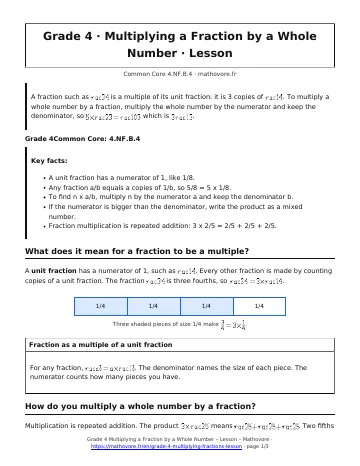
A unit fraction has a numerator of 1, such as \( rac{1}{4}\). Every other fraction is made by counting copies of a unit fraction. The fraction \( rac{3}{4}\) is three fourths, so \( rac{3}{4} = 3 \times rac{1}{4}\).
For any fraction, \( rac{a}{b} = a \times rac{1}{b}\). The denominator names the size of each piece. The numerator counts how many pieces you have.
How do you multiply a whole number by a fraction?
Multiplication is repeated addition. The product \(3 \times rac{2}{5}\) means \( rac{2}{5} + rac{2}{5} + rac{2}{5}\). Two fifths three times is six fifths, and the pieces stay the same size.
So multiply the whole number by the numerator and keep the denominator:
\[n \times \frac{a}{b} = \frac{n \times a}{b}\]
| Product | Repeated addition | Answer |
|---|---|---|
| \(4 \times rac{1}{3}\) | \(\frac{1}{3} + \frac{1}{3} + \frac{1}{3} + \frac{1}{3}\) | \( rac{4}{3}\) |
| \(3 \times rac{2}{5}\) | \(\frac{2}{5} + \frac{2}{5} + \frac{2}{5}\) | \( rac{6}{5}\) |
| \(5 \times rac{3}{8}\) | \(\frac{3}{8} + \frac{3}{8} + \frac{3}{8} + \frac{3}{8} + \frac{3}{8}\) | \( rac{15}{8}\) |
What if the product is more than one whole?
When the numerator is larger than the denominator, the fraction is greater than 1. Write it as a mixed number by finding how many wholes fit. On the number line, three hops of \( rac{3}{4}\) reach \( rac{9}{4}\). Since \(\frac{8}{4} = 2\), the product is 2 wholes and 1 fourth more, or \(2 rac{1}{4}\).
How do you solve a fraction word problem?
- Find the number of equal groups and the size of each group.
- Write a multiplication sentence.
- Multiply the numerator by the whole number and keep the denominator.
- Rewrite as a mixed number if it is more than 1.
- Check the answer against an estimate and include the unit.
Example. Jamal runs \( rac{3}{4}\) mile every morning for 5 mornings. How far does he run?
\(5 \times rac{3}{4} = rac{15}{4} = 3 rac{3}{4}\). He runs \(3 rac{3}{4}\) miles. Check: \( rac{3}{4}\) is a little less than 1, so five of them should be a little less than 5. The answer fits.
Multiplying a Fraction by a Whole Number: frequently asked questions
What is a unit fraction?
A unit fraction is a fraction with 1 as the numerator, such as \( rac{1}{6}\). It names one equal piece of a whole. Every fraction, like \( rac{5}{6}\), is a count of unit fractions.
Why does the denominator stay the same when multiplying by a whole number?
The denominator tells the size of the pieces, and the pieces do not change when you collect more of them. Three groups of \( rac{2}{5}\) are six fifths, not six fifteenths.
How do you turn an improper fraction into a mixed number?
Find how many full wholes fit in the fraction, then write what is left over. For \( rac{15}{4}\), four fourths make 1 whole, so 3 wholes use 12 fourths and 3 fourths remain: \(3 rac{3}{4}\).
Does \(3 \times rac{2}{5}\) equal \( rac{2}{5} \times 3\)?
Yes. Changing the order of the factors does not change the product. Both mean three groups of two fifths, which is \( rac{6}{5}\).
How can you check a fraction product?
Use repeated addition or a number line to see if you get the same answer. You can also estimate: \(4 \times rac{5}{6}\) should be a little less than 4.
How to use this grade 4 multiplying fractions lesson
Use this grade 4 multiplying fractions lesson before the worksheet, then check what you learned with the quiz.

- Multiplying a Fraction by a Whole Number worksheet (24 problems)
- Multiplying a Fraction by a Whole Number quiz (10 questions)
- Multiplying a Fraction by a Whole Number test (45 minutes)
- Previous lesson: Adding and Subtracting Fractions and Mixed Numbers
- Next lesson: Decimal Fractions and Decimal Notation
See every chapter on the Grade 4 math page.