Key takeaway: This grade 4 equivalent fractions test is a printable paper with 9 questions and a 20 point scale. It checks how well students rename fractions, read models, and compare fractions with unlike denominators. Students work in pencil, show each step, and write every comparison with a symbol. In addition, the questions mix pictures, number lines, and short stories, so a student cannot rely on one trick. The matching key shows how teachers can split partial credit.
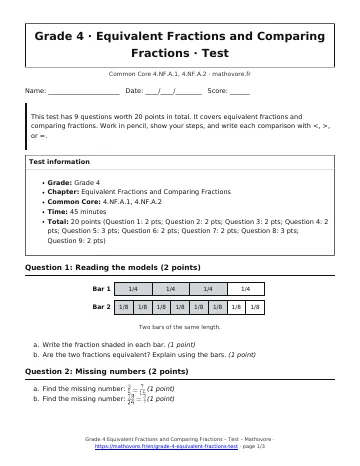
This test has 9 questions worth 20 points in total. It covers equivalent fractions and comparing fractions. Work in pencil, show your steps, and write each comparison with <, >, or =.
- Grade: Grade 4
- Chapter: Equivalent Fractions and Comparing Fractions
- Common Core: 4.NF.A.1, 4.NF.A.2
- Time: 45 minutes
- Total: 20 points (Question 1: 2 pts; Question 2: 2 pts; Question 3: 2 pts; Question 4: 2 pts; Question 5: 3 pts; Question 6: 2 pts; Question 7: 2 pts; Question 8: 3 pts; Question 9: 2 pts)
Grade 4 Equivalent Fractions Test: questions 1–5
1. Reading the models (2 points)
- Write the fraction shaded in each bar. (1 point)
- Are the two fractions equivalent? Explain using the bars. (1 point)
2. Missing numbers (2 points)
- Find the missing number: \(\frac{3}{5} = \frac{?}{15}\) (1 point)
- Find the missing number: \(\frac{18}{24} = \frac{3}{?}\) (1 point)
3. Changing the denominator (2 points)
- Write a fraction equivalent to \(\frac{5}{6}\) with denominator 12. (1 point)
- Write \(\frac{6}{10}\) as an equivalent fraction with denominator 5. (1 point)
4. Number line (2 points)
- Write the fraction for point P and for point Q. (1 point)
- Write point Q as a fraction with denominator 4. (1 point)
5. Compare with symbols (3 points)
- Write <, >, or = to make the statement true: \(\frac{3}{8} \quad ? \quad \frac{1}{2}\) (1 point)
- Write <, >, or =: \(\frac{7}{12} \quad ? \quad \frac{2}{3}\) (1 point)
- Write <, >, or =: \(\frac{4}{6} \quad ? \quad \frac{4}{5}\) (1 point)
Grade 4 Equivalent Fractions Test: questions 6–9
6. Is Maya correct? (2 points)
Maya says that \(\frac{5}{8}\) is greater than \(\frac{3}{4}\) because 5 is greater than 3. Is she correct? Explain.
7. Order three fractions (2 points)
Write \(\frac{5}{6}\), \(\frac{1}{2}\), \(\frac{2}{3}\) in order from least to greatest.
8. Chapter reading (3 points)
Diego read \(\frac{3}{5}\) of his library book. Aisha read \(\frac{7}{10}\) of her library book. The books have the same number of pages.
- Who read the greater fraction of the book? (2 points)
- Noah read \(\frac{1}{2}\) of the same book. Who read more, Diego or Noah? (1 point)
9. Tenths and hundredths (2 points)
Compare \(\frac{7}{10}\) and \(\frac{65}{100}\) using <, >, or =. Show your work.

What does the grade 4 equivalent fractions test cover?
Question 1 shows two bars of equal length and asks students to write the shaded fractions. Then it asks whether they are equivalent. Next, question 2 finds missing numbers such as \(\frac{3}{5} = \frac{?}{15}\) and \(\frac{18}{24} = \frac{?}{4}\). Question 3 renames \(\frac{5}{6}\) with denominator 12, and question 4 reads points P and Q on a number line.
Which questions test comparing?
Question 5 asks for symbols in three statements, including \(\frac{3}{8}\) against \(\frac{1}{2}\). Meanwhile, question 6 shows Maya claiming that \(\frac{5}{8}\) beats \(\frac{3}{4}\) because 5 is greater than 3. Students must explain the error. After that, question 7 orders \(\frac{5}{6}\), \(\frac{1}{2}\), and \(\frac{2}{3}\) from least to greatest.
How should students handle the last two questions?
In question 8, Diego read \(\frac{3}{5}\) of a library book and Aisha read \(\frac{7}{10}\) of hers. Therefore, tenths make the comparison easy. Finally, question 9 compares \(\frac{7}{10}\) and \(\frac{65}{100}\), so students rename tenths as hundredths. A short sketch of each fraction can save time, and the questions grow from simple to demanding.
How can you prepare for the test?
First, make a flash card for each multiplier from 2 to 6. Then practice renaming three fractions every day. Also, compare pairs with the half benchmark before you try common denominators. Finally, review your lost points by question number and redo the types that cost you the most.

See every chapter on the Grade 4 math page.