Key takeaway: This grade 4 line plots worksheet has 22 printable problems on data with halves, fourths, and eighths. Problems 1 to 7 read points, count marks, and find the most common value. Next, problems 8 to 16 make a plot and use subtraction or addition. Then problems 17 to 22 use ribbon, rainfall, two gardens, rope, and seed lengths. Students need a pencil and a ruler for the plotting problems. A separate answer key lets them check their counts and sums when they finish.
These 22 problems practice standard 4.MD.B.4: reading line plots whose number lines use halves, fourths, and eighths, making a line plot from measurements, and solving addition and subtraction problems with the data.
The problems start with reading points and counting marks, then move to differences, totals, and multi-step word problems.
Grade 4 Line Plots Worksheet: problems 1–5
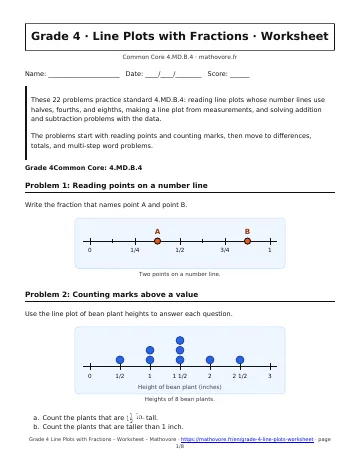
1. Reading points on a number line
Write the fraction that names point A and point B.
2. Counting marks above a value
Use the line plot of bean plant heights to answer each question.
- Count the plants that are \(1\frac{1}{2}\text{ in.}\) tall.
- Count the plants that are taller than 1 inch.
3. How many data values?
Study the line plot of the fabric strips Diego cut for a quilt.
- Count the strips he measured in all.
- Count the strips that are exactly \(\frac{3}{4}\text{ ft}\) long.
4. The most common length
Find the length that appears most often on the line plot, and tell how many crayons have that length.
5. Shortest and longest
Use the line plot of 8 seashell lengths.
- Write the length of the shortest shell.
- Write the length of the longest shell.
Grade 4 Line Plots Worksheet: problems 6–10
6. Longer than a given length
Count the nails that are longer than \(1\frac{1}{4}\text{ in.}\).
7. Comparing two groups
Compare the number of seeds shorter than \(\frac{1}{2}\text{ in.}\) with the number longer than \(\frac{1}{2}\text{ in.}\). Tell which group is larger and by how many seeds.
8. Make a line plot
Copy the number line and make a line plot of the lengths of 7 pieces of string Aisha measured, in feet: \(\frac{1}{2}\), \(1\), \(\frac{3}{4}\), \(\frac{1}{2}\), \(\frac{3}{4}\), \(\frac{3}{4}\), \(1\frac{1}{4}\).
9. Longest minus shortest
Find how much longer the longest caterpillar is than the shortest caterpillar.
10. Adding two lengths
Use the line plot.
- Add the lengths of the longest and the shortest ribbon.
- Find the total length of two ribbons that are each \(1\frac{1}{4}\text{ ft}\) long when they are tied end to end.
Grade 4 Line Plots Worksheet: problems 11–15
11. Total of all the pieces
Find the total length of all the pieces of tape on the line plot.
12. Subtracting with regrouping
Find how much longer the wire that measures 3 inches is than the wire that measures \(2\frac{1}{4}\text{ in.}\).
13. Adding eighths
Find the total length of the 6 paper strips.
14. Repeated addition
Find the total length of three pieces of ribbon that are each \(\frac{3}{4}\text{ ft}\) long.
15. Choosing a scale
Decide which tick-mark spacing a number line should use for the measurements \(\frac{1}{2}\), \(\frac{3}{4}\), \(1\frac{1}{4}\), \(1\frac{1}{2}\) inches: halves, fourths, or eighths. Explain.
Grade 4 Line Plots Worksheet: problems 16–20
16. Find the missing count
Find the number of marks at \(1\frac{1}{4}\) on a line plot that has 10 marks in all. There are 3 marks at \(\frac{1}{2}\), 2 marks at \(\frac{3}{4}\), and 4 marks at 1. The rest are at \(1\frac{1}{4}\).
17. Ribbon for a banner
Use the line plot to solve. Aisha needs 2 feet of ribbon for a bake sale banner. She ties the three ribbons that measure \(\frac{3}{4}\text{ ft}\) end to end.
- Find the length of the tied ribbon.
- Find how much longer it is than the 2 feet she needs.
18. Rainfall over 10 days
Use the line plot of rainfall on 10 days to answer each question.
- Find how much rain fell in all on the days with \(\frac{1}{8}\text{ in.}\) of rain.
- Find how much more rain fell on the wettest day than on the driest day.
- Find how much rain fell on all 10 days.
19. Two garden plots
Use the two line plots of pods that Jamal and Mei measured in their garden.
- Find how much longer Jamal’s longest pod is than Mei’s longest pod.
- Find the total length of Jamal’s pods and of Mei’s pods. Then find how much greater Jamal’s total is.
20. Rope and a knot
Use the line plot. Jamal ties the two longest pieces and one \(1\text{ ft}\) piece end to end. Ignore the knots.
- Find the total length.
- Find how much shorter this is than a 4 foot rope.
Grade 4 Line Plots Worksheet: problems 21–22
21. Find the mistake
Explain Noah’s mistake and find the correct sum. He added the lengths of the two nails on the line plot and wrote \(\frac{5}{8} + \frac{7}{8} = \frac{12}{16}\).
22. Make a plot and solve
Make a line plot with an eighths scale from 0 to 1 for the 7 seed lengths Sofia measured, in inches: \(\frac{1}{4}\), \(\frac{3}{8}\), \(\frac{3}{8}\), \(\frac{1}{2}\), \(\frac{5}{8}\), \(\frac{5}{8}\), \(\frac{7}{8}\). Then find (a) the total length of the seeds and (b) how much longer the longest seed is than the shortest seed.

What do the first line plot problems ask?
Problem 1 asks for the fraction at points A and B. Then problem 2 counts marks above a value on a plot of eight bean plants. Meanwhile, problem 4 looks for the length that appears most often among crayons. Problem 5 reads the shortest and longest of eight seashells. In problem 6, students count nails longer than \(1\frac{1}{4}\) inches.
How does the grade 4 line plots worksheet build plots and sums?
Problem 8 gives seven string lengths in feet, and students copy the number line and add an X for each one. After that, problem 9 subtracts the shortest caterpillar from the longest. Problem 12 asks how much longer a 3 inch wire is than a \(2\frac{1}{4}\) inch wire, so students regroup to get \(\frac{3}{4}\). In problem 14, three ribbons of \(\frac{3}{4}\) foot make \(2\frac{1}{4}\) feet.
Which problems stretch students most?
Problem 15 asks which spacing suits \(\frac{1}{2}\), \(\frac{3}{4}\), and other lengths, so students compare scales. In problem 16, they find a missing count when 10 marks are in the plot. Problem 19 sets two plots side by side, one for Jamal and one for Mei. However, problem 21 hides a mistake in Noah’s sum. Last, problem 22 plots seven seed lengths on an eighths scale.
Strategies for this worksheet
First, label every tick mark in pencil before you read a point. Then circle the unit, since inches and feet both appear. Also, count the Xs and compare with the number of data values. Afterward, check each sum by estimating with whole numbers, and redo any answer that looks too big.

See every chapter on the Grade 4 math page.