Key takeaway: This grade 4 measurement conversions lesson explains how to write one amount in two different units. A larger unit becomes a smaller unit by multiplying, because more small pieces fit into the same amount. For instance, 3 kilometers equal 3,000 meters. The lesson covers length, mass, liquid volume, and time, and it shows how a two-column table keeps the pattern clear. Fourth graders also see how conversion facts support word problems about distance, money, and elapsed time. Every section ends with a check that students can repeat alone.
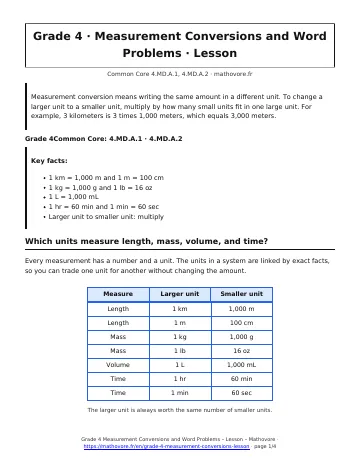
Measurement conversion means writing the same amount in a different unit. To change a larger unit to a smaller unit, multiply by how many small units fit in one large unit. For example, 3 kilometers is 3 times 1,000 meters, which equals 3,000 meters.
Grade 4 Measurement Conversions Lesson: key facts
- 1 km = 1,000 m and 1 m = 100 cm
- 1 kg = 1,000 g and 1 lb = 16 oz
- 1 L = 1,000 mL
- 1 hr = 60 min and 1 min = 60 sec
- Larger unit to smaller unit: multiply
Which units measure length, mass, volume, and time?
Every measurement has a number and a unit. The units in a system are linked by exact facts, so you can trade one unit for another without changing the amount.
A kilometer is a larger unit than a meter. A larger unit needs fewer copies to measure the same amount, and a smaller unit needs more copies. The smaller unit gives a bigger number.
How do you change a larger unit into a smaller unit?
Multiply the number by how many smaller units fit in one larger unit. Three kilometers is three groups of 1,000 meters.
- Find the fact that links the two units, such as \(1\text{ kg} = 1{,}000\text{ g}\).
- Multiply the number of larger units by that fact.
- Write the answer with the smaller unit.
Example. A rope is 4 m 35 cm long. Change the whole length to centimeters. First, \(4\text{ m} = 4 \times 100 = 400\text{ cm}\). Then add the extra 35 cm: \(400 + 35 = 435\text{ cm}\).
How can a two-column table help?
A table shows a pattern. Each time the kilograms go up by 1, the grams go up by 1,000. To find the grams for any row, multiply the kilograms by 1,000.
How do you solve word problems about time, volume, mass, and money?
Change every measurement to the same unit before adding, subtracting, or comparing. For elapsed time, count up on a number line from the start time to the end time.
A practice starts at 3:15 and ends at 4:05. Count 45 minutes to reach 4:00, then 5 more minutes to reach 4:05. The practice lasts \(45 + 5 = 50\) minutes.
Money works the same way. If cheese costs $6 per pound, then 3 pounds cost \(3 \times \$6 = \$18\). Tip: if a problem uses halves or fourths, such as \(\frac{1}{2}\text{ km}\), find that fraction of the larger unit: half of 1,000 m is 500 m.
- Larger to smaller: multiply.
- Match the units before you add or compare.
- Check that the smaller unit gives the bigger number.
Measurement Conversions and Word Problems: frequently asked questions
How many centimeters are in a meter?
There are 100 centimeters in 1 meter. To change meters to centimeters, multiply by 100. For example, 6 m is 600 cm.
Why does the number get bigger when I change to a smaller unit?
A smaller unit is a shorter or lighter piece, so you need more of them to cover the same amount. Four meters need 400 centimeter pieces to measure the same length.
How many ounces are in a pound?
There are 16 ounces in 1 pound. Multiply the pounds by 16 to get ounces, so 5 lb is 80 oz.
How do I find elapsed time?
Start at the beginning time on a number line and count up to the end time. Add the jumps, such as 45 minutes to the next hour and 5 more minutes. The total is the elapsed time.
What should I do when a problem mixes units?
Change everything to the smaller unit first, then add or subtract. For 2 kg 300 g, write 2,000 g plus 300 g, which is 2,300 g.
What does a grade 4 measurement conversions lesson memorize?
Only a handful of facts carry the whole chapter. One kilometer is 1,000 meters, and one meter is 100 centimeters. One kilogram is 1,000 grams, one liter is 1,000 milliliters, and one pound is 16 ounces. Finally, one hour is 60 minutes. Therefore, flash cards for these seven facts pay off quickly.
Why does the number get bigger?
A small unit is a small piece, so you need many pieces to cover the same amount. Think of 4 meters. Each meter holds 100 centimeters, so 4 meters hold \(4 \times 100 = 400\) centimeters. The amount did not change. Only the size of the counting unit did.
How does a table help?
Write the large unit in the left column and the small unit in the right column. Then fill in the pattern: 1 kg gives 1,000 g, 2 kg gives 2,000 g, and 3 kg gives 3,000 g. As a result, you can spot the multiplier right away and apply it to any row.
How do mixed units work?
Convert the larger part first, and then add the smaller part. For example, 2 hr 30 min becomes \(120 + 30 = 150\) minutes. A similar step turns 5 m 40 cm into 540 centimeters.
Next steps for practice
Make the seven flash cards first. Then fill one conversion table for each unit pair. After that, solve two mixed-unit problems every day for a week. Finally, take the quiz and note which unit pair slowed you down the most.

See every chapter on the Grade 4 math page.