



This grade 4 adding fractions lesson explains adding and subtracting fractions and mixed numbers in one printable page, with definitions, a method and a worked example.
To add or subtract fractions with the same denominator, add or subtract the numerators and keep the denominator, because the pieces are the same size. For mixed numbers, add or subtract the whole numbers and the fractions separately, or first rename each mixed number as a fraction greater than one.
Grade 4 Adding Fractions Lesson: key facts
- A fraction is a sum of unit fractions, and it can be decomposed in more than one way.
- With the same denominator, add or subtract the numerators and keep the denominator.
- A mixed number equals a fraction greater than 1: multiply the whole by the denominator and add the numerator.
- When the fractions in a sum make more than one whole, rename the extra wholes.
What does it mean to decompose a fraction?
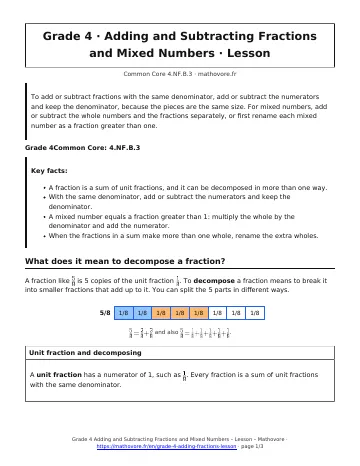
A fraction like \(\frac{5}{8}\) is 5 copies of the unit fraction \(\frac{1}{8}\). To decompose a fraction means to break it into smaller fractions that add up to it. You can split the 5 parts in different ways.
A unit fraction has a numerator of 1, such as \(\frac{1}{8}\). Every fraction is a sum of unit fractions with the same denominator.
How do you add and subtract fractions with the same denominator?
Think of a pizza cut into 8 equal slices. If you eat 3 slices and a friend eats 4 slices, you ate 7 slices of the same size. You count slices, not slice sizes. That is why the denominator never changes when you add or subtract like fractions.
When the pieces are the same size, you only count the pieces. Add or subtract the numerators and keep the denominator.
\[\frac{a}{c}+\frac{b}{c}=\frac{a+b}{c} \quad \frac{a}{c}-\frac{b}{c}=\frac{a-b}{c}\]
Example. Find \(\frac{7}{10}\) − \(\frac{3}{10}\).
- The denominators match (10), so the pieces are the same size.
- Subtract the numerators: \(7 – 3 = 4\).
- Keep the denominator: \(\frac{7}{10}-\frac{3}{10}=\frac{4}{10}\).
How do you add and subtract mixed numbers?
A mixed number has a whole number part and a fraction part, such as \(2\frac{3}{4}\). It can be renamed as a fraction greater than 1: \(2\frac{3}{4}=\frac{11}{4}\), because \(2 \times 4 + 3 = 11\).
Check each answer with a quick estimate. For example, \(1\frac{5}{6}\) is close to 2 and \(2\frac{4}{6}\) is close to 3, so the sum should be near 5. An answer of \(4\frac{3}{6}\) makes sense, while \(3\frac{9}{6}\) should be renamed because its fraction is more than one whole.
To add mixed numbers, add the whole numbers and the fractions separately. If the fractions make more than one whole, rename the extra.
Example. Find \(1\frac{5}{6}\) + \(2\frac{4}{6}\).
- Add the wholes: \(1 + 2 = 3\).
- Add the fractions: \(\frac{5}{6}+\frac{4}{6}=\frac{9}{6}=1\frac{3}{6}\).
- Combine: \(3 + 1\frac{3}{6}=4\frac{3}{6}\).
To subtract when the fraction you take away is bigger, rename the first number as a fraction: \(3\frac{1}{4}-1\frac{3}{4}=\frac{13}{4}-\frac{7}{4}=\frac{6}{4}=1\frac{2}{4}\).
Adding and Subtracting Fractions and Mixed Numbers: frequently asked questions
How do you add fractions with the same denominator?
Add the numerators and keep the denominator the same. For example, \(\frac{3}{8}+\frac{4}{8}=\frac{7}{8}\). The denominator names the size of the pieces, and adding does not change their size.
What does decomposing a fraction mean?
It means breaking a fraction into a sum of smaller fractions with the same denominator. For example, \(\frac{5}{8}=\frac{2}{8}+\frac{3}{8}\). A fraction can be decomposed in more than one way.
How do you change a mixed number into a fraction?
Multiply the whole number by the denominator and add the numerator. Keep the denominator. For \(2\frac{3}{4}\), \(2 \times 4 + 3 = 11\), so it equals \(\frac{11}{4}\).
What do you do when the fractions add to more than one?
Rename the extra wholes. In \(1\frac{5}{6}+2\frac{4}{6}\), the fractions give \(\frac{9}{6}\), which is \(1\frac{3}{6}\). Add that 1 to the wholes to get \(4\frac{3}{6}\).
How do you subtract mixed numbers when the second fraction is bigger?
Rename both mixed numbers as fractions greater than 1, subtract the numerators, then rename the answer as a mixed number. For example, \(3\frac{1}{4}=\frac{13}{4}\) and \(1\frac{3}{4}=\frac{7}{4}\), so the difference is \(\frac{6}{4}\), or \(1\frac{2}{4}\).
How to use this grade 4 adding fractions lesson
Use this grade 4 adding fractions lesson before the worksheet, then check what you learned with the quiz.

- Adding and Subtracting Fractions and Mixed Numbers worksheet (25 problems)
- Adding and Subtracting Fractions and Mixed Numbers quiz (10 questions)
- Adding and Subtracting Fractions and Mixed Numbers test (45 minutes)
- Previous lesson: Equivalent Fractions and Comparing Fractions
- Next lesson: Multiplying a Fraction by a Whole Number
See every chapter on the Grade 4 math page.