



This grade 4 equivalent fractions lesson explains equivalent fractions and comparing fractions in one printable page, with definitions, a method and a worked example.
Equivalent fractions are different fractions that name the same amount, such as \(\frac{1}{2}\) and \(\frac{4}{8}\). To make one, multiply or divide the numerator and denominator by the same nonzero number. To compare fractions with different denominators, rewrite them with a common denominator or compare each to a benchmark such as \(\frac{1}{2}\).
Grade 4 Equivalent Fractions Lesson: key facts
- Equivalent fractions have the same value and sit at the same point on a number line.
- Multiply or divide the numerator and denominator by the same nonzero number to make an equivalent fraction.
- Fractions with the same denominator are compared by their numerators; with the same numerator, the larger denominator means the smaller fraction.
- One half is a handy benchmark for comparing fractions.
What are equivalent fractions?
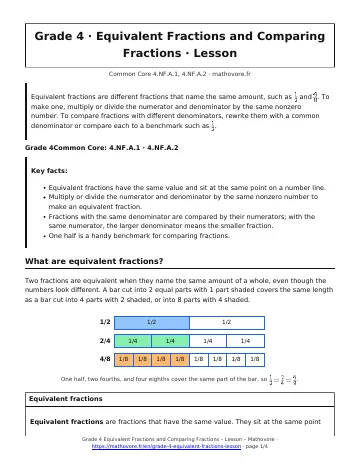
Two fractions are equivalent when they name the same amount of a whole, even though the numbers look different. A bar cut into 2 equal parts with 1 part shaded covers the same length as a bar cut into 4 parts with 2 shaded, or into 8 parts with 4 shaded.
Equivalent fractions are fractions that have the same value. They sit at the same point on a number line. The fractions \(\frac{3}{4}\) and \(\frac{6}{8}\) are equivalent.
How do you make an equivalent fraction?
Multiply the numerator and the denominator by the same number (not zero). You can also divide both by the same number. Cutting every part into smaller equal pieces changes how many parts there are, but not the amount that is shaded.
The number line shows the same idea. The point for three fourths is also the point for nine twelfths.
Example. Write a fraction with denominator 12 that is equivalent to \(\frac{3}{4}\).
- Ask what to multiply 4 by to get 12: \(4 \times 3 = 12\).
- Multiply the numerator by the same number: \(3 \times 3 = 9\).
- Write the new fraction: \(\frac{3}{4}=\frac{9}{12}\).
How do you compare fractions with different denominators?
You can only compare fractions of the same whole. Use one of three tools.
- Benchmark fraction. Compare each fraction with \(\frac{1}{2}\). For \(\frac{3}{8}\), half of 8 is 4, and 3 is less than 4, so \(\frac{3}{8} < \frac{1}{2}\). For \(\frac{5}{6}\), half of 6 is 3, and 5 is more than 3, so \(\frac{5}{6} > \frac{1}{2}\).
- Common denominator. Rewrite both fractions with the same denominator, then compare the numerators.
- Common numerator. If the numerators match, the fraction with the larger denominator has smaller pieces and is less.
Example. Compare \(\frac{2}{3}\) and \(\frac{3}{5}\). The denominators 3 and 5 both go into 15. So \(\frac{2}{3}=\frac{10}{15}\) and \(\frac{3}{5}=\frac{9}{15}\). Since 10 is greater than 9, \(\frac{2}{3} > \frac{3}{5}\).
Write > for “is greater than”, < for “is less than”, and = for “is equal to”. Always say which whole you are using before you compare.
Equivalent Fractions and Comparing Fractions: frequently asked questions
What is an equivalent fraction?
It is a fraction with a different numerator and denominator that has the same value. For example, \(\frac{2}{3}\) and \(\frac{8}{12}\) name the same part of a whole. They land on the same point of a number line.
How do you find an equivalent fraction?
Multiply or divide the numerator and the denominator by the same number. To change \(\frac{3}{5}\) into tenths, multiply both by 2 to get \(\frac{6}{10}\). Doing something to only one of the numbers changes the value.
How do you compare two fractions with different denominators?
Rewrite them with a common denominator and compare the numerators, or compare both to a benchmark like \(\frac{1}{2}\). A visual model or number line also works. Always compare fractions of the same whole.
Why is 1/4 less than 1/3 even though 4 is greater than 3?
The denominator tells how many equal parts make the whole. More parts means smaller parts. A whole cut into 4 pieces has smaller pieces than a whole cut into 3 pieces, so \(\frac{1}{4} < \frac{1}{3}\).
How do you know a fraction is greater than one half?
Double the numerator and compare it with the denominator. For \(\frac{7}{12}\), double 7 is 14, which is greater than 12, so the fraction is greater than \(\frac{1}{2}\). If the doubled numerator is smaller, the fraction is less than one half.
How to use this grade 4 equivalent fractions lesson
Use this grade 4 equivalent fractions lesson before the worksheet, then check what you learned with the quiz.

- Equivalent Fractions and Comparing Fractions worksheet (24 problems)
- Equivalent Fractions and Comparing Fractions quiz (10 questions)
- Equivalent Fractions and Comparing Fractions test (45 minutes)
- Previous lesson: Number and Shape Patterns
- Next lesson: Adding and Subtracting Fractions and Mixed Numbers
See every chapter on the Grade 4 math page.