



Division with remainders splits a number into equal groups and keeps what is left over. The remainder is always smaller than the divisor. For example, \(26 : 4 = 6\) R 2 because \(4 \times 6 + 2 = 26\). Word problems decide whether to ignore, round up, or report the remainder.
Key facts:
- The remainder is always smaller than the divisor.
- Check any answer with divisor times quotient, plus remainder, which must equal the dividend.
- An area model splits the dividend into hundreds, tens, and ones that the divisor can share evenly.
- Long division works left to right: divide, multiply, subtract, bring down.
- In word problems, ignore the remainder, round the quotient up, or report the remainder, depending on the question.
What is division with a remainder?
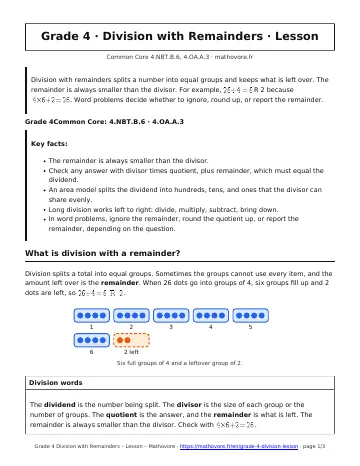
Division splits a total into equal groups. Sometimes the groups cannot use every item, and the amount left over is the remainder. When 26 dots go into groups of 4, six groups fill up and 2 dots are left, so \(26 : 4 = 6\text{ R }2\).
The dividend is the number being split. The divisor is the size of each group or the number of groups. The quotient is the answer, and the remainder is what is left. The remainder is always smaller than the divisor. Check with \(4 \times 6 + 2 = 26\).
How does an area model help with division?
An area model cuts the dividend into friendly pieces that the divisor splits evenly. For \(487 : 4\), take 400, then 80, then 4 out of the last 7. Each piece gives a partial quotient, and the leftover 3 is the remainder.
Add the partial quotients: \(100 + 20 + 1 = 121\). So \(487 : 4 = 121\text{ R }3\).
How do you use long division?
Long division does the same work one place at a time, from left to right. Follow these steps for \(2,675 : 4\).
- Start with 26, the first digits that make a number at least as large as 4. Divide: \(26 : 4 = 6\). Multiply: \(6 \times 4 = 24\). Subtract: \(26 – 24 = 2\).
- Bring down the 7 to make 27. Then \(27 : 4 = 6\) and \(27 – 24 = 3\).
- Bring down the 5 to make 35. Then \(35 : 4 = 8\) and \(35 – 32 = 3\).
- No digits are left, so the quotient is 668 and the remainder is 3. Check: \(4 \times 668 + 3 = 2,675\).
What do you do with the remainder in a word problem?
The question decides what the remainder means. Ignore it when only full groups count, as with 47 cookies packed 6 to a box. Round the quotient up when every person needs a place, as with 38 students riding in vans that hold 8. Report the remainder itself when the question asks what is left, as with 100 days and 7 days in a week.
Division with Remainders: frequently asked questions
What is a remainder in division?
A remainder is the amount left over when a number cannot be split into equal groups with nothing left. In \(26 : 4 = 6\) R 2, the 2 is the remainder.
How do you check a division problem with a remainder?
Multiply the divisor by the quotient, then add the remainder. The result must equal the dividend. For 26 divided by 4, \(4 \times 6 + 2 = 26\).
Can the remainder be bigger than the divisor?
No. If the remainder is as big as the divisor, another full group can still be made. Then the quotient must go up by one and the remainder gets smaller.
When should I round the quotient up?
Round up when every item or person must be placed. If 38 students ride in vans that hold 8, the answer \(4\) R 6 means 4 full vans plus one more van, so 5 vans are needed.
How do area models help with long division?
An area model shows the dividend as a rectangle split into easy parts. Each part is divided by the divisor, and the partial quotients are added together. It is the same work as long division, shown in pieces.
See every chapter on the Grade 4 math page.