Key takeaway: This grade 4 factors multiples quiz offers 10 multiple-choice questions on factor pairs, multiples, and prime or composite numbers. Each question has one best answer, and a short explanation follows. The set uses an array, a number line, and stories about chairs and savings. In addition, the wrong choices mirror real mistakes, such as calling 1 prime or forgetting a factor pair. Most students finish in about 15 minutes. A prime number question appears twice, so the idea gets practice.
This 10-question quiz checks factors, multiples, factor pairs, and prime and composite numbers from standard 4.OA.B.4. Choose the one best answer for each question, then read the explanation to learn from any mistake.
Question 1
Question 2
Question 3
Question 4
Question 5
Question 6
Question 7
Question 8
Question 9
Question 10
🎉 Quiz complete!
Remember:
- A factor pair is two whole numbers that multiply to give the number, such as 4 and 9 for 36.
- Multiples are found by skip counting: the multiples of 6 are 6, 12, 18, 24, and so on.
- A prime number has exactly two factors; a composite number has more than two.
- The number 1 is neither prime nor composite, and 2 is the only even prime.
- To list every factor pair, test 1, 2, 3, and so on until the numbers meet.
What kinds of questions does the quiz ask?
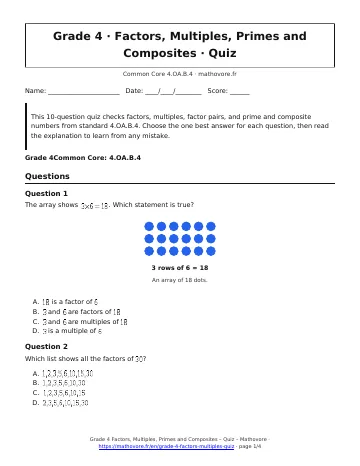
Question 1 shows an array for \(3 \times 6 = 18\), and the true statement says 3 and 6 are factors of 18. Then question 2 asks for every way to set 42 chairs in equal rows, so the list is 1, 2, 3, 6, 7, 14, 21, 42. Next, question 3 asks for a multiple of 8, and the answer is 64. Question 6 skip counts by 9 on a number line to reach 45.
Which grade 4 factors multiples quiz questions are tricky?
Question 4 asks for the prime number, which is 59. Question 5 asks for the composite number, and 39 wins because \(3 \times 13 = 39\). Meanwhile, question 7 asks how many factor pairs 49 has. The answer is 2, since 7 and 7 form one pair. Question 8 wants a factor of 54 that is also a multiple of 9, which is 18.
How do the last questions work?
Question 9 asks why 1 is neither prime nor composite. It has exactly one factor, so it fails both definitions. Finally, question 10 has Liam saving $7 each week, so only $63 fits as a multiple of 7. Therefore, skip counting solves it quickly.
What to do with the results
Read every explanation, even for answers you got right. Then rewrite two missed questions in your own words. Next, practice the matching worksheet problems. Afterward, return to the quiz later in the week and see whether the explanations still make sense.

See every chapter on the Grade 4 math page.