


This geometry probability quiz asks 10 multiple-choice questions on probability: independence, conditional probability and fair decisions, and each answer comes with a short explanation.
Ten multiple-choice questions check the main probability ideas: Venn diagrams, independence, conditional probability from tables, counting, fair choices and medical-test reasoning. Each question has exactly one correct answer.
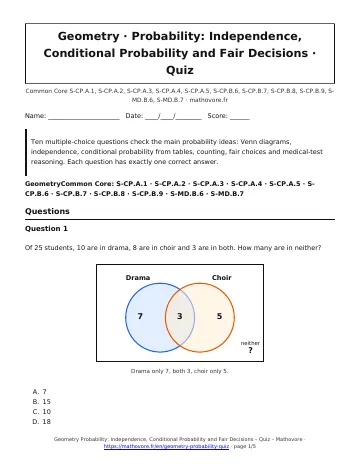
Of 25 students, 10 are in drama, 8 are in choir and 3 are in both. How many are in neither?
A die is rolled. What is the complement of the event “at least 3”?
For events A and B, \(P(A)=0.5,\ P(B)=0.4\) and \(P(A\text{ and }B)=0.2\). Which statement is true?
A survey of 80 students recorded sports and band participation. Find P(band given sports).
\(P(A)=0.5,\ P(B)=0.35\) and \(P(A\text{ or }B)=0.7\). Find \(P(A\text{ and }B)\).
Two marbles are drawn without replacement from a bag of 4 red and 6 blue marbles. Find the probability that both are red.
A coach picks 3 of 8 players for a relay team, and the order does not matter. How many teams are possible?
Two players use the spinner below. Which rule makes the game fair?
The tree shows 1,000 people tested for a condition. Find the probability that a person with a positive test has the condition.
A contestant picks one of three doors; the host, who knows where the car is, opens a different door with a goat. What is the probability of winning the car by switching?
🎉 Quiz complete!
How does this quiz work?
Read each question, choose one answer among A, B, C and D, then check it: a short explanation appears after every answer. Your score out of 10 is shown at the end, and you can restart the quiz as often as you like.
What should you review before the quiz?
Reread the key facts of the lesson and the worked example. If a question is hard, go back to the matching part of the lesson, then try the quiz again. Write your work on scrap paper: most mistakes come from skipping a step, not from the idea itself.
Remember:
- Addition rule: P(A or B) = P(A) + P(B) – P(A and B); complement: P(not A) = 1 – P(A).
- Independent events satisfy P(A and B) = P(A)P(B), which is the same as P(A given B) = P(A).
- Conditional probability: P(A given B) = P(A and B) / P(B); general multiplication rule: P(A and B) = P(B)P(A given B).
- Permutations count ordered selections, nPr = n!/(n-r)!; combinations count unordered ones, nCr = n!/(r!(n-r)!).
- A random decision is fair when every choice has the same probability; natural frequencies make medical-test probabilities clear.
How to use this geometry probability quiz
Retake this geometry probability quiz until every answer is right, then move on to the worksheet and the test.

See every chapter on the Geometry math page.