
This algebra 2 exponential log equations lesson explains solving exponential and logarithmic equations in one printable page, with definitions, a method and a worked example.
To solve an exponential equation, isolate the power, take a logarithm of both sides, and use the power rule to bring the exponent down. To solve a logarithmic equation, combine logs, rewrite in exponential form, and check every answer, because the argument of a logarithm must be positive. These methods solve growth, decay and interest problems.
Algebra 2 Exponential Log Equations Lesson: key facts
- Standards F-LE.A.4 and A-SSE.B.3c: solve \(ab^{ct}=d\) with logarithms and rewrite exponential expressions.
- To solve \(b^{x}=k\), take logs: \(x=\frac{\ln k}{\ln b}\).
- To solve \(\log_{b} x=c\), rewrite it as \(x=b^{c}\); then check that every log argument is positive.
- Compound interest \(A=P(1+\frac{r}{n})^{nt}\), continuous growth \(A=Pe^{rt}\) and half-life \(N=N_{0}(\frac{1}{2})^{t/h}\) all reduce to exponential equations.
- Rewrite \(b^{t}\) as \(e^{t\ln b}\) or \((b^{1/12})^{12t}\) to show a different growth rate.
How do you solve an exponential equation?
An exponential equation has the unknown in an exponent. If both sides can be written with the same base, set the exponents equal: \(2^{x}=32\) gives \(x=5\). Otherwise take a logarithm of both sides, which brings the exponent down as a multiplier.
Example: Sofia invests \$500 at 4% per year, so \(500(1.04)^{t}=1500\) tells when she has \$1,500.
- Isolate the power: \(1.04^{t}=3\).
- Take \(\ln\) of both sides: \(\ln 1.04^{t}=\ln 3\).
- Use the power rule: \(t\ln 1.04=\ln 3\).
- Divide: \(t=\frac{\ln 3}{\ln 1.04}\approx 28.01\) years.
Use the same-base method when both sides are powers of one number, such as \(9^{x}=27^{x-1}\). Use logarithms when they are not, such as \(3^{x}=20\). Either way, the exponent is the unknown you are solving for, and the result must satisfy the original equation.
How do you solve a logarithmic equation?
Rewrite the equation in exponential form: \(\log_{b} x=c\) means \(x=b^{c}\). If several logs appear, combine them first with the product and quotient rules, then rewrite. For example, \(\log_{2} x+\log_{2}(x-2)=3\) becomes \(\log_{2}(x(x-2))=3\), so \(x(x-2)=8\) and \(x^{2}-2x-8=0\). The solutions are \(x=4\) and \(x=-2\).
The argument of every logarithm must be positive. Here \(x=-2\) makes \(\log_{2}(-2)\) undefined, so it is an extraneous solution. Only \(x=4\) works: \(\log_{2} 4+\log_{2} 2=2+1=3\).
How do half-life and compound interest use these equations?
- Compound interest: \(A=P(1+\frac{r}{n})^{nt}\).
- Continuous growth: \(A=Pe^{rt}\).
- Half-life \(h\): \(N=N_{0}(\frac{1}{2})^{t/h}\).
A 80 mg dose with half-life 5 days follows \(N=80(\frac{1}{2})^{t/5}\). To find when 25 mg remain, solve \((\frac{1}{2})^{t/5}=0.3125\), so \(t=5\cdot\frac{\ln 0.3125}{\ln 0.5}\approx 8.39\) days.
How can you rewrite an exponential expression to show its rate?
Exponent properties give equivalent forms. Since \(1.05^{t}=(1.05^{1/12})^{12t}\) and \(1.05^{1/12}\approx 1.00407\), a 5% yearly rate matches growth of about 0.407% per month. Also \(b^{t}=e^{t\ln b}\), so \(1.05^{t}=e^{0.0488t}\).
This is the idea behind standard A-SSE.B.3c rewriting: the base you see is not the only way to describe the same growth. A yearly factor, a monthly factor and a continuous rate all describe one curve, so choose the form that answers the question being asked.
Solving Exponential and Logarithmic Equations: frequently asked questions
When can I solve an exponential equation without logarithms?
When both sides can be written with the same base. For example \(9^{x}=27^{x-1}\) becomes \(3^{2x}=3^{3x-3}\), so \(2x=3x-3\) and \(x=3\).
Why do I need to isolate the power before taking the log?
The log rule applies to a single power. In \(500(1.04)^{t}=1500\) you must divide by 500 first, giving \(1.04^{t}=3\). Taking a log of 500 times the power does not simplify.
What is an extraneous solution?
It is an answer that comes out of the algebra but fails in the original equation. In log equations it happens when a solution makes a log argument zero or negative.
Do ln and log give the same answer when solving?
Yes. \(\frac{\ln 3}{\ln 1.04}\) and \(\frac{\log 3}{\log 1.04}\) are equal, because the base cancels in the quotient. Use whichever key you prefer.
How do I find a doubling time?
Set the amount equal to twice the start. For 5% growth, \(1.05^{t}=2\), so \(t=\frac{\ln 2}{\ln 1.05}\approx 14.21\) years.
How to use this algebra 2 exponential log equations lesson
Use this algebra 2 exponential log equations lesson before the worksheet, then check what you learned with the quiz.

Printable PDF · Lesson
Algebra 2 Solving Exponential and Logarithmic Equations lesson
Download the PDF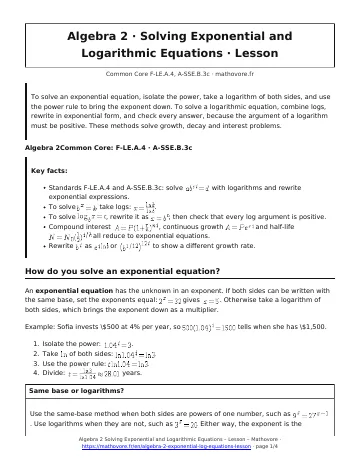
See every chapter on the Algebra 2 math page.