


This geometry parallelograms test answer key gives the full solution and the scoring guide for each of the 9 test questions on parallelograms and special quadrilaterals.
Each solution names the theorem it uses and ends with a scoring guide. Award the points shown for correct work, and give partial credit when a student has the right method with one arithmetic slip. Accept any valid proof order that keeps each statement supported by a reason.
Geometry Parallelograms Test Answer Key: questions 1–5
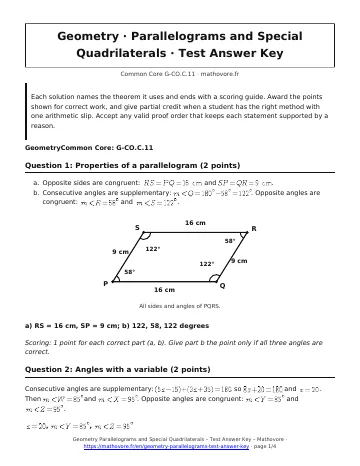
Question 1: Properties of a parallelogram (2 points)
- Opposite sides are congruent: \(RS=PQ=16\text{ cm}\) and \(SP=QR=9\text{ cm}\).
- Consecutive angles are supplementary: \(m\angle Q=180^{\circ}-58^{\circ}=122^{\circ}\). Opposite angles are congruent: \(m\angle R=58^{\circ}\) and \(m\angle S=122^{\circ}\).
a) RS = 16 cm, SP = 9 cm; b) 122, 58, 122 degrees
Scoring: 1 point for each correct part (a, b). Give part b the point only if all three angles are correct.
Question 2: Angles with a variable (2 points)
Consecutive angles are supplementary: \((5x-15)+(3x+35)=180\), so \(8x+20=180\) and \(x=20\). Then \(m\angle W=85^{\circ}\) and \(m\angle X=95^{\circ}\). Opposite angles are congruent: \(m\angle Y=85^{\circ}\) and \(m\angle Z=95^{\circ}\).
\(x=20\), \(m\angle Y=85^{\circ}\), \(m\angle Z=95^{\circ}\)
Scoring: 1 point for the correct equation and \(x=20\); 1 point for both angles.
Question 3: Diagonals with two variables (2 points)
The diagonals bisect each other. \(JN=NL\): \(3x-4=x+10\), so \(x=7\) and \(JN=17\). Then \(JL=34\). \(KN=NM\): \(2y+5=4y-11\), so \(y=8\) and \(KN=21\). Then \(KM=42\).
\(JL=34\), \(KM=42\)
Scoring: 1 point for JL (equation and value), 1 point for KM (equation and value).
Question 4: Parallelogram or not? (3 points)
- Yes. One pair of opposite sides that is parallel and congruent is enough to prove a parallelogram.
- Yes. Both pairs of opposite angles are congruent, so the quadrilateral is a parallelogram.
- No. Two pairs of congruent adjacent sides with perpendicular diagonals describe a kite, and a kite whose two pairs of sides are unequal is not a parallelogram.
a) yes, b) yes, c) no
Scoring: 1 point per part, awarded only when both the yes or no answer and the justification are correct.
Question 5: Diagonals of a rectangle (2 points)
The diagonals of a rectangle are congruent: \(6x+4=4x+18\), \(2x=14\) and \(x=7\). Then \(RT=6(7)+4=46\). Check: \(SU=4(7)+18=46\).
\(x=7\), \(RT=46\)
Scoring: 1 point for \(x=7\) with the congruent-diagonals equation; 1 point for \(RT=46\).
Geometry Parallelograms Test Answer Key: questions 6–9
Question 6: Angles of a rhombus (2 points)
Consecutive angles are supplementary: \(m\angle BAD=180^{\circ}-76^{\circ}=104^{\circ}\). Diagonal \(\overline{AC}\) bisects \(\angle BAD\), so \(m\angle BAC=\frac{104}{2}=52^{\circ}\).
\(m\angle BAD=104^{\circ}\), \(m\angle BAC=52^{\circ}\)
Scoring: 1 point for each correct angle with a valid reason.
Question 7: Isosceles trapezoid (2 points)
- Base angles are congruent: \(m\angle B=64^{\circ}\). Consecutive angles along a leg are supplementary: \(m\angle D=m\angle C=180^{\circ}-64^{\circ}=116^{\circ}\).
- Diagonals of an isosceles trapezoid are congruent: \(4x+1=6x-11\), \(12=2x\), \(x=6\). So \(AC=4(6)+1=25\).
a) 64, 116, 116 degrees; b) AC = 25
Scoring: 1 point for all three angles; 1 point for the equation and AC = 25.
Question 8: Kite (2 points)
In a kite, the angles between the unequal sides are congruent: \(m\angle L=m\angle N\). The angle sum is \(360^{\circ}\), so \(2\,m\angle L=360^{\circ}-88^{\circ}-48^{\circ}=224^{\circ}\) and \(m\angle L=112^{\circ}\). The diagonals of a kite are perpendicular, so \(m\angle KPL=90^{\circ}\).
\(m\angle L=112^{\circ}\), \(m\angle KPL=90^{\circ}\)
Scoring: 1 point for \(112^{\circ}\) with the angle-sum reasoning; 1 point for \(90^{\circ}\).
Question 9: Two-column proof (3 points)
| Statements | Reasons |
|---|---|
| 1. \(\overline{AB}\) is parallel to \(\overline{DC}\) and \(AB=DC\) | 1. Given |
| 2. \(m\angle BAC=m\angle DCA\) | 2. Alternate interior angles theorem |
| 3. \(AC=AC\) | 3. Reflexive property |
| 4. Triangle \(ABC\) is congruent to triangle \(CDA\) | 4. SAS (steps 1, 2, 3) |
| 5. \(m\angle BCA=m\angle DAC\) | 5. CPCTC |
| 6. \(\overline{AD}\) is parallel to \(\overline{BC}\) | 6. Converse of the alternate interior angles theorem |
| 7. \(ABCD\) is a parallelogram | 7. Definition of a parallelogram (both pairs of opposite sides parallel) |
Scoring: 1 point for proving the triangles congruent (steps 2 to 4 with correct reasons); 1 point for steps 5 and 6; 1 point for the conclusion using the definition.
Scoring summary
20 points: add the points of every question of this geometry parallelograms test answer key.
How to use this geometry parallelograms test answer key
Use this geometry parallelograms test answer key to score the test fairly and to see which skills need more practice.

See every chapter on the Geometry math page.