


Each solution names the theorem it uses and ends with a scoring guide. Award the points shown for correct work, and give partial credit when a student has the right method with one arithmetic slip. Accept any valid proof order that keeps each statement supported by a reason.
Question 1: Properties of a parallelogram (2 points)
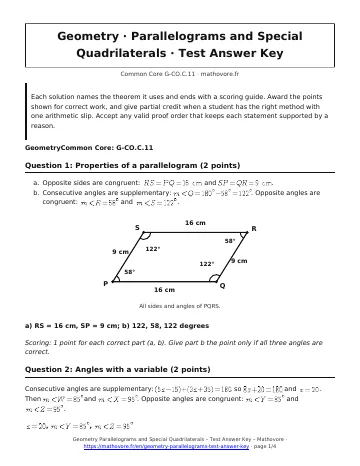
- Opposite sides are congruent: \(RS=PQ=16\text{ cm}\) and \(SP=QR=9\text{ cm}\).
- Consecutive angles are supplementary: \(m\angle Q=180^{\circ}-58^{\circ}=122^{\circ}\). Opposite angles are congruent: \(m\angle R=58^{\circ}\) and \(m\angle S=122^{\circ}\).
a) RS = 16 cm, SP = 9 cm; b) 122, 58, 122 degrees
Scoring: 1 point for each correct part (a, b). Give part b the point only if all three angles are correct.
Question 2: Angles with a variable (2 points)
Consecutive angles are supplementary: \((5x-15)+(3x+35)=180\), so \(8x+20=180\) and \(x=20\). Then \(m\angle W=85^{\circ}\) and \(m\angle X=95^{\circ}\). Opposite angles are congruent: \(m\angle Y=85^{\circ}\) and \(m\angle Z=95^{\circ}\).
\(x=20\), \(m\angle Y=85^{\circ}\), \(m\angle Z=95^{\circ}\)
Scoring: 1 point for the correct equation and \(x=20\); 1 point for both angles.
Question 3: Diagonals with two variables (2 points)
The diagonals bisect each other. \(JN=NL\): \(3x-4=x+10\), so \(x=7\) and \(JN=17\). Then \(JL=34\). \(KN=NM\): \(2y+5=4y-11\), so \(y=8\) and \(KN=21\). Then \(KM=42\).
\(JL=34\), \(KM=42\)
Scoring: 1 point for JL (equation and value), 1 point for KM (equation and value).
Question 4: Parallelogram or not? (3 points)
- Yes. One pair of opposite sides that is parallel and congruent is enough to prove a parallelogram.
- Yes. Both pairs of opposite angles are congruent, so the quadrilateral is a parallelogram.
- No. Two pairs of congruent adjacent sides with perpendicular diagonals describe a kite, and a kite whose two pairs of sides are unequal is not a parallelogram.
a) yes, b) yes, c) no
Scoring: 1 point per part, awarded only when both the yes or no answer and the justification are correct.
Question 5: Diagonals of a rectangle (2 points)
The diagonals of a rectangle are congruent: \(6x+4=4x+18\), \(2x=14\) and \(x=7\). Then \(RT=6(7)+4=46\). Check: \(SU=4(7)+18=46\).
\(x=7\), \(RT=46\)
Scoring: 1 point for \(x=7\) with the congruent-diagonals equation; 1 point for \(RT=46\).
Question 6: Angles of a rhombus (2 points)
Consecutive angles are supplementary: \(m\angle BAD=180^{\circ}-76^{\circ}=104^{\circ}\). Diagonal \(\overline{AC}\) bisects \(\angle BAD\), so \(m\angle BAC=\frac{104}{2}=52^{\circ}\).
\(m\angle BAD=104^{\circ}\), \(m\angle BAC=52^{\circ}\)
Scoring: 1 point for each correct angle with a valid reason.
Question 7: Isosceles trapezoid (2 points)
- Base angles are congruent: \(m\angle B=64^{\circ}\). Consecutive angles along a leg are supplementary: \(m\angle D=m\angle C=180^{\circ}-64^{\circ}=116^{\circ}\).
- Diagonals of an isosceles trapezoid are congruent: \(4x+1=6x-11\), \(12=2x\), \(x=6\). So \(AC=4(6)+1=25\).
a) 64, 116, 116 degrees; b) AC = 25
Scoring: 1 point for all three angles; 1 point for the equation and AC = 25.
Question 8: Kite (2 points)
In a kite, the angles between the unequal sides are congruent: \(m\angle L=m\angle N\). The angle sum is \(360^{\circ}\), so \(2\,m\angle L=360^{\circ}-88^{\circ}-48^{\circ}=224^{\circ}\) and \(m\angle L=112^{\circ}\). The diagonals of a kite are perpendicular, so \(m\angle KPL=90^{\circ}\).
\(m\angle L=112^{\circ}\), \(m\angle KPL=90^{\circ}\)
Scoring: 1 point for \(112^{\circ}\) with the angle-sum reasoning; 1 point for \(90^{\circ}\).
Question 9: Two-column proof (3 points)
| Statements | Reasons |
|---|---|
| 1. \(\overline{AB}\) is parallel to \(\overline{DC}\) and \(AB=DC\) | 1. Given |
| 2. \(m\angle BAC=m\angle DCA\) | 2. Alternate interior angles theorem |
| 3. \(AC=AC\) | 3. Reflexive property |
| 4. Triangle \(ABC\) is congruent to triangle \(CDA\) | 4. SAS (steps 1, 2, 3) |
| 5. \(m\angle BCA=m\angle DAC\) | 5. CPCTC |
| 6. \(\overline{AD}\) is parallel to \(\overline{BC}\) | 6. Converse of the alternate interior angles theorem |
| 7. \(ABCD\) is a parallelogram | 7. Definition of a parallelogram (both pairs of opposite sides parallel) |
Scoring: 1 point for proving the triangles congruent (steps 2 to 4 with correct reasons); 1 point for steps 5 and 6; 1 point for the conclusion using the definition.
20 points
See every chapter on the Geometry math page.