


This geometry reasoning proof lesson explains logic and two-column proofs in one printable page, with definitions, a method and a worked example.
A conditional statement “If p, then q” has a converse, inverse and contrapositive, and only the contrapositive always has the same truth value. Inductive reasoning finds patterns, deductive reasoning proves them. A two-column proof lists statements with reasons, as in the proof that vertical angles are congruent.
Geometry Reasoning Proof Lesson: key facts
- A conditional “If p, then q” has a hypothesis (p) and a conclusion (q).
- The converse swaps p and q, the inverse negates both, and the contrapositive does both.
- A statement and its contrapositive always have the same truth value.
- One counterexample disproves a conditional; inductive patterns are not proofs.
- Vertical angles are congruent, proved with linear pairs and the Subtraction Property of Equality.
What is a conditional statement?
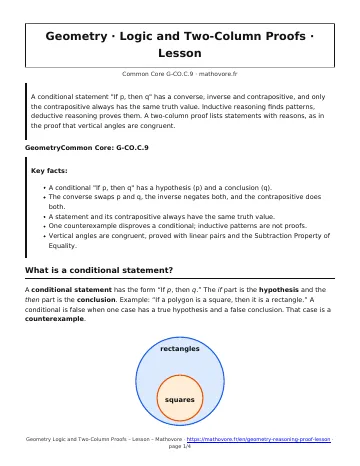
A conditional statement has the form “If p, then q.” The if part is the hypothesis and the then part is the conclusion. Example: “If a polygon is a square, then it is a rectangle.” A conditional is false when one case has a true hypothesis and a false conclusion. That case is a counterexample.
How do you write the converse, inverse and contrapositive?
| Statement | Form | Square example |
|---|---|---|
| Conditional | If p, then q | If a polygon is a square, then it is a rectangle. (true) |
| Converse | If q, then p | If a polygon is a rectangle, then it is a square. (false) |
| Inverse | If not p, then not q | If a polygon is not a square, then it is not a rectangle. (false) |
| Contrapositive | If not q, then not p | If a polygon is not a rectangle, then it is not a square. (true) |
A statement and its contrapositive always have the same truth value. When a conditional and its converse are both true, combine them into a biconditional using “if and only if.”
What is the difference between inductive and deductive reasoning?
Inductive reasoning forms a conjecture from patterns. The squares below suggest that the sum of the first n odd numbers is \(n^{2}\), but patterns can fail, and one counterexample disproves a conjecture. Deductive reasoning uses accepted facts (definitions, postulates and proven theorems) in logical steps, so the conclusion must be true.
How do you write a two-column proof?
Reflexive: \(a=a\). Symmetric: if \(a=b\), then \(b=a\). Transitive: if \(a=b\) and \(b=c\), then \(a=c\).
Addition, Subtraction, Multiplication and Division Properties: doing the same thing to both sides keeps an equation true. Substitution: replace a quantity with an equal one.
- Mark the figure, then write the Given and the Prove.
- Write each statement in the left column and its reason in the right column.
- Every reason is Given, a definition, a postulate, a property or a proven theorem. The last statement is the Prove.
Worked example. Given: lines ℓ and m intersect. Prove: \(\angle 1\) ≅ \(\angle 3\) (vertical angles are congruent).
| Statements | Reasons |
|---|---|
| 1. Lines ℓ and m intersect | Given |
| 2. \(\angle 1\) and \(\angle 2\) are a linear pair; \(\angle 2\) and \(\angle 3\) are a linear pair | Definition of linear pair |
| 3. \(\angle 1\) and \(\angle 2\) are supplementary; \(\angle 2\) and \(\angle 3\) are supplementary | Linear Pair Postulate |
| 4. \(m\angle 1+m\angle 2=180^{\circ}\); \(m\angle 2+m\angle 3=180^{\circ}\) | Definition of supplementary angles |
| 5. \(m\angle 1+m\angle 2=m\angle 2+m\angle 3\) | Transitive Property of Equality |
| 6. \(m\angle 1=m\angle 3\) | Subtraction Property of Equality |
| 7. \(\angle 1\) ≅ \(\angle 3\) | Definition of congruent angles |
A paragraph proof gives the same steps in sentences.
Logic and Two-Column Proofs: frequently asked questions
How do you find the converse of a conditional statement?
Swap the hypothesis and the conclusion. The converse of “If it is a square, then it is a rectangle” is “If it is a rectangle, then it is a square.” A true statement can have a false converse.
Why does the contrapositive matter?
The contrapositive always has the same truth value as the original statement. If a statement is true, its contrapositive is true, which makes it useful in proofs.
What is the difference between a conjecture and a theorem?
A conjecture is a guess based on patterns, found by inductive reasoning. A theorem is a statement that has been proven with deductive reasoning from definitions, postulates and earlier theorems.
How many counterexamples disprove a statement?
Just one. A single case where the hypothesis is true and the conclusion is false shows that a conditional statement is false, even if it works in many other cases.
What reasons can you use in a two-column proof?
Use Given information, definitions, postulates, properties of equality and theorems that were already proven. Never cite a statement you are trying to prove.
How to use this geometry reasoning proof lesson
Use this geometry reasoning proof lesson before the worksheet, then check what you learned with the quiz.

See every chapter on the Geometry math page.