


This grade 7 cross worksheet answer key solves all 20 problems of the cross sections of 3d figures worksheet step by step.
This answer key gives a worked solution for each of the 20 cross section problems. Every solution names the shape of the slice, finds its dimensions, and then computes the area where one is asked for. Compare each step with your own work to find any mistake.
Grade 7 Cross Worksheet Answer Key: problems 1–5
Problem 1: Slicing a cube
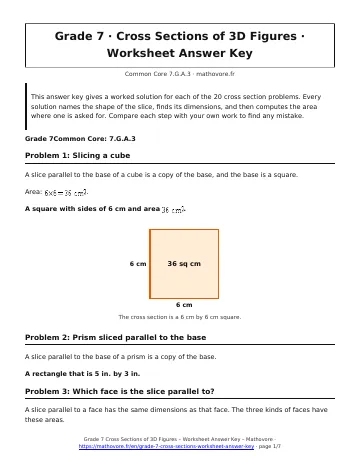
A slice parallel to the base of a cube is a copy of the base, and the base is a square.
Area: \(6 \times 6 = 36\text{ cm}^{2}\).
A square with sides of 6 cm and area \(36\text{ cm}^{2}\).
Problem 2: Prism sliced parallel to the base
A slice parallel to the base of a prism is a copy of the base.
A rectangle that is 5 in. by 3 in.
Problem 3: Which face is the slice parallel to?
A slice parallel to a face has the same dimensions as that face. The three kinds of faces have these areas.
- Top and bottom: \(12 \times 8 = 96\text{ in}^{2}\).
- Front and back: \(12 \times 6 = 72\text{ in}^{2}\).
- Left and right ends: \(8 \times 6 = 48\text{ in}^{2}\).
The plane is parallel to the 8 in. by 6 in. end faces.
Problem 4: Name the cross section
- Rectangle, the same size as the base.
- Rectangle, with the height of the prism as one side.
- Rectangle, smaller than the base.
- Triangle.
Problem 5: A slice is a smaller copy
A slice parallel to the base is a smaller copy of the base. The length shrinks by the factor \(7.5 : 10 = 0.75 = \frac{3}{4}\).
Width: \(4 \times 0.75 = 3\) ft. Area: \(7.5 \times 3 = 22.5\text{ ft}^{2}\).
The same factor applies to the height above the slice, so \(\frac{3}{4}\) of the height is above the slice.
Width 3 ft; area \(22.5\text{ ft}^{2}\); \(\frac{3}{4}\) of the height.
Grade 7 Cross Worksheet Answer Key: problems 6–10
Problem 6: Vertical slice of a prism
The cut is parallel to the end face, so the cross section is a rectangle 4 cm wide and 6 cm tall.
\(4\times 6=24\), so the area is \(24\text{ cm}^{2}\).
Problem 7: Slice parallel to the front face
A slice parallel to a face is a copy of that face, so the cross section is a rectangle that is 9 in. by 5 in.
Area: \(9 \times 5 = 45\text{ in}^{2}\).
A 9 in. by 5 in. rectangle with area \(45\text{ in}^{2}\).
Problem 8: Pyramid sliced parallel to the base
The slice is a rectangle. Halfway up, each side is \(\frac{1}{2}\) as long as the base side: \(12\times \frac{1}{2}=6\) and \(8\times \frac{1}{2}=4\).
The cross section is a 6 in. by 4 in. rectangle with area \(6\times 4=\)\(24\text{ in.}^{2}\).
Problem 9: Two slices through the apex
A vertical plane through the apex gives a triangle whose base is a side of the pyramid base and whose height is the pyramid height, 7 in.
Plane P: base 9 in. \(A = \frac{1}{2} \times 9 \times 7 = 31.5\text{ in}^{2}\).
Plane Q: base 5 in. \(A = \frac{1}{2} \times 5 \times 7 = 17.5\text{ in}^{2}\).
Plane P: triangle, \(31.5\text{ in}^{2}\). Plane Q: triangle, \(17.5\text{ in}^{2}\).
Problem 10: Slice through the apex
The plane passes through the apex, so the cross section is a triangle. Its base is the 10 ft side of the pyramid and its height is the pyramid height, 8 ft.
\(\frac{1}{2}\times 10\times 8=40\), so the area is \(40\text{ ft}^{2}\).
Grade 7 Cross Worksheet Answer Key: problems 11–15
Problem 11: Cut a pyramid near the base
The cut is 2 ft above the base, so the part above the cut has height \(8 – 2 = 6\) ft. The cross section is a smaller copy of the base, scaled by \(\frac{6}{8} = \frac{3}{4}\).
Length: \(20 \times \frac{3}{4} = 15\) ft. Width: \(12 \times \frac{3}{4} = 9\) ft.
Area: \(15 \times 9 = 135\text{ ft}^{2}\).
A 15 ft by 9 ft rectangle with area \(135\text{ ft}^{2}\).
Problem 12: Always, sometimes , or never
- True.
- False. It always gives a rectangle.
- True.
- False. The rectangle is smaller than the base, and it shrinks as the plane moves toward the apex.
Problem 13: Work backward from the area
The cross section is a triangle whose height is the height of the pyramid. \(A = \frac{1}{2} b h\), so \(30 = \frac{1}{2} \times 10 \times h = 5h\).
\(h = 30 : 5 = 6\).
The pyramid is 6 ft tall.
Problem 14: Slice across a diagonal
The cross section is a rectangle. Its length is the base diagonal, 10 in., and its width is the height of the prism, 5 in.
\(10\times 5=50\), so the area is \(50\text{ in.}^{2}\).
Problem 15: Slicing a loaf
Number of slices: \(12: 1=12\).
Each cut is perpendicular to the length, so each face is a 4 in. by 5 in. rectangle with area \(4\times 5=20\text{ in.}^{2}\).
Volume of one slice: \(20\times 1=20\text{ in.}^{3}\). Check: \(12\times 20=240=12\times 4\times 5\).
12 slices, face area \(20\text{ in.}^{2}\), volume \(20\text{ in.}^{3}\)
Grade 7 Cross Worksheet Answer Key: problems 16–20
Problem 16: Layer cake
(a) The cut is parallel to the base, so the cross section is a rectangle that is 12 in. by 8 in. Area: \(12 \times 8 = 96\text{ in}^{2}\).
(b) Each layer is \(3 : 2 = 1.5\) in. thick. Volume: \(96 \times 1.5 = 144\text{ in}^{3}\).
(c) One piece is \(12 : 3 = 4\) in. by \(8 : 2 = 4\) in. by 1.5 in. Volume: \(4 \times 4 \times 1.5 = 24\text{ in}^{3}\). Each layer gives \(3 \times 2 = 6\) pieces, so there are \(2 \times 6 = 12\) pieces. Check: \(12 \times 24 = 288 = 12 \times 8 \times 3\).
96 in²; 144 in³; pieces 4 in. by 4 in. by 1.5 in. (24 in³); 12 pieces.
Problem 17: Museum pyramid model
(a) Halfway up, the remaining height is half of the full height, so each dimension of the base is halved: \(24 : 2 = 12\) cm and \(18 : 2 = 9\) cm.
(b) Area: \(12 \times 9 = 108\text{ cm}^{2}\).
(c) The base area is \(24 \times 18 = 432\text{ cm}^{2}\). \(\frac{108}{432} = \frac{1}{4}\).
12 cm by 9 cm; \(108\text{ cm}^{2}\); \(\frac{1}{4}\) of the base area.
Problem 18: Ice sculpture block
(a) A slice parallel to a face matches that face. Cut 1: \(36 \times 24 = 864\text{ in}^{2}\). Cut 2: \(36 \times 18 = 648\text{ in}^{2}\). Cut 3: \(24 \times 18 = 432\text{ in}^{2}\).
(b) The biggest is 864 and the smallest is 432: \(864 – 432 = 432\text{ in}^{2}\).
(c) The slab is \(864 \times 2 = 1{,}728\text{ in}^{3}\).
864, 648, and 432 in²; difference 432 in²; slab volume 1,728 in³.
Problem 19: Trapezoid cross section
Use the trapezoid area formula \(A=\frac{1}{2}(b_1+b_2)h\).
\(A=\frac{1}{2}(6+3)\times 5=\frac{1}{2}\times 9\times 5=22.5\)
\(22.5\text{ ft}^{2}\)
Problem 20: Cutting a square pyramid
- The height above the cut is \(9-3=6\), which is \(\frac{6}{9}=\frac{2}{3}\) of the height. Side: \(12\times \frac{2}{3}=8\). 8 in.
- Cross section: \(8\times 8=64\text{ in.}^{2}\). Base: \(12\times 12=144\text{ in.}^{2}\). \(64\text{ in.}^{2}\) and \(144\text{ in.}^{2}\)
- \(\frac{64}{144}=\frac{4}{9}\). \(\frac{4}{9}\) of the base area
How to use this grade 7 cross worksheet answer key
Read this grade 7 cross worksheet answer key after trying each problem yourself, and redo any problem you missed.

See every chapter on the Grade 7 math page.