


This answer key gives a worked solution for each of the 20 problems on constructing triangles. Every solution shows the sums, the inequality, or the reasoning used to count the triangles. Compare your work with the steps to find and fix any mistake.
Problem 1: Reading a protractor
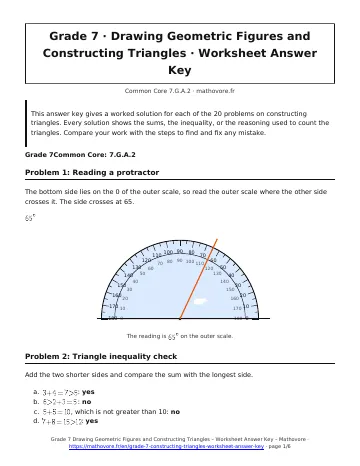
The bottom side lies on the 0 of the outer scale, so read the outer scale where the other side crosses it. The side crosses at 65.
\(65^{\circ}\)
Problem 2: Triangle inequality check
Add the two shorter sides and compare the sum with the longest side.
- \(3+4=7>5\): yes
- \(6>2+3=5\): no
- \(5+5=10\), which is not greater than 10: no
- \(7+8=15>12\): yes
Problem 3: Third angle and type
(a) The angles of a triangle add to \(180^{\circ}\). \(48^{\circ} + 67^{\circ} = 115^{\circ}\), and \(180^{\circ} – 115^{\circ} = 65^{\circ}\).
(b) All three angles (\(48^{\circ}\), \(67^{\circ}\), \(65^{\circ}\)) are less than \(90^{\circ}\), so the triangle is acute.
Angle C = \(65^{\circ}\); the triangle is acute.
Problem 4: Angles of a triangle
The angles of a triangle must add up to \(180^{\circ}\).
- \(50+60+70=180\): yes
- \(90+60+40=190\): no
- \(100+45+35=180\): yes
- \(62+59+58=179\): no
Problem 5: Decimal side lengths
- \(1.5 + 2.5 = 4\), which is not greater than 4. No.
- \(2.5 + 4 = 6.5 > 6\). Yes.
- \(3.2 + 3.2 = 6.4 > 6.3\). Yes.
- \(0.8 + 1.1 = 1.9\), which is less than 2. No.
Problem 6: Third side length
The third side \(x\) must satisfy \(5+9>x\) and \(5+x>9\). So \(14>x\) and \(x>4\).
The whole numbers from 5 to 13 work. Smallest: 5 in. Largest: 13 in.
Problem 7: Isosceles bases
(a) The base must be greater than \(7 – 7 = 0\) and less than \(7 + 7 = 14\). Whole numbers: 1 to 13. The smallest is 1 in. and the largest is 13 in.
(b) The whole numbers from 1 through 13 give \(13 – 1 + 1 = 13\) bases. 13 bases.
Problem 8: Angles x, 2x, and 3x
The angles add to \(180^{\circ}\): \(x + 2x + 3x = 6x = 180\), so \(x = 180 : 6 = 30\).
The angles are \(30^{\circ}\), \(2 \times 30^{\circ} = 60^{\circ}\), and \(3 \times 30^{\circ} = 90^{\circ}\). Check: \(30 + 60 + 90 = 180\).
\(x = 30\); angles \(30^{\circ}\), \(60^{\circ}\), \(90^{\circ}\); a right triangle.
Problem 9: Three angles
- No. The bottom sides are 3 cm and 5 cm, so the second triangle is larger.
- No. Three angles fix only the shape. Triangles of any size can have the same angles, so infinitely many triangles fit.
Problem 10: Equilateral triangle construction
(a) C is 5 cm from A and 5 cm from B, so \(AC = BC = 5\text{ cm}\).
(b) All three sides are equal, so the triangle is equilateral. Each angle measures \(60^{\circ}\), and \(3 \times 60^{\circ} = 180^{\circ}\).
(c) No. The arcs cross at one point above AB, so the classmate gets a triangle with the same size and shape. (The arcs also cross below AB, which gives a mirror image.)
AC = BC = 5 cm; each angle is \(60^{\circ}\); the triangle is unique.
Problem 11: Two sides and an angle between
Yes. The angle is between the two given sides. Once the 7 cm side and the \(40^{\circ}\) angle are drawn, point C is 5 cm along the second ray, and B and C are fixed. Only one triangle fits, so Sofia’s triangle matches Jamal’s.
Problem 12: Right angle between two sides
(a) A ruler measurement of BC gives 10 cm.
(b) Yes. Two sides and the angle between them are given, so exactly one triangle can be drawn.
(c) The sides are 6 cm, 8 cm, and 10 cm. All three are different, so the triangle is scalene.
Problem 13: One, many, or none
- \(4 + 5 = 9 > 6\), so a triangle exists, and three sides fix its shape. Exactly one.
- \(3 + 4 = 7\) is not greater than 8. No triangle.
- The angles add to \(180^{\circ}\), so triangles exist, but no side length is given, so any size works. More than one.
- The angles add to \(115^{\circ}\), less than \(180^{\circ}\), and the side AB is between them (ASA). Exactly one.
- \(100 + 90 + 10 = 200\), which is more than \(180^{\circ}\). No triangle.
Problem 14: Two angles and a side
- \(180-35-75=70\), so \(\angle C=70^{\circ}\).
- The 8 cm side lies between the two angles, so the two rays meet at only one point C. Exactly one triangle.
Problem 15: Stick triangle
- \(7+10=17\), which is less than 18. No, the two shorter sticks cannot reach across the third.
- The new length \(x\) needs \(7+10=17>x\) and \(x>10-7=3\). The whole numbers from 4 to 16 work. Smallest: 4 in. Largest: 16 in.
Problem 16: Hiking loop
(a) CA must be greater than \(8 – 5 = 3\) and less than \(5 + 8 = 13\). The whole-number lengths are 4 through 12 miles.
(b) The loop is \(5 + 8 + CA = 13 + CA\). Shortest: \(13 + 4 = 17\) miles. Longest: \(13 + 12 = 25\) miles.
(c) \(20 – 13 = 7\), and 7 is between 4 and 12, so yes. CA = 7 miles.
Problem 17: Garden fence
- The third side \(x\) satisfies \(40+25=65>x\) and \(x>40-25=15\). The whole numbers are 16 through 64 ft.
- Smallest: \(40+25+16=81\). Largest: \(40+25+64=129\). Smallest 81 ft, largest 129 ft.
Problem 18: Land survey
(a) \(52^{\circ} + 71^{\circ} = 123^{\circ}\), and \(180^{\circ} – 123^{\circ} = 57^{\circ}\).
(b) Two angles and the side between them are given, so exactly one triangle fits.
(c) With \(60^{\circ}\) the angles would add to \(52 + 71 + 60 = 183\) degrees, which is more than \(180^{\circ}\). Angles of a triangle must add to exactly \(180^{\circ}\).
Angle at the tree: \(57^{\circ}\); one triangle; \(60^{\circ}\) is impossible.
Problem 19: Pennant banner
(a) With \(s = 6\), the two equal sides add to \(6 + 6 = 12\), which equals the base but is not greater than it. The sides would lie flat along the base, so no triangle forms.
(b) Need \(s + s > 12\), so \(s > 6\). The smallest whole number is 7 in.
(c) \(7 + 7 + 12 = 26\). The least perimeter is 26 in.
Problem 20: Two possible triangles
- Two triangles: \(AB_1C\) and \(AB_2C\). Both have \(\angle A=30^{\circ}\), \(AC=10\text{ cm}\), and \(BC=7\text{ cm}\).
- Triangle \(AB_2C\) has the longer side AB, about 13.6 cm, compared with about 3.8 cm for \(AB_1C\).
- No. The given angle is not between the two given sides, so the arc can cross the ray twice, once, or not at all.
See every chapter on the Grade 7 math page.