Key takeaway: This grade 7 constructing worksheet answer key shows the sums, the inequality checks, and the reasoning that decide how many triangles fit each description. Students can compare each step with their own work and find where a drawing or a calculation went off course.
Read the sum first, because a wrong sum flips a yes into a no. Then read the sentence that explains the decision. Families can use that same order when they review homework together. Short comments under each answer explain the decision.
This answer key gives a worked solution for each of the 20 problems on constructing triangles. Every solution shows the sums, the inequality, or the reasoning used to count the triangles. Compare your work with the steps to find and fix any mistake.
Grade 7 Constructing Worksheet Answer Key: problems 1–5
1. Reading a protractor
The bottom side lies on the 0 of the outer scale, so read the outer scale where the other side crosses it. The side crosses at 65.
\(65^{\circ}\)
2. Triangle inequality check
Add the two shorter sides and compare the sum with the longest side.
- \(3+4=7>5\): yes
- \(6>2+3=5\): no
- \(5+5=10\), which is not greater than 10: no
- \(7+8=15>12\): yes
3. Third angle and type
(a) The angles of a triangle add to \(180^{\circ}\). \(48^{\circ} + 67^{\circ} = 115^{\circ}\), and \(180^{\circ} – 115^{\circ} = 65^{\circ}\).
(b) All three angles (\(48^{\circ}\), \(67^{\circ}\), \(65^{\circ}\)) are less than \(90^{\circ}\), so the triangle is acute.
Angle C = \(65^{\circ}\); the triangle is acute.
4. Angles of a triangle
The angles of a triangle must add up to \(180^{\circ}\).
- \(50+60+70=180\): yes
- \(90+60+40=190\): no
- \(100+45+35=180\): yes
- \(62+59+58=179\): no
5. Decimal side lengths
- \(1.5 + 2.5 = 4\), which is not greater than 4. No.
- \(2.5 + 4 = 6.5 > 6\). Yes.
- \(3.2 + 3.2 = 6.4 > 6.3\). Yes.
- \(0.8 + 1.1 = 1.9\), which is less than 2. No.
Grade 7 Constructing Worksheet Answer Key: problems 6–10
6. Third side length
The third side \(x\) must satisfy \(5+9>x\) and \(5+x>9\). So \(14>x\) and \(x>4\).
The whole numbers from 5 to 13 work. Smallest: 5 in. Largest: 13 in.
7. Isosceles bases
(a) The base must be greater than \(7 – 7 = 0\) and less than \(7 + 7 = 14\). Whole numbers: 1 to 13. The smallest is 1 in. and the largest is 13 in.
(b) The whole numbers from 1 through 13 give \(13 – 1 + 1 = 13\) bases. 13 bases.
8. Angles x, 2x, and 3x
The angles add to \(180^{\circ}\): \(x + 2x + 3x = 6x = 180\), so \(x = 180 : 6 = 30\).
The angles are \(30^{\circ}\), \(2 \times 30^{\circ} = 60^{\circ}\), and \(3 \times 30^{\circ} = 90^{\circ}\). Check: \(30 + 60 + 90 = 180\).
\(x = 30\); angles \(30^{\circ}\), \(60^{\circ}\), \(90^{\circ}\); a right triangle.
9. Three angles
- No. The bottom sides are 3 cm and 5 cm, so the second triangle is larger.
- No. Three angles fix only the shape. Triangles of any size can have the same angles, so infinitely many triangles fit.
10. Equilateral triangle construction
(a) C is 5 cm from A and 5 cm from B, so \(AC = BC = 5\text{ cm}\).
(b) All three sides are equal, so the triangle is equilateral. Each angle measures \(60^{\circ}\), and \(3 \times 60^{\circ} = 180^{\circ}\).
(c) No. The arcs cross at one point above AB, so the classmate gets a triangle with the same size and shape. (The arcs also cross below AB, which gives a mirror image.)
AC = BC = 5 cm; each angle is \(60^{\circ}\); the triangle is unique.
Grade 7 Constructing Worksheet Answer Key: problems 11–15
11. Two sides and an angle between
Yes. The angle is between the two given sides. Once the 7 cm side and the \(40^{\circ}\) angle are drawn, point C is 5 cm along the second ray, and B and C are fixed. Only one triangle fits, so Sofia’s triangle matches Jamal’s.
12. Right angle between two sides
(a) A ruler measurement of BC gives 10 cm.
(b) Yes. Two sides and the angle between them are given, so exactly one triangle can be drawn.
(c) The sides are 6 cm, 8 cm, and 10 cm. All three are different, so the triangle is scalene.
13. One, many, or none
- \(4 + 5 = 9 > 6\), so a triangle exists, and three sides fix its shape. Exactly one.
- \(3 + 4 = 7\) is not greater than 8. No triangle.
- The angles add to \(180^{\circ}\), so triangles exist, but no side length is given, so any size works. More than one.
- The angles add to \(115^{\circ}\), less than \(180^{\circ}\), and the side AB is between them (ASA). Exactly one.
- \(100 + 90 + 10 = 200\), which is more than \(180^{\circ}\). No triangle.
14. Two angles and a side
- \(180-35-75=70\), so \(\angle C=70^{\circ}\).
- The 8 cm side lies between the two angles, so the two rays meet at only one point C. Exactly one triangle.
15. Stick triangle
- \(7+10=17\), which is less than 18. No, the two shorter sticks cannot reach across the third.
- The new length \(x\) needs \(7+10=17>x\) and \(x>10-7=3\). The whole numbers from 4 to 16 work. Smallest: 4 in. Largest: 16 in.
Grade 7 Constructing Worksheet Answer Key: problems 16–20
16. Hiking loop
(a) CA must be greater than \(8 – 5 = 3\) and less than \(5 + 8 = 13\). The whole-number lengths are 4 through 12 miles.
(b) The loop is \(5 + 8 + CA = 13 + CA\). Shortest: \(13 + 4 = 17\) miles. Longest: \(13 + 12 = 25\) miles.
(c) \(20 – 13 = 7\), and 7 is between 4 and 12, so yes. CA = 7 miles.
17. Garden fence
- The third side \(x\) satisfies \(40+25=65>x\) and \(x>40-25=15\). The whole numbers are 16 through 64 ft.
- Smallest: \(40+25+16=81\). Largest: \(40+25+64=129\). Smallest 81 ft, largest 129 ft.
18. Land survey
(a) \(52^{\circ} + 71^{\circ} = 123^{\circ}\), and \(180^{\circ} – 123^{\circ} = 57^{\circ}\).
(b) Two angles and the side between them are given, so exactly one triangle fits.
(c) With \(60^{\circ}\) the angles would add to \(52 + 71 + 60 = 183\) degrees, which is more than \(180^{\circ}\). Angles of a triangle must add to exactly \(180^{\circ}\).
Angle at the tree: \(57^{\circ}\); one triangle; \(60^{\circ}\) is impossible.
19. Pennant banner
(a) With \(s = 6\), the two equal sides add to \(6 + 6 = 12\), which equals the base but is not greater than it. The sides would lie flat along the base, so no triangle forms.
(b) Need \(s + s > 12\), so \(s > 6\). The smallest whole number is 7 in.
(c) \(7 + 7 + 12 = 26\). The least perimeter is 26 in.
20. Two possible triangles
- Two triangles: \(AB_1C\) and \(AB_2C\). Both have \(\angle A=30^{\circ}\), \(AC=10\text{ cm}\), and \(BC=7\text{ cm}\).
- Triangle \(AB_2C\) has the longer side AB, about 13.6 cm, compared with about 3.8 cm for \(AB_1C\).
- No. The given angle is not between the two given sides, so the arc can cross the ray twice, once, or not at all.
Which triangle inequality answers are correct?
For 3, 4, 5 the short sides total 7, which beats 5, so it works. The triple 2, 3, 6 totals only 5, which loses to 6. Next, 5, 5, 10 ties at 10, so no triangle forms. Finally, 7, 8, 12 totals 15, which beats 12.
How do you check the angle answers?
The third angle in triangle ABC is 180 minus 48 minus 67, which is 65 degrees. Since all three angles are acute, the triangle is acute. The angles x, 2x, and 3x give x equal to 30, so the angles are 30, 60, and 90.
What are the answers for the stick and third side problems?
For sides of 5 and 9 inches, the third side can be any whole number from 5 to 13. Ethan’s sticks of 7, 10, and 18 inches cannot form a triangle, because 17 does not beat 18. Test one value inside the range to confirm the rule.
Which construction errors does the key warn about?
Some students set the compass to the wrong length, so the arcs never meet. Others read the protractor from the wrong zero line. Finally, a few forget that three equal angles do not fix the size.
Use the key for steady progress
Tag each miss as a bad sum, a protractor slip, or a wrong count of triangles. Then redo one problem for each tag. A short quiz later in the week will show whether those habits improved.

Printable PDF · Worksheet Answer Key
Grade 7 Drawing Geometric Figures and Constructing Triangles worksheet answer key
Download the PDF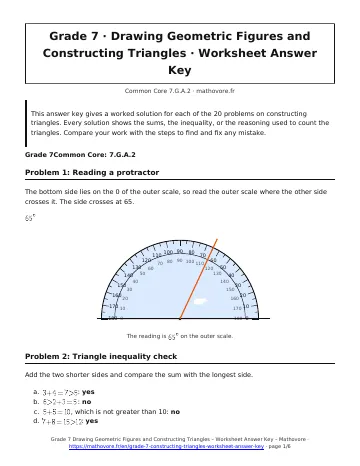
See every chapter on the Grade 7 math page.