



Question 1: Likelihood (2 points)
(a) No marble is blue, so \(P(\text{blue}) = \frac{0}{10} = 0\). The event is impossible.
(b) Every marble is red, so \(P(\text{red}) = \frac{10}{10} = 1\). The event is certain.
Scoring: 1 point for each part (probability and the matching word).
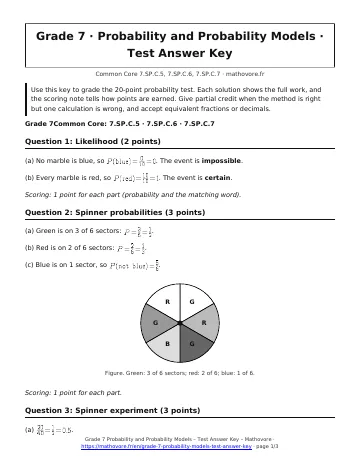
Question 2: Spinner probabilities (3 points)
(a) Green is on 3 of 6 sectors: \(P = \frac{3}{6} = \frac{1}{2}\).
(b) Red is on 2 of 6 sectors: \(P = \frac{2}{6} = \frac{1}{3}\).
(c) Blue is on 1 sector, so \(P(\text{not blue}) = \frac{5}{6}\).
Scoring: 1 point for each part.
Question 3: Spinner experiment (3 points)
(a) \(\frac{20}{40} = \frac{1}{2} = 0.5\).
(b) \(\frac{14}{40} = \frac{7}{20} = 0.35\).
(c) Blue: \(\frac{6}{40} = 0.15\), and \(0.15 \times 200 = 30\). About 30 blues.
Scoring: 1 point for each part. In (c) give the point for 0.15 times 200.
Question 4: Fair cube (2 points)
(a) Faces greater than 4: 5 and 6. So \(P = \frac{2}{6} = \frac{1}{3}\).
(b) Odd faces: 1, 3, 5. So \(P = \frac{3}{6} = \frac{1}{2}\).
Scoring: 1 point for each part (fraction need not be simplified if correct).
Question 5: Missing probability (3 points)
(a) The probabilities add to 1: \(0.5 + 0.25 + 0.15 = 0.9\), so \(P(D) = 1 – 0.9 = 0.1\).
(b) \(P(C \text{ or } D) = 0.15 + 0.1 = 0.25\).
(c) \(0.25 \times 200 = 50\). About 50 times .
Scoring: 1 point for each part.
Question 6: Fair or not (3 points)
(a) The expected count is \(\frac{1}{6} \times 30 = 5\) for each face.
(b) Differences: face 1: -2; face 2: +1; face 3: 0; face 4: -1; face 5: +2; face 6: 0. Faces 1 and 5 differ the most, by 2 each.
(c) Yes. Every count is within 2 of 5, which is normal variation for only 30 rolls.
Scoring: 1 point for 5; 1 point for faces 1 and 5 with the difference 2; 1 point for a reasonable conclusion with a reason.
Question 7: Tossing a cup (2 points)
(a) Up: \(\frac{12}{80} = 0.15\). Down: \(\frac{36}{80} = 0.45\). Side: \(\frac{32}{80} = 0.4\). Check: \(0.15 + 0.45 + 0.4 = 1\).
(b) \(0.4 \times 300 = 120\). About 120 side landings.
Scoring: 1 point for the model; 1 point for the prediction.
Question 8: Bus schedule (2 points)
(a) \(1 – \frac{3}{20} = \frac{17}{20}\). The probability of being on time is \(\frac{17}{20}\).
(b) \(\frac{3}{20} \times 40 = 6\). She should expect about 6 late days.
Scoring: 1 point for each part.
20 points
See every chapter on the Grade 7 math page.