


This grade 3 time measurement lesson explains time, liquid volume and mass in one printable page, with definitions, a method and a worked example.
Time is read from a clock to the nearest minute, and elapsed time is the number of minutes that pass between a start and an end. Mass is measured in grams and kilograms, and liquid volume is measured in liters. Add, subtract, multiply, or divide measurements that use the same unit to solve one-step word problems.
Grade 3 Time Measurement Lesson: key facts
- The hour hand shows the hour; the minute hand shows minutes, counted by 5s and then by 1s.
- Elapsed time is the time from a start to an end, and a number line with jumps shows it.
- Grams (g) measure small masses and kilograms (kg) measure larger masses.
- Liters (L) measure liquid volume, and a beaker scale shows how many liters it holds.
- Use the same unit, then add, subtract, multiply, or divide to solve the story.
How do you tell time to the nearest minute?
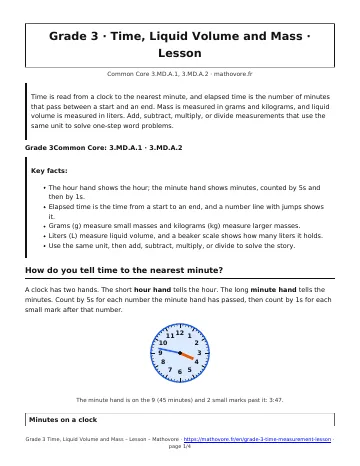
A clock has two hands. The short hour hand tells the hour. The long minute hand tells the minutes. Count by 5s for each number the minute hand has passed, then count by 1s for each small mark after that number.
Each number on the clock is 5 minutes after the last one. The 3 means 15 minutes, the 6 means 30 minutes, and the 9 means 45 minutes. On the clock above, the minute hand is on the 9 and 2 marks beyond it: \(45 + 2 = 47\) minutes. We write the time as 3:47.
How do you find elapsed time?
Elapsed time is the amount of time that passes from a start time to an end time. A number line helps: jump from the start to an easy time such as the next half hour, then jump to the end, and add the jumps.
- Mark the start time on the number line.
- Jump to a friendly time, like 4:30.
- Jump from there to the end time.
- Add the lengths of the jumps.
Example: Maya starts reading at 4:15 and stops at 4:50. The first jump is 15 minutes and the second jump is 20 minutes. \(15 + 20 = 35\), so she read for 35 minutes. To find an end time, jump forward from the start. To find a start time, jump backward from the end.
What are grams and kilograms?
Mass tells how much matter is in an object. We measure small masses in grams (g). A paper clip has a mass of about 1 gram. We measure larger masses in kilograms (kg). A big dictionary has a mass of about 1 kilogram, and a backpack full of books has a mass of a few kilograms. A scale shows the mass. Read the number the needle points to, using the small marks between the numbers.
What is a liter?
Liquid volume is how much liquid fits in a container. We measure it in liters (L). A large water bottle holds about 1 liter, and a bathtub holds many liters. A beaker has a scale on its side. Read the mark where the top of the water stops.
How do you solve measurement word problems?
Draw a picture or a tape diagram, then choose the operation. The units must match, so add or subtract grams with grams and liters with liters.
| The story | Operation | Example |
|---|---|---|
| Put amounts together | Add | \(3 + 4 = 7\) kilograms |
| Find how much more or less | Subtract | \(9 – 4 = 5\) liters |
| Equal groups | Multiply | \(3 \times 2 = 6\) liters |
| Share equally | Divide | \(20 : 5 = 4\) liters |
Time, Liquid Volume and Mass: frequently asked questions
How do you read a clock to the nearest minute?
Look at the hour hand to find the hour. Then count the minute hand by 5s up to the last number it passed and by 1s for the small marks after it. When the minute hand is on the 4 and 3 marks beyond, the time is 20 + 3 = 23 minutes after the hour.
What is elapsed time?
Elapsed time is how many minutes pass from when something starts to when it ends. Jump on a number line from the start to the end and add the jumps. From 2:10 to 2:45 the jumps 20 and 15 make 35 minutes.
What is the difference between a gram and a kilogram?
Both measure mass, but a kilogram is much bigger than a gram. A grape is about a few grams, while a bag of potatoes is about 2 kilograms. Pick grams for light things and kilograms for heavy things.
How much liquid is one liter?
A liter is a unit of liquid volume. A large bottle of water holds about 1 liter. A beaker marked from 0 to 10 liters can hold up to 10 of those bottles.
How do you know which operation to use in a measurement word problem?
Picture the story. Putting amounts together means add, finding the difference means subtract, equal groups mean multiply, and sharing equally means divide. Always check that every measurement uses the same unit.
How to use this grade 3 time measurement lesson
Use this grade 3 time measurement lesson before the worksheet, then check what you learned with the quiz.

See every chapter on the Grade 3 math page.