

Key takeaway: This algebra 2 trig worksheet answer key lists amplitudes, periods, midlines and model values for all 22 problems, with the reasoning for each wave. Check the four features in order: midline, amplitude, period, then shift. Because each feature comes from a different number, one wrong value rarely spoils the others.
Every solution below shows the formula, the substitution and the final value in bold. Compare each step with your own work, and recheck the sign of A and the grouping inside the sine or cosine whenever your answer is off.
Algebra 2 Trig Worksheet Answer Key: problems 1–5
1. Sine at key angles
- \(\sin 0=\) \(0\)
- \(\sin\frac{\pi}{2}=\) \(1\) (top of the first hump)
- \(\sin\pi=\) \(0\)
- \(\sin\frac{3\pi}{2}=\) \(-1\) (bottom of the wave)
- \(\sin 2\pi=\) \(0\) (one full cycle is done)
2. Cosine at key angles
- \(\cos 0=\) \(1\)
- \(\cos\frac{\pi}{2}=\) \(0\)
- \(\cos\pi=\) \(-1\)
- \(\cos\frac{3\pi}{2}=\) \(0\)
- \(\cos 2\pi=\) \(1\)
3. Find the amplitude
The amplitude is \(|A|\).
- \(|4|=\) \(4\)
- \(|-3|=\) \(3\)
- \(|\frac{1}{2}|=\) \(\frac{1}{2}\)
- \(|2.5|=\) \(2.5\)
4. Find the period
Use \(\text{period}=\frac{2\pi}{B}\).
- \(\frac{2\pi}{2}=\) \(\pi\)
- \(\frac{2\pi}{4}=\) \(\frac{\pi}{2}\)
- Here \(B=\frac{1}{2}\), so \(2\pi: \frac{1}{2}=\) \(4\pi\)
- \(\frac{2\pi}{\pi}=\) \(2\)
- \(\frac{2\pi}{3}\): \(\frac{2\pi}{3}\)
5. Midline and range
The midline is \(y=D\); the range is \([D-|A|,\,D+|A|]\).
- Midline \(y=3\), range \([2,4]\)
- Midline \(y=-1\), range \([-1-2,\,-1+2]=\) \([-3,1]\)
- Midline \(y=2\), range \([2-4,\,2+4]=\) \([-2,6]\)
Algebra 2 Trig Worksheet Answer Key: problems 6–10
6. Read the phase shift
- Subtracting \(\frac{\pi}{4}\): right \(\frac{\pi}{4}\)
- Adding \(\frac{\pi}{3}\) means \(x-(-\frac{\pi}{3})\): left \(\frac{\pi}{3}\)
- The factored form \(2(x-\frac{\pi}{6})\) shows right \(\frac{\pi}{6}\) (the shift is not \(\frac{\pi}{3}\))
- right \(\frac{3\pi}{2}\)
7. Equation from a cosine graph
The maximum is \(3\) at \(x=0\), and \(\cos 0=1\), so \(A=3\). The minimum \(-3\) at \(x=\pi\) agrees.
\(A=3\), \(y=3\cos x\)
8. Midline from a graph
Maximum \(3\), minimum \(-1\). Midline \(=\frac{3+(-1)}{2}=1\). Amplitude \(=\frac{3-(-1)}{2}=2\).
Equation: \(y=2\sin x+1\)
9. Period from a graph
The graph completes one cycle between \(x=0\) and \(x=\pi\), so the period is \(\pi\). Then \(B=\frac{2\pi}{\pi}=2\). The maximum is \(2\), so \(A=2\).
Period \(\pi\), \(B=2\), \(y=2\cos(2x)\)
10. Evaluate a sinusoid
- \(2\cdot\frac{1}{2}+1=\) \(2\)
- \(2\cdot 1+1=\) \(3\)
- \(\sin\frac{7\pi}{6}=-\frac{1}{2}\), so \(2(-\frac{1}{2})+1=\) \(0\)
- \(2(-1)+1=\) \(-1\)
Algebra 2 Trig Worksheet Answer Key: problems 11–15
11. Maximum and minimum values
- Maximum \(2+5=\) \(7\), minimum \(2-5=\) \(-3\)
- Amplitude \(2\), midline \(-1\): maximum \(-1+2=\) \(1\), minimum \(-1-2=\) \(-3\)
12. Three features at once
Amplitude \(|3|=3\). Period \(\frac{2\pi}{4}=\frac{\pi}{2}\). Midline \(y=-2\).
Amplitude \(3\), period \(\frac{\pi}{2}\), midline \(y=-2\)
13. Plot key points
Values: \(3\sin 0=0\), \(3\sin\frac{\pi}{2}=3\), \(3\sin\pi=0\), \(3\sin\frac{3\pi}{2}=-3\), \(3\sin 2\pi=0\).
\(y\): \(0,\ 3,\ 0,\ -3,\ 0\)
14. All four features
Amplitude \(|-3|=3\). Period \(\frac{2\pi}{2}=\pi\). The factor is \(x+\frac{\pi}{4}=x-(-\frac{\pi}{4})\), so the shift is \(\frac{\pi}{4}\) to the left. Midline \(y=1\).
Maximum \(1+3=4\), minimum \(1-3=-2\) (the negative sign flips the wave but does not change these values).
Amplitude 3, period \(\pi\), left \(\frac{\pi}{4}\), midline \(y=1\), max 4, min \(-2\)
15. Write a sine equation
\(A=4\), \(D=1\), and \(B=\frac{2\pi}{\pi}=2\).
\(y=4\sin(2x)+1\)
Algebra 2 Trig Worksheet Answer Key: problems 16–20
16. Write a cosine equation
\(A=\frac{8-2}{2}=3\), \(D=\frac{8+2}{2}=5\), \(B=\frac{2\pi}{8}=\frac{\pi}{4}\).
\(y=3\cos(\frac{\pi}{4}x)+5\)
Check: at \(x=0\) the value is \(3+5=8\), the maximum.
17. Tide model
- Amplitude \(3\), period \(\frac{2\pi}{\pi/6}=12\) hours: \(12\), midline \(y=5\)
- Highest \(5+3=\) \(8\text{ ft}\), lowest \(5-3=\) \(2\text{ ft}\)
- \(D(2)=5+3\cos\frac{\pi}{3}=5+1.5=\) \(6.5\text{ ft}\); \(D(4)=5+3\cos\frac{2\pi}{3}=5-1.5=\) \(3.5\text{ ft}\)
18. Ferris wheel
- Period \(=\frac{2\pi}{\pi/20}=\) \(40\text{ s}\)
- Lowest \(28-25=\) \(3\text{ ft}\), highest \(28+25=\) \(53\text{ ft}\)
- \(h(10)=28-25\cos\frac{\pi}{2}=28-0=\) \(28\text{ ft}\); \(h(5)=28-25\cos\frac{\pi}{4}\approx 28-17.68=\) \(10.3\text{ ft}\)
19. Daylight hours
- Amplitude \(2.5\), period \(365\) days, midline \(y=12\), phase shift \(80\) days to the right
- Longest \(12+2.5=\) \(14.5\text{ h}\), shortest \(12-2.5=\) \(9.5\text{ h}\)
- \(D(125)=12+2.5\sin\frac{2\pi\cdot 45}{365}\approx 12+2.5(0.6967)\approx\) \(13.7\text{ h}\) (calculator in radian mode)
20. Bobbing buoy
- \(A=\frac{14-8}{2}=3\), \(D=\frac{14+8}{2}=11\), \(B=\frac{2\pi}{4}=\frac{\pi}{2}\): \(h(t)=3\cos(\frac{\pi}{2}t)+11\)
- \(h(1.5)=11+3\cos\frac{3\pi}{4}\approx 11-2.12=\) \(8.9\text{ ft}\)
- Set \(\cos(\frac{\pi}{2}t)=0\): \(\frac{\pi}{2}t=\frac{\pi}{2}\), so \(t=1\) second
Algebra 2 Trig Worksheet Answer Key: problems 21–22
21. Daily temperature
- The maximum is \(62+14=\) \(76^{\circ}\text{F}\) when \(\frac{\pi(t-9)}{12}=\frac{\pi}{2}\), so \(t=15\) (3 p.m.). The minimum is \(62-14=\) \(48^{\circ}\text{F}\) when the angle is \(-\frac{\pi}{2}\), so \(t=3\) (3 a.m.).
- \(T(12)=62+14\sin\frac{\pi}{4}\approx 62+9.90=\) \(71.9^{\circ}\text{F}\)
- Solve \(\sin(\frac{\pi(t-9)}{12})=0\): the angle is \(0\) or \(\pi\), so \(t=9\) and \(t=21\).
22. Spring and weight
- Amplitude \(6\text{ in}\), period \(\frac{2\pi}{2\pi/3}=\) \(3\text{ s}\)
- \(h(1)=30+6\cos\frac{2\pi}{3}=30-3=\) \(27\text{ in}\)
- Solve \(30+6\cos\frac{2\pi t}{3}=33\), so \(\cos\frac{2\pi t}{3}=\frac{1}{2}\). In one cycle the angle is \(\frac{\pi}{3}\) or \(\frac{5\pi}{3}\), giving \(t=\frac{1}{2}\) or \(t=\frac{5}{2}\): \(t=0.5\) s and \(t=2.5\) s
What are the answers to the feature problems?
Problem 1 gives 0, 1, 0, \(-1\), 0, and problem 2 gives 1, 0, \(-1\), 0, 1. The amplitudes in problem 3 are 4, 3, \(\frac{1}{2}\) and 2.5. In problem 5, the midlines are 3, \(-1\) and 2, with ranges \([2,4]\), \([-3,1]\) and \([-2,6]\). Problem 12 gives amplitude 3, period \(\frac{\pi}{2}\) and midline \(-2\).
Which evaluation and extreme-value answers should you check?
For \(f(x)=2\sin x+1\), the values are 2 at \(\frac{\pi}{6}\) and 3 at \(\frac{\pi}{2}\). The extremes in problem 11 are 7 and \(-3\) for \(5\sin x+2\), and 1 and \(-3\) for \(-2\cos x-1\). Problem 16 gives midline 5, amplitude 3 and \(B=\frac{\pi}{4}\), so the equation is \(y=3\cos(\frac{\pi x}{4})+5\).
How do the model answers read?
The tide has a range from 2 to 8 feet and a period of 12 hours. The Ferris wheel has period 40 minutes, with minimum 3 feet and maximum 53 feet. The spring has period 3 seconds and ranges from 24 to 36 inches. Therefore each model answer combines a number with its unit.
How should you study the key?
For each miss, redraw the wave by hand from your equation and compare it with the key’s features. Next, change one number in the equation and predict what moves. Predicting the change is the best proof that you understand the roles of A, B, C and D.

Printable PDF · Worksheet Answer Key
Algebra 2 Graphs of Trigonometric Functions worksheet answer key
Download the PDF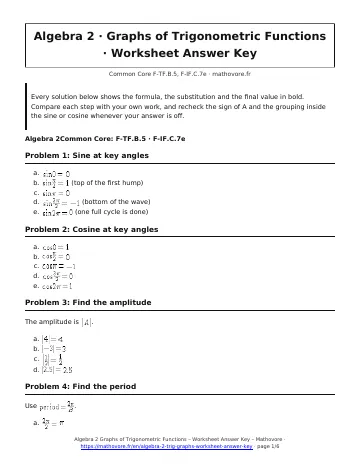
See every chapter on the Algebra 2 math page.