



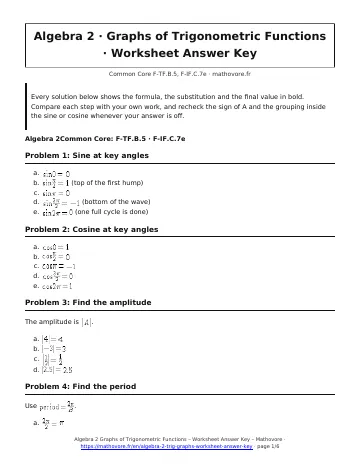
Every solution below shows the formula, the substitution and the final value in bold. Compare each step with your own work, and recheck the sign of A and the grouping inside the sine or cosine whenever your answer is off.
Problem 1: Sine at key angles
- \(\sin 0=\) \(0\)
- \(\sin\frac{\pi}{2}=\) \(1\) (top of the first hump)
- \(\sin\pi=\) \(0\)
- \(\sin\frac{3\pi}{2}=\) \(-1\) (bottom of the wave)
- \(\sin 2\pi=\) \(0\) (one full cycle is done)
Problem 2: Cosine at key angles
- \(\cos 0=\) \(1\)
- \(\cos\frac{\pi}{2}=\) \(0\)
- \(\cos\pi=\) \(-1\)
- \(\cos\frac{3\pi}{2}=\) \(0\)
- \(\cos 2\pi=\) \(1\)
Problem 3: Find the amplitude
The amplitude is \(|A|\).
- \(|4|=\) \(4\)
- \(|-3|=\) \(3\)
- \(|\frac{1}{2}|=\) \(\frac{1}{2}\)
- \(|2.5|=\) \(2.5\)
Problem 4: Find the period
Use \(\text{period}=\frac{2\pi}{B}\).
- \(\frac{2\pi}{2}=\) \(\pi\)
- \(\frac{2\pi}{4}=\) \(\frac{\pi}{2}\)
- Here \(B=\frac{1}{2}\), so \(2\pi: \frac{1}{2}=\) \(4\pi\)
- \(\frac{2\pi}{\pi}=\) \(2\)
- \(\frac{2\pi}{3}\): \(\frac{2\pi}{3}\)
Problem 5: Midline and range
The midline is \(y=D\); the range is \([D-|A|,\,D+|A|]\).
- Midline \(y=3\), range \([2,4]\)
- Midline \(y=-1\), range \([-1-2,\,-1+2]=\) \([-3,1]\)
- Midline \(y=2\), range \([2-4,\,2+4]=\) \([-2,6]\)
Problem 6: Read the phase shift
- Subtracting \(\frac{\pi}{4}\): right \(\frac{\pi}{4}\)
- Adding \(\frac{\pi}{3}\) means \(x-(-\frac{\pi}{3})\): left \(\frac{\pi}{3}\)
- The factored form \(2(x-\frac{\pi}{6})\) shows right \(\frac{\pi}{6}\) (the shift is not \(\frac{\pi}{3}\))
- right \(\frac{3\pi}{2}\)
Problem 7: Equation from a cosine graph
The maximum is \(3\) at \(x=0\), and \(\cos 0=1\), so \(A=3\). The minimum \(-3\) at \(x=\pi\) agrees.
\(A=3\), \(y=3\cos x\)
Problem 8: Midline from a graph
Maximum \(3\), minimum \(-1\). Midline \(=\frac{3+(-1)}{2}=1\). Amplitude \(=\frac{3-(-1)}{2}=2\).
Equation: \(y=2\sin x+1\)
Problem 9: Period from a graph
The graph completes one cycle between \(x=0\) and \(x=\pi\), so the period is \(\pi\). Then \(B=\frac{2\pi}{\pi}=2\). The maximum is \(2\), so \(A=2\).
Period \(\pi\), \(B=2\), \(y=2\cos(2x)\)
Problem 10: Evaluate a sinusoid
- \(2\cdot\frac{1}{2}+1=\) \(2\)
- \(2\cdot 1+1=\) \(3\)
- \(\sin\frac{7\pi}{6}=-\frac{1}{2}\), so \(2(-\frac{1}{2})+1=\) \(0\)
- \(2(-1)+1=\) \(-1\)
Problem 11: Maximum and minimum values
- Maximum \(2+5=\) \(7\), minimum \(2-5=\) \(-3\)
- Amplitude \(2\), midline \(-1\): maximum \(-1+2=\) \(1\), minimum \(-1-2=\) \(-3\)
Problem 12: Three features at once
Amplitude \(|3|=3\). Period \(\frac{2\pi}{4}=\frac{\pi}{2}\). Midline \(y=-2\).
Amplitude \(3\), period \(\frac{\pi}{2}\), midline \(y=-2\)
Problem 13: Plot key points
Values: \(3\sin 0=0\), \(3\sin\frac{\pi}{2}=3\), \(3\sin\pi=0\), \(3\sin\frac{3\pi}{2}=-3\), \(3\sin 2\pi=0\).
\(y\): \(0,\ 3,\ 0,\ -3,\ 0\)
Problem 14: All four features
Amplitude \(|-3|=3\). Period \(\frac{2\pi}{2}=\pi\). The factor is \(x+\frac{\pi}{4}=x-(-\frac{\pi}{4})\), so the shift is \(\frac{\pi}{4}\) to the left. Midline \(y=1\).
Maximum \(1+3=4\), minimum \(1-3=-2\) (the negative sign flips the wave but does not change these values).
Amplitude 3, period \(\pi\), left \(\frac{\pi}{4}\), midline \(y=1\), max 4, min \(-2\)
Problem 15: Write a sine equation
\(A=4\), \(D=1\), and \(B=\frac{2\pi}{\pi}=2\).
\(y=4\sin(2x)+1\)
Problem 16: Write a cosine equation
\(A=\frac{8-2}{2}=3\), \(D=\frac{8+2}{2}=5\), \(B=\frac{2\pi}{8}=\frac{\pi}{4}\).
\(y=3\cos(\frac{\pi}{4}x)+5\)
Check: at \(x=0\) the value is \(3+5=8\), the maximum.
Problem 17: Tide model
- Amplitude \(3\), period \(\frac{2\pi}{\pi/6}=12\) hours: \(12\), midline \(y=5\)
- Highest \(5+3=\) \(8\text{ ft}\), lowest \(5-3=\) \(2\text{ ft}\)
- \(D(2)=5+3\cos\frac{\pi}{3}=5+1.5=\) \(6.5\text{ ft}\); \(D(4)=5+3\cos\frac{2\pi}{3}=5-1.5=\) \(3.5\text{ ft}\)
Problem 18: Ferris wheel
- Period \(=\frac{2\pi}{\pi/20}=\) \(40\text{ s}\)
- Lowest \(28-25=\) \(3\text{ ft}\), highest \(28+25=\) \(53\text{ ft}\)
- \(h(10)=28-25\cos\frac{\pi}{2}=28-0=\) \(28\text{ ft}\); \(h(5)=28-25\cos\frac{\pi}{4}\approx 28-17.68=\) \(10.3\text{ ft}\)
Problem 19: Daylight hours
- Amplitude \(2.5\), period \(365\) days, midline \(y=12\), phase shift \(80\) days to the right
- Longest \(12+2.5=\) \(14.5\text{ h}\), shortest \(12-2.5=\) \(9.5\text{ h}\)
- \(D(125)=12+2.5\sin\frac{2\pi\cdot 45}{365}\approx 12+2.5(0.6967)\approx\) \(13.7\text{ h}\) (calculator in radian mode)
Problem 20: Bobbing buoy
- \(A=\frac{14-8}{2}=3\), \(D=\frac{14+8}{2}=11\), \(B=\frac{2\pi}{4}=\frac{\pi}{2}\): \(h(t)=3\cos(\frac{\pi}{2}t)+11\)
- \(h(1.5)=11+3\cos\frac{3\pi}{4}\approx 11-2.12=\) \(8.9\text{ ft}\)
- Set \(\cos(\frac{\pi}{2}t)=0\): \(\frac{\pi}{2}t=\frac{\pi}{2}\), so \(t=1\) second
Problem 21: Daily temperature
- The maximum is \(62+14=\) \(76^{\circ}\text{F}\) when \(\frac{\pi(t-9)}{12}=\frac{\pi}{2}\), so \(t=15\) (3 p.m.). The minimum is \(62-14=\) \(48^{\circ}\text{F}\) when the angle is \(-\frac{\pi}{2}\), so \(t=3\) (3 a.m.).
- \(T(12)=62+14\sin\frac{\pi}{4}\approx 62+9.90=\) \(71.9^{\circ}\text{F}\)
- Solve \(\sin(\frac{\pi(t-9)}{12})=0\): the angle is \(0\) or \(\pi\), so \(t=9\) and \(t=21\).
Problem 22: Spring and weight
- Amplitude \(6\text{ in}\), period \(\frac{2\pi}{2\pi/3}=\) \(3\text{ s}\)
- \(h(1)=30+6\cos\frac{2\pi}{3}=30-3=\) \(27\text{ in}\)
- Solve \(30+6\cos\frac{2\pi t}{3}=33\), so \(\cos\frac{2\pi t}{3}=\frac{1}{2}\). In one cycle the angle is \(\frac{\pi}{3}\) or \(\frac{5\pi}{3}\), giving \(t=\frac{1}{2}\) or \(t=\frac{5}{2}\): \(t=0.5\) s and \(t=2.5\) s
See every chapter on the Algebra 2 math page.