Key takeaway: This algebra 2 sequences series worksheet gives 24 printable problems on arithmetic and geometric sequences, recursive and explicit rules, sigma notation, series sums and finance applications. Standards A-SSE.B.4, F-BF.A.2 and F-IF.A.3 apply. Problems 1 to 9 write rules, problems 10 to 16 evaluate sums, and problems 17 to 24 model theater seating, a bouncing ball, raises and loans. Plan about 60 minutes.
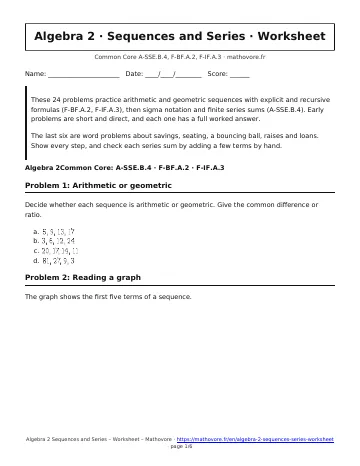
These 24 problems practice arithmetic and geometric sequences with explicit and recursive formulas (F-BF.A.2, F-IF.A.3), then sigma notation and finite series sums (A-SSE.B.4). Early problems are short and direct, and each one has a full worked answer.
The last six are word problems about savings, seating, a bouncing ball, raises and loans. Show every step, and check each series sum by adding a few terms by hand.
Algebra 2 Sequences Series Worksheet: problems 1–5
1. Arithmetic or geometric
Decide whether each sequence is arithmetic or geometric. Give the common difference or ratio.
- \(5,\,9,\,13,\,17\)
- \(3,\,6,\,12,\,24\)
- \(20,\,17,\,14,\,11\)
- \(81,\,27,\,9,\,3\)
2. Reading a graph
The graph shows the first five terms of a sequence.
- Decide whether the sequence is arithmetic or geometric.
- Write an explicit formula for \(a_{n}\).
- Find \(a_{12}\).
3. Explicit arithmetic rule
An arithmetic sequence has \(a_{1}=7\) and common difference \(d=5\). Write an explicit formula for \(a_{n}\) and find \(a_{20}\).
4. Explicit geometric rule
A geometric sequence has \(a_{1}=3\) and common ratio \(r=2\). Write an explicit formula for \(a_{n}\) and find \(a_{10}\).
5. Terms from a recursive rule
Write the first five terms of each sequence.
- \(a_{1}=4,\quad a_{n}=-2\cdot a_{n-1}\)
- \(b_{1}=50,\quad b_{n}=b_{n-1}-6\)
Algebra 2 Sequences Series Worksheet: problems 6–10
6. Writing a recursive rule
Write a recursive formula for each sequence.
- \(12,\,19,\,26,\,33\)
- \(80,\,40,\,20,\,10\)
7. How many terms
An arithmetic sequence starts \(8,\,13,\,18\) and continues with common difference 5 until its last term, 163. How many terms does it have?
8. Rule from two terms
An arithmetic sequence has \(a_{2}=9\) and \(a_{7}=39\). Find the common difference, \(a_{1}\), and an explicit formula.
9. Geometric from two terms
A geometric sequence of positive numbers has \(a_{2}=12\) and \(a_{5}=324\). Find \(r\), \(a_{1}\), and \(a_{8}\).
10. Evaluating sigma notation
Evaluate \(\sum_{k=1}^{6}(2k+1)\).
Algebra 2 Sequences Series Worksheet: problems 11–15
11. Geometric sigma
Evaluate \(\sum_{k=1}^{4}2\cdot 3^{k-1}\).
12. Writing sigma notation
Write each series in sigma notation.
- \(6+10+14+18+22\)
- \(3+6+12+24+48+96\)
13. Arithmetic series sum
Find the sum of the arithmetic series that starts \(4+9+14\) and continues with common difference 5 until the last term, 99.
14. Geometric series sum
Find the sum of the first 8 terms of the geometric series \(5+10+20+40\) that continues with ratio 2.
15. Ratio less than 1
Find the sum of the first 6 terms of the geometric series \(81+27+9+3\) that continues with ratio \(\frac{1}{3}\).
Algebra 2 Sequences Series Worksheet: problems 16–20
16. Finding the number of terms
An arithmetic series has \(a_{1}=2\) and \(d=3\). How many terms must be added to reach a sum of 155?
17. Weekly savings
Maya saves $5 in week 1. Each week after that she saves $3 more than the week before.
- How much does she save in week 12?
- How much has she saved in total after 12 weeks?
18. Theater seating
A school theater has 18 rows. Row 1 has 14 seats and each row has 2 more seats than the row in front of it.
- How many seats are in row 18?
- How many seats are in the theater?
19. Bouncing ball
Jamal drops a ball from a height of 10 feet. After each bounce, the ball rises to 60% of the height of the previous bounce.
- Write an explicit formula for the height of bounce \(n\).
- Find the height of the fifth bounce.
- Find the sum of the first five bounce heights.
20. Chain email
Noah emails a joke to 3 friends on day 1. On each following day, every person who got the joke the day before forwards it to 3 new people.
- How many people receive the joke on day 7?
- How many people have received it in total by the end of day 7?
Algebra 2 Sequences Series Worksheet: problems 21–24
21. Raises over ten years
Aisha starts a job at $42,000 per year and receives a 3% raise at the start of each year after the first. Round to the nearest cent.
- Find her salary in year 10.
- Find her total earnings over the first 10 years.
22. Savings account
Priya deposits $200 at the end of every month into an account that earns 0.5% interest per month. Find the balance right after her 12th deposit.
23. Car loan
Diego pays $300 per month for 36 months to repay a car loan at 0.5% interest per month. The amount borrowed equals the value today of all 36 payments, where a payment made \(k\) months from now is worth \(300(1.005)^{-k}\) today.
- Find the amount he borrowed.
- Find the total interest he pays.
24. Mortgage payment
Mei takes out a $150,000 mortgage for 15 years at 6% annual interest, which is 0.5% per month. The loan amount equals the value today of all 180 equal monthly payments \(M\).
- Write the loan amount as a geometric series sum in terms of \(M\), then find \(M\) to the nearest cent.
- Find the total amount paid over 15 years and the total interest.

How do the first nine problems build rules?
Problem 1 classifies sequences like 5, 9, 13, 17 and states the difference or ratio. Then problem 3 gives \(a_{1}=7\) and \(d=5\), so \(a_{n}=5n+2\). The geometric version with \(a_{1}=3\) and \(r=2\) is \(3\cdot 2^{n-1}\). In problem 8, two terms, \(a_{2}=9\) and \(a_{7}=39\), give \(d=6\) and \(a_{n}=6n-3\). Problem 9 finds \(r=3\) from \(a_{2}=12\) and \(a_{5}=324\).
Which sum problems need care?
Problem 10 evaluates \(\sum_{k=1}^{6}(2k+1)\), which is 48. Problem 14 sums eight terms of \(5+10+20+\cdots\) to get 1275. For problem 15, the ratio is \(\frac{1}{3}\), so the six-term sum is about 121.33. Problem 16 asks how many terms of an arithmetic series reach 155, so solve \(3n^{2}+n-310=0\) and keep the positive root, 10.
What do the finance problems teach?
Raises of 3% a year form a geometric pattern, so the tenth-year salary uses \(42000(1.03)^{9}\). Priya’s monthly deposits and Diego’s car loan both sum a geometric series with ratio 1.005. The theater has 18 rows starting at 14 seats with 2 more per row, so row 18 has 48 seats and the total is 558. Finally, a mortgage payment problem asks you to work backward from the present value.
How should you wrap up this practice?
Sort your answers into rule problems, sum problems and application problems, and rate each group from easy to hard. Then redo one problem from the hardest group. If a formula slipped from memory, rebuild it from the first three terms. After that, check the key and try the quiz.

See every chapter on the Algebra 2 math page.