



Every solution shows the formula, the substitution and a final answer in bold. Compare your steps as well as your results, and recheck sums by listing a few terms.
Problem 1: Arithmetic or geometric
- Differences: \(9-5=4\), \(13-9=4\), \(17-13=4\). Arithmetic, \(d=4\).
- Differences \(3,\,6,\,12\) are not equal; ratios \(\frac{6}{3}=\frac{12}{6}=\frac{24}{12}=2\). Geometric, \(r=2\).
- Differences are all \(-3\). Arithmetic, \(d=-3\).
- Ratios: \(\frac{27}{81}=\frac{9}{27}=\frac{3}{9}=\frac{1}{3}\). Geometric, \(r=\frac{1}{3}\).
Problem 2: Reading a graph
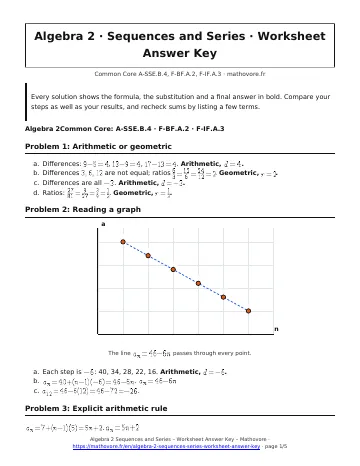
- Each step is \(-6\): 40, 34, 28, 22, 16. Arithmetic, \(d=-6\).
- \(a_{n}=40+(n-1)(-6)=46-6n\). \(a_{n}=46-6n\)
- \(a_{12}=46-6(12)=46-72=\)\(-26\).
Problem 3: Explicit arithmetic rule
\(a_{n}=7+(n-1)(5)=5n+2\). \(a_{n}=5n+2\)
\(a_{20}=5(20)+2=\)\(102\).
Problem 4: Explicit geometric rule
\(a_{n}=3\cdot 2^{n-1}\)
\(a_{10}=3\cdot 2^{9}=3\cdot 512=\)\(1536\).
Problem 5: Terms from a recursive rule
- Multiply by \(-2\) each time: \(4,\,-8,\,16,\,-32,\,64\).
- Subtract 6 each time: \(50,\,44,\,38,\,32,\,26\).
Problem 6: Writing a recursive rule
- Differences are all 7: \(a_{1}=12,\quad a_{n}=a_{n-1}+7\).
- Ratios are all \(\frac{1}{2}\): \(a_{1}=80,\quad a_{n}=\frac{1}{2}a_{n-1}\).
Problem 7: How many terms
Solve \(8+(n-1)(5)=163\): \(5(n-1)=155\), so \(n-1=31\). \(n=32\) terms.
Problem 8: Rule from two terms
From \(a_{2}\) to \(a_{7}\) there are 5 steps: \(5d=39-9=30\), so \(d=6\).
\(a_{1}=9-6=\)\(3\). Then \(a_{n}=3+6(n-1)=\)\(6n-3\). Check: \(a_{7}=6(7)-3=39\).
Problem 9: Geometric from two terms
From \(a_{2}\) to \(a_{5}\) there are 3 steps: \(r^{3}=\frac{324}{12}=27\), so \(r=3\).
\(a_{1}=\frac{12}{3}=\)\(4\). Then \(a_{8}=4\cdot 3^{7}=4\cdot 2187=\)\(8748\).
Problem 10: Evaluating sigma notation
Substitute \(k=1,\,2,\,3,\,4,\,5,\,6\): \(3+5+7+9+11+13=\)\(48\).
Check with the formula: \(\frac{6(3+13)}{2}=48\).
Problem 11: Geometric sigma
Terms: \(2,\,6,\,18,\,54\). Sum: \(80\).
Check: \(\frac{2(1-3^{4})}{1-3}=\frac{2(-80)}{-2}=80\).
Problem 12: Writing sigma notation
- Arithmetic with \(a_{1}=6\), \(d=4\): the rule is \(4k+2\). \(\sum_{k=1}^{5}(4k+2)\).
- Geometric with \(a_{1}=3\), \(r=2\): the rule is \(3\cdot 2^{k-1}\). \(\sum_{k=1}^{6}3\cdot 2^{k-1}\).
Problem 13: Arithmetic series sum
Number of terms: \(4+5(n-1)=99\) gives \(n=20\).
\(S_{20}=\frac{20(4+99)}{2}=10\cdot 103=\)\(1030\).
Problem 14: Geometric series sum
\(S_{8}=\frac{5(1-2^{8})}{1-2}=\frac{5(-255)}{-1}=\)\(1275\).
Problem 15: Ratio less than 1
\(S_{6}=\frac{81(1-(\frac{1}{3})^{6})}{1-\frac{1}{3}}=\frac{81\cdot\frac{728}{729}}{\frac{2}{3}}=\frac{\frac{728}{9}}{\frac{2}{3}}=\)\(\frac{364}{3}\), or about 121.33.
Check by adding: \(81+27+9+3+1+\frac{1}{3}=121\frac{1}{3}\).
Problem 16: Finding the number of terms
\(S_{n}=\frac{n}{2}(2a_{1}+(n-1)d)=\frac{n}{2}(4+3n-3)=\frac{n(3n+1)}{2}\).
Set equal to 155: \(3n^{2}+n=310\), so \(3n^{2}+n-310=0\), which factors as \((3n+31)(n-10)=0\).
\(n=-\frac{31}{3}\) is impossible, so \(n=10\) terms. Check: \(a_{10}=29\) and \(\frac{10(2+29)}{2}=155\).
Problem 17: Weekly savings
- \(a_{12}=5+11(3)=38\). $38.
- \(S_{12}=\frac{12(5+38)}{2}=6\cdot 43=258\). $258.
Problem 18: Theater seating
- \(a_{18}=14+17(2)=48\). 48 seats.
- \(S_{18}=\frac{18(14+48)}{2}=9\cdot 62=558\). 558 seats.
Problem 19: Bouncing ball
- Bounce 1 is \(10(0.6)=6\) feet, with ratio 0.6: \(h_{n}=6(0.6)^{n-1}\).
- \(h_{5}=6(0.6)^{4}=6(0.1296)=\)0.7776 ft.
- \(S_{5}=\frac{6(1-0.6^{5})}{1-0.6}=\frac{6(0.92224)}{0.4}=\)13.8336 ft.
Problem 20: Chain email
- Geometric with \(a_{1}=3\), \(r=3\): \(a_{7}=3\cdot 3^{6}=2187\). 2,187 people.
- \(S_{7}=\frac{3(1-3^{7})}{1-3}=\frac{3(-2186)}{-2}=3279\). 3,279 people.
Problem 21: Raises over ten years
Salaries form a geometric sequence with \(a_{1}=42000\) and \(r=1.03\).
- \(a_{10}=42000(1.03)^{9}\approx \$54,800.47\). $54,800.47.
- \(S_{10}=\frac{42000(1.03^{10}-1)}{0.03}\approx \$481,482.93\). $481,482.93 earned in 10 years.
Problem 22: Savings account
The last deposit earns no interest and the first earns interest for 11 months. The values form a geometric series with \(a_{1}=200\), \(r=1.005\), \(n=12\).
\(S_{12}=\frac{200(1.005^{12}-1)}{0.005}\approx \$2,467.11\). $2,467.11.
Problem 23: Car loan
The values form a geometric series with \(a_{1}=\frac{300}{1.005}\), \(r=\frac{1}{1.005}\), \(n=36\).
- \(P=300\cdot\frac{1-1.005^{-36}}{0.005}\approx \$9,861.30\). $9,861.30.
- Total paid: \(300\cdot 36=\$10{,}800\). Interest: \(10800-9861.30\approx \$938.70\). $938.70.
Problem 24: Mortgage payment
Payment \(k\) is worth \(M(1.005)^{-k}\) today. The sum of 180 of these is \(M\cdot\frac{1-1.005^{-180}}{0.005}\), and it equals 150,000.
- \(M=\frac{150000(0.005)}{1-1.005^{-180}}\approx \$1,265.79\). $1,265.79 per month.
- Total paid: \(1265.79\cdot 180=\$227,842.20\). Interest: $77,842.20.
See every chapter on the Algebra 2 math page.