This algebra 2 exponential worksheet answer key solves all 23 problems of the solving exponential and logarithmic equations worksheet step by step.
Each solution shows the isolating, logging and checking steps. If your decimal differs in the last digit, keep more digits in your calculator until the final step.
Algebra 2 Exponential Worksheet Answer Key: problems 1–5
Problem 1: Same base
- \(2^{5}=32\), so \(x=5\)
- \(3^{4}=81\), so \(x=4\)
- \(5^{-3}=\frac{1}{125}\), so \(x=-3\)
- \(2^{2x}=2^{3}\), so \(2x=3\) and \(x=\frac{3}{2}\)
Problem 2: Rewrite to a common base
- \(2^{3x-1}=2^{6}\), so \(3x-1=6\) and \(x=\frac{7}{3}\)
- \(3^{2x}=3^{3x-3}\), so \(2x=3x-3\) and \(x=3\)
- \(2^{-2x-2}=2^{4}\), so \(-2x-2=4\) and \(x=-3\)
- \(2^{3x}=2^{-5}\), so \(3x=-5\) and \(x=-\frac{5}{3}\)
Problem 3: Logarithmic to exponential form
- \(x=6^{2}=\)36
- \(x=2^{-4}=\)\(\frac{1}{16}\)
- \(x=4^{3/2}=(4^{1/2})^{3}=2^{3}=\)8
- \(x=e^{3}\approx\)20.086
Problem 4: One-step exponential equations
- \(x=\frac{\ln 20}{\ln 3}\approx\)2.7268
- \(x=\frac{\ln 100}{\ln 2}\approx\)6.6439
- \(x=\log 45\approx\)1.6532
- \(x=\ln 12\approx\)2.4849
Problem 5: Isolate the power first
- \(5^{x}=25\), so \(x=2\)
- \(3\cdot 2^{x}=48\), \(2^{x}=16\), so \(x=4\)
- \(1.5^{x}=\frac{50}{7}\), so \(x=\frac{\ln(50/7)}{\ln 1.5}\approx\frac{1.9661}{0.4055}\approx\)4.849
Algebra 2 Exponential Worksheet Answer Key: problems 6–10
Problem 6: Exponents with a coefficient
- \(3x=\frac{\ln 50}{\ln 2}\approx 5.6439\), so \(x\approx 1.881\)
- \(2x-1=\frac{\ln 40}{\ln 5}\approx 2.2920\), \(2x\approx 3.2920\), so \(x\approx 1.646\)
Problem 7: Equations with base e
- \(e^{2x}=15\), \(2x=\ln 15\), so \(x\approx 1.3540\)
- \(5e^{0.3x}=20\), \(e^{0.3x}=4\), \(0.3x=\ln 4\), so \(x=\frac{\ln 4}{0.3}\approx 4.6210\)
Problem 8: Solve a formula for time
- \(\frac{A}{P}=e^{rt}\), so \(\ln\frac{A}{P}=rt\) and \(t=\frac{\ln(A/P)}{r}\). With the values: \\(t=\\frac{\\ln 1.75}{0.05}\\approx\\)11.19 years.
- \(\frac{A}{P}=(1+r)^{t}\), so \(t=\frac{\ln(A/P)}{\ln(1+r)}\). With the values: \\(t=\\frac{\\ln 1.75}{\\ln 1.05}\\approx\\frac{0.5596}{0.0488}\\approx\\)11.47 years.
Problem 9: Simple logarithmic equations
- \(x+5=2^{4}=16\), so \(x=11\)
- \(2x-1=3^{2}=9\), so \(x=5\)
- \(x-4=10^{1}\), so \(x=14\)
- \(3x=e^{2}\), so \(x=\frac{e^{2}}{3}\approx\)2.463
Problem 10: Isolate the logarithm
- \(3\log_{2} x=12\), \(\log_{2} x=4\), so \(x=16\)
- \(\ln(x+1)=3\), \(x+1=e^{3}\), so \(x=e^{3}-1\approx\)19.086
- \(4\log_{5}(x-2)=8\), \(\log_{5}(x-2)=2\), \(x-2=25\), so \(x=27\)
Algebra 2 Exponential Worksheet Answer Key: problems 11–15
Problem 11: Equal logarithms
- \(3x+1=x+9\), \(2x=8\), so \(x=4\). Check: \(13\) and \(13\) are both positive.
- \(2x-3=x+5\), so \(x=8\). Check: \(13\) and \(13\).
- \(x^{2}=5x-6\), \(x^{2}-5x+6=0\), \((x-2)(x-3)=0\). Both work: \(x=2\) gives \(4\) and \(4\); \(x=3\) gives \(9\) and \(9\). \(x=2\) or \(x=3\)
Problem 12: Add two logarithms
- \(\log_{2}(x(x-6))=4\), so \(x^{2}-6x=16\) and \(x^{2}-6x-16=0\). Then \((x-8)(x+2)=0\). \(x=-2\) is extraneous because \(\log_{2}(-2)\) is undefined. \(x=8\). Check: \(3+1=4\).
- \(x(x+6)=27\), \(x^{2}+6x-27=0\), \((x+9)(x-3)=0\). \(x=-9\) is extraneous. \(x=3\). Check: \(1+2=3\).
Problem 13: Subtract two logarithms
- \(\log_{3}\frac{x+8}{x}=2\), so \(\frac{x+8}{x}=9\), \(x+8=9x\), and \(x=1\). Check: \(\log_{3} 9-\log_{3} 1=2\).
- \(\frac{x+5}{x-1}=3\), \(x+5=3x-3\), \(2x=8\), so \(x=4\). Check: \(\ln 9-\ln 3=\ln 3\).
Problem 14: Reject extraneous solutions
- \(x(x-3)=10\), \(x^{2}-3x-10=0\), \((x-5)(x+2)=0\). \(x=5\); \(x=-2\) is extraneous.
- \((x+2)(x-1)=4\), \(x^{2}+x-6=0\), \((x+3)(x-2)=0\). \(x=2\); \(x=-3\) is extraneous.
Problem 15: Quadratic form
Since \(2^{2x}=u^{2}\), the equation is \(u^{2}-6u+8=0\), so \((u-2)(u-4)=0\) and \(u=2\) or \(u=4\). Then \(2^{x}=2\) gives \(x=1\) and \(2^{x}=4\) gives \(x=2\). The solutions are \(x=1\) and \(x=2\), the x-intercepts of the graph.
Algebra 2 Exponential Worksheet Answer Key: problems 16–20
Problem 16: Quadratic form with e
Let \(u=e^{x}\): \(u^{2}-5u+6=0\), \((u-2)(u-3)=0\). Then \(e^{x}=2\) and \(e^{x}=3\), so \(x=\ln 2\approx 0.6931\) or \(x=\ln 3\approx 1.0986\).
Problem 17: Equivalent growth rates
\(1.035^{t}=e^{t\ln 1.035}\), so \(k=\ln 1.035\approx\)0.0344, giving \(P(t)=12000e^{0.0344t}\).
Monthly factor: \(1.035^{1/12}\approx 1.00287\), so the rate is about 0.287% per month.
Problem 18: Bacteria growth
\(200(1.08)^{t}=1000\), \(1.08^{t}=5\), \(t=\frac{\ln 5}{\ln 1.08}\approx\frac{1.6094}{0.0770}\approx\)20.91 hours.
Doubling: \(1.08^{t}=2\), \(t=\frac{\ln 2}{\ln 1.08}\approx\)9.01 hours.
Problem 19: Compound interest
\(3000(1.01125)^{4t}=5000\), so \(1.01125^{4t}=\frac{5}{3}\). Then \(4t=\frac{\ln(5/3)}{\ln 1.01125}\approx\frac{0.5108}{0.01119}\approx 45.66\), so \(t\approx 11.42\) years.
Problem 20: Continuous compounding
Double: \(e^{0.032t}=2\), \(t=\frac{\ln 2}{0.032}\approx\)21.66 years.
\$4,000: \(e^{0.032t}=\frac{8}{3}\), \(t=\frac{\ln(8/3)}{0.032}\approx\frac{0.9808}{0.032}\approx\)30.65 years.
Algebra 2 Exponential Worksheet Answer Key: problems 21–23
Problem 21: Medicine half-life
\((\frac{1}{2})^{t/6}=\frac{15}{200}=0.075\). Then \(\frac{t}{6}=\frac{\ln 0.075}{\ln 0.5}\approx 3.737\), so \(t\approx 22.42\) hours.
Problem 22: Earthquake comparison
- The difference is \(7.6-5.2=2.4\), so the ratio is \(10^{2.4}\approx\)251 times .
- \(M=5.2+\log 250\approx 5.2+2.398=\)7.6.
Problem 23: pH and decibels
- \(-\log[H^{+}]=3.8\), so \([H^{+}]=10^{-3.8}\approx\)\(1.58\times 10^{-4}\) mol/L.
- \(\log\frac{I}{I_{0}}=9.5\), so \(\frac{I}{I_{0}}=10^{9.5}\approx\)\(3.16\times 10^{9}\).
How to use this algebra 2 exponential worksheet answer key
Read this algebra 2 exponential worksheet answer key after trying each problem yourself, and redo any problem you missed.

Printable PDF · Worksheet Answer Key
Algebra 2 Solving Exponential and Logarithmic Equations worksheet answer key
Download the PDF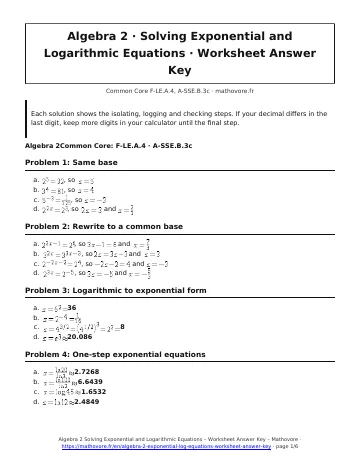
See every chapter on the Algebra 2 math page.