



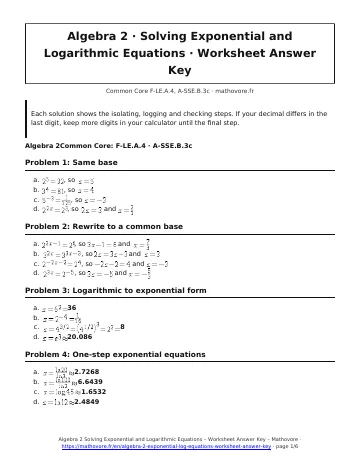
Each solution shows the isolating, logging and checking steps. If your decimal differs in the last digit, keep more digits in your calculator until the final step.
Problem 1: Same base
- \(2^{5}=32\), so \(x=5\)
- \(3^{4}=81\), so \(x=4\)
- \(5^{-3}=\frac{1}{125}\), so \(x=-3\)
- \(2^{2x}=2^{3}\), so \(2x=3\) and \(x=\frac{3}{2}\)
Problem 2: Rewrite to a common base
- \(2^{3x-1}=2^{6}\), so \(3x-1=6\) and \(x=\frac{7}{3}\)
- \(3^{2x}=3^{3x-3}\), so \(2x=3x-3\) and \(x=3\)
- \(2^{-2x-2}=2^{4}\), so \(-2x-2=4\) and \(x=-3\)
- \(2^{3x}=2^{-5}\), so \(3x=-5\) and \(x=-\frac{5}{3}\)
Problem 3: Logarithmic to exponential form
- \(x=6^{2}=\)36
- \(x=2^{-4}=\)\(\frac{1}{16}\)
- \(x=4^{3/2}=(4^{1/2})^{3}=2^{3}=\)8
- \(x=e^{3}\approx\)20.086
Problem 4: One-step exponential equations
- \(x=\frac{\ln 20}{\ln 3}\approx\)2.7268
- \(x=\frac{\ln 100}{\ln 2}\approx\)6.6439
- \(x=\log 45\approx\)1.6532
- \(x=\ln 12\approx\)2.4849
Problem 5: Isolate the power first
- \(5^{x}=25\), so \(x=2\)
- \(3\cdot 2^{x}=48\), \(2^{x}=16\), so \(x=4\)
- \(1.5^{x}=\frac{50}{7}\), so \(x=\frac{\ln(50/7)}{\ln 1.5}\approx\frac{1.9661}{0.4055}\approx\)4.849
Problem 6: Exponents with a coefficient
- \(3x=\frac{\ln 50}{\ln 2}\approx 5.6439\), so \(x\approx 1.881\)
- \(2x-1=\frac{\ln 40}{\ln 5}\approx 2.2920\), \(2x\approx 3.2920\), so \(x\approx 1.646\)
Problem 7: Equations with base e
- \(e^{2x}=15\), \(2x=\ln 15\), so \(x\approx 1.3540\)
- \(5e^{0.3x}=20\), \(e^{0.3x}=4\), \(0.3x=\ln 4\), so \(x=\frac{\ln 4}{0.3}\approx 4.6210\)
Problem 8: Solve a formula for time
- \(\frac{A}{P}=e^{rt}\), so \(\ln\frac{A}{P}=rt\) and \(t=\frac{\ln(A/P)}{r}\). With the values: \\(t=\\frac{\\ln 1.75}{0.05}\\approx\\)11.19 years.
- \(\frac{A}{P}=(1+r)^{t}\), so \(t=\frac{\ln(A/P)}{\ln(1+r)}\). With the values: \\(t=\\frac{\\ln 1.75}{\\ln 1.05}\\approx\\frac{0.5596}{0.0488}\\approx\\)11.47 years.
Problem 9: Simple logarithmic equations
- \(x+5=2^{4}=16\), so \(x=11\)
- \(2x-1=3^{2}=9\), so \(x=5\)
- \(x-4=10^{1}\), so \(x=14\)
- \(3x=e^{2}\), so \(x=\frac{e^{2}}{3}\approx\)2.463
Problem 10: Isolate the logarithm
- \(3\log_{2} x=12\), \(\log_{2} x=4\), so \(x=16\)
- \(\ln(x+1)=3\), \(x+1=e^{3}\), so \(x=e^{3}-1\approx\)19.086
- \(4\log_{5}(x-2)=8\), \(\log_{5}(x-2)=2\), \(x-2=25\), so \(x=27\)
Problem 11: Equal logarithms
- \(3x+1=x+9\), \(2x=8\), so \(x=4\). Check: \(13\) and \(13\) are both positive.
- \(2x-3=x+5\), so \(x=8\). Check: \(13\) and \(13\).
- \(x^{2}=5x-6\), \(x^{2}-5x+6=0\), \((x-2)(x-3)=0\). Both work: \(x=2\) gives \(4\) and \(4\); \(x=3\) gives \(9\) and \(9\). \(x=2\) or \(x=3\)
Problem 12: Add two logarithms
- \(\log_{2}(x(x-6))=4\), so \(x^{2}-6x=16\) and \(x^{2}-6x-16=0\). Then \((x-8)(x+2)=0\). \(x=-2\) is extraneous because \(\log_{2}(-2)\) is undefined. \(x=8\). Check: \(3+1=4\).
- \(x(x+6)=27\), \(x^{2}+6x-27=0\), \((x+9)(x-3)=0\). \(x=-9\) is extraneous. \(x=3\). Check: \(1+2=3\).
Problem 13: Subtract two logarithms
- \(\log_{3}\frac{x+8}{x}=2\), so \(\frac{x+8}{x}=9\), \(x+8=9x\), and \(x=1\). Check: \(\log_{3} 9-\log_{3} 1=2\).
- \(\frac{x+5}{x-1}=3\), \(x+5=3x-3\), \(2x=8\), so \(x=4\). Check: \(\ln 9-\ln 3=\ln 3\).
Problem 14: Reject extraneous solutions
- \(x(x-3)=10\), \(x^{2}-3x-10=0\), \((x-5)(x+2)=0\). \(x=5\); \(x=-2\) is extraneous.
- \((x+2)(x-1)=4\), \(x^{2}+x-6=0\), \((x+3)(x-2)=0\). \(x=2\); \(x=-3\) is extraneous.
Problem 15: Quadratic form
Since \(2^{2x}=u^{2}\), the equation is \(u^{2}-6u+8=0\), so \((u-2)(u-4)=0\) and \(u=2\) or \(u=4\). Then \(2^{x}=2\) gives \(x=1\) and \(2^{x}=4\) gives \(x=2\). The solutions are \(x=1\) and \(x=2\), the x-intercepts of the graph.
Problem 16: Quadratic form with e
Let \(u=e^{x}\): \(u^{2}-5u+6=0\), \((u-2)(u-3)=0\). Then \(e^{x}=2\) and \(e^{x}=3\), so \(x=\ln 2\approx 0.6931\) or \(x=\ln 3\approx 1.0986\).
Problem 17: Equivalent growth rates
\(1.035^{t}=e^{t\ln 1.035}\), so \(k=\ln 1.035\approx\)0.0344, giving \(P(t)=12000e^{0.0344t}\).
Monthly factor: \(1.035^{1/12}\approx 1.00287\), so the rate is about 0.287% per month.
Problem 18: Bacteria growth
\(200(1.08)^{t}=1000\), \(1.08^{t}=5\), \(t=\frac{\ln 5}{\ln 1.08}\approx\frac{1.6094}{0.0770}\approx\)20.91 hours.
Doubling: \(1.08^{t}=2\), \(t=\frac{\ln 2}{\ln 1.08}\approx\)9.01 hours.
Problem 19: Compound interest
\(3000(1.01125)^{4t}=5000\), so \(1.01125^{4t}=\frac{5}{3}\). Then \(4t=\frac{\ln(5/3)}{\ln 1.01125}\approx\frac{0.5108}{0.01119}\approx 45.66\), so \(t\approx 11.42\) years.
Problem 20: Continuous compounding
Double: \(e^{0.032t}=2\), \(t=\frac{\ln 2}{0.032}\approx\)21.66 years.
\$4,000: \(e^{0.032t}=\frac{8}{3}\), \(t=\frac{\ln(8/3)}{0.032}\approx\frac{0.9808}{0.032}\approx\)30.65 years.
Problem 21: Medicine half-life
\((\frac{1}{2})^{t/6}=\frac{15}{200}=0.075\). Then \(\frac{t}{6}=\frac{\ln 0.075}{\ln 0.5}\approx 3.737\), so \(t\approx 22.42\) hours.
Problem 22: Earthquake comparison
- The difference is \(7.6-5.2=2.4\), so the ratio is \(10^{2.4}\approx\)251 times .
- \(M=5.2+\log 250\approx 5.2+2.398=\)7.6.
Problem 23: pH and decibels
- \(-\log[H^{+}]=3.8\), so \([H^{+}]=10^{-3.8}\approx\)\(1.58\times 10^{-4}\) mol/L.
- \(\log\frac{I}{I_{0}}=9.5\), so \(\frac{I}{I_{0}}=10^{9.5}\approx\)\(3.16\times 10^{9}\).
See every chapter on the Algebra 2 math page.