
This algebra 2 inverse functions lesson explains function operations, composition and inverses in one printable page, with definitions, a method and a worked example.
An inverse function reverses another function: if f sends a to b, then f inverse sends b back to a. To find it, write y = f(x), swap x and y, and solve for y. Check with composition, because f(f inverse(x)) and f inverse(f(x)) must both equal x. The graphs are mirror images across the line y = x.
Algebra 2 Inverse Functions Lesson: key facts
- Composition: (f ∘ g)(x) = f(g(x)); the inner function g runs first and order usually matters.
- Inverse method: write y = f(x), swap x and y, solve for y, rename it f⁻¹(x).
- Two functions are inverses when f(g(x)) = x and g(f(x)) = x for every x in the domains.
- The graph of f⁻¹ is the reflection of the graph of f across the line y = x; points (a, b) become (b, a).
- Only one-to-one functions have inverses; restrict the domain (such as x ≥ 0 for x²) when needed.
How do you combine functions with operations and composition?
Functions can be added, subtracted, multiplied, and divided output by output: \((f+g)(x)=f(x)+g(x)\), \((fg)(x)=f(x)\cdot g(x)\), and \((\frac{f}{g})(x)=\frac{f(x)}{g(x)}\) where \(g(x)\neq 0\). Composition, written f ∘ g, sends the output of one function into another: the value of f ∘ g at \(x\) is \(f(g(x))\).
In \(f(g(x))\) the inner function \(g\) runs first. The domain of the composite is every \(x\) in the domain of \(g\) for which \(g(x)\) is in the domain of \(f\). In general \(f(g(x))\neq g(f(x))\).
For \(f(x)=2x+3\) and \(g(x)=x^{2}-1\):
| Combination | Result |
|---|---|
| \((f+g)(x)\) | \(x^{2}+2x+2\) |
| \((f-g)(x)\) | \(-x^{2}+2x+4\) |
| \((fg)(x)\) | \(2x^{3}+3x^{2}-2x-3\) |
| \(f(g(x))\) | \(2x^{2}+1\) |
| \(g(f(x))\) | \(4x^{2}+12x+8\) |
How do you find the inverse of a function?
The inverse function \(f^{-1}\) undoes \(f\): \(f^{-1}(f(x))=x\) and \(f(f^{-1}(x))=x\). The \(-1\) is a label, not an exponent, so \(f^{-1}(x)\) is not \(\frac{1}{f(x)}\). Only a one-to-one function, one that passes the horizontal line test, has an inverse function.
Worked example: find the inverse of \(f(x)=\frac{2x+1}{3}\).
- Write \(y=\frac{2x+1}{3}\).
- Swap the variables: \(x=\frac{2y+1}{3}\).
- Solve for \(y\): \(3x=2y+1\), so \(y=\frac{3x-1}{2}\).
- Name it: \(f^{-1}(x)=\frac{3x-1}{2}\).
Check by composition: \(f(\frac{3x-1}{2})=\frac{(3x-1)+1}{3}=x\).
What does the graph of an inverse look like?
Swapping \(x\) and \(y\) turns each point \((a,b)\) of \(f\) into the point \((b,a)\) of \(f^{-1}\). So the two graphs are reflections of each other across the line \(y=x\), and the domain of \(f\) becomes the range of \(f^{-1}\).
A function that fails the horizontal line test can still be inverted on a restricted domain. The parabola \(f(x)=x^{2}\) is not one-to-one, but on \(x\ge 0\) its inverse is \(f^{-1}(x)=\sqrt{x}\).
Function Operations, Composition and Inverses: frequently asked questions
Is f⁻¹(x) the same as 1/f(x)?
No. The notation f⁻¹ means the inverse function, which undoes f. For f(x) = 2x the inverse is f⁻¹(x) = x/2, while the reciprocal is 1/(2x). These are different functions.
Does the order of composition matter?
Usually yes. For f(x) = x + 1 and g(x) = x², f(g(2)) = 5 but g(f(2)) = 9. The inner function always runs first.
How can you tell whether a function has an inverse function?
Apply the horizontal line test: if every horizontal line meets the graph at most once, the function is one-to-one and has an inverse. Functions that are always increasing or always decreasing pass the test.
How do you check that two functions are inverses?
Compute f(g(x)) and g(f(x)). If both simplify to x, they are inverses. For f(x) = 5x + 3 and g(x) = (x − 3)/5, both compositions give x.
Why do you restrict the domain before finding an inverse?
A function such as f(x) = x² sends both 2 and −2 to 4, so the inverse would not be a function. Restricting to x ≥ 0 makes the function one-to-one, and the inverse is √x.
How to use this algebra 2 inverse functions lesson
Use this algebra 2 inverse functions lesson before the worksheet, then check what you learned with the quiz.

Printable PDF · Lesson
Algebra 2 Function Operations, Composition and Inverses lesson
Download the PDF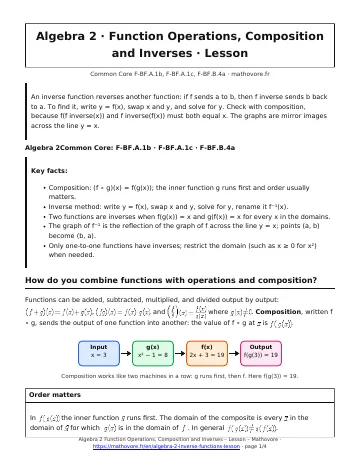
See every chapter on the Algebra 2 math page.