



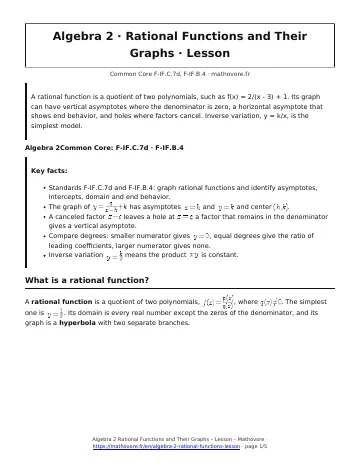
A rational function is a quotient of two polynomials, such as f(x) = 2/(x – 3) + 1. Its graph can have vertical asymptotes where the denominator is zero, a horizontal asymptote that shows end behavior, and holes where factors cancel. Inverse variation, y = k/x, is the simplest model.
Key facts:
- Standards F-IF.C.7d and F-IF.B.4: graph rational functions and identify asymptotes, intercepts, domain and end behavior.
- The graph of \(y=\frac{a}{x-h}+k\) has asymptotes \(x=h\) and \(y=k\) and center \((h,k)\).
- A canceled factor \(x-c\) leaves a hole at \(x=c\); a factor that remains in the denominator gives a vertical asymptote.
- Compare degrees: smaller numerator gives \(y=0\), equal degrees give the ratio of leading coefficients, larger numerator gives none.
- Inverse variation \(y=\frac{k}{x}\) means the product \(xy\) is constant.
What is a rational function?
A rational function is a quotient of two polynomials, \(f(x)=\frac{p(x)}{q(x)}\), where \(q(x)\neq 0\). The simplest one is \(y=\frac{1}{x}\). Its domain is every real number except the zeros of the denominator, and its graph is a hyperbola with two separate branches.
How do you find vertical and horizontal asymptotes?
Vertical asymptote: a line \(x=c\) that the graph approaches but never touches. It occurs where the denominator is zero after common factors are removed.
Horizontal asymptote: a line \(y=L\) that the graph approaches as \(x\) gets very large or very negative.
Hole: a single missing point that comes from a factor canceled in the numerator and denominator.
Compare the degrees of the numerator and denominator to find the horizontal asymptote.
| Degrees | Horizontal asymptote | Example |
|---|---|---|
| Numerator smaller | \(y=0\) | \(\frac{3}{x^{2}+1}\) gives \(y=0\) |
| Degrees equal | ratio of leading coefficients | \(\frac{6x+1}{2x-5}\) gives \(y=3\) |
| Numerator larger | none | \(\frac{x^{2}+1}{x-1}\) has none |
How do you graph y = a/(x – h) + k?
This form is \(y=\frac{1}{x}\) stretched by \(a\), moved right \(h\) and up \(k\). The asymptotes are \(x=h\) and \(y=k\), and they cross at the center \((h,k)\). If \(a>0\) the branches lie up-right and down-left of the center; if \(a< 0\) they are reversed.
- Draw dashed lines \(x=h\) and \(y=k\).
- Make a table with \(x\)-values on both sides of \(h\).
- Plot the points and sketch each branch toward the asymptotes.
Worked example. Graph \(y=\frac{2}{x-3}+1\). The asymptotes are \(x=3\) and \(y=1\). Then \(x=4\) gives \(3\), \(x=5\) gives \(2\), \(x=2\) gives \(-1\) and \(x=1\) gives \(0\).
What is a hole in a graph?
Factor first. For \(f(x)=\frac{x^{2}-4}{x-2}=\frac{(x-2)(x+2)}{x-2}\), the factor \(x-2\) cancels, so the graph is the line \(y=x+2\) except at \(x=2\). The hole is at \((2,4)\), and there is no vertical asymptote there.
What is inverse variation?
Two quantities vary inversely when \(y=\frac{k}{x}\), or \(xy=k\), for a constant \(k\neq 0\). If \(y=3\) when \(x=4\), then \(k=12\), and \(y=\frac{12}{x}\) gives \(y=2\) when \(x=6\).
Rational Functions and Their Graphs: frequently asked questions
How do you find the vertical asymptote of a rational function?
Factor the numerator and denominator and cancel common factors. Set each remaining factor of the denominator equal to zero. For \(y=\frac{5}{x+7}\) the vertical asymptote is \(x=-7\).
What is the difference between a hole and a vertical asymptote?
Both occur where the denominator is zero. A hole comes from a factor that cancels, so only one point is missing. An asymptote comes from a factor that stays in the denominator, so the graph rises or falls without bound.
How do you find a horizontal asymptote?
Compare the degrees of the numerator and denominator. If the numerator has the smaller degree, the asymptote is \(y=0\). If the degrees are equal, divide the leading coefficients, so \(\frac{6x+1}{2x-5}\) has \(y=3\).
What is the domain of a rational function?
The domain is all real numbers except the values that make the denominator zero in the original expression, including values that create a hole. For \(\frac{x+1}{x^{2}-9}\) the domain excludes \(x=3\) and \(x=-3\).
How do you know if a situation is inverse variation?
Multiply paired values. If \(xy\) gives the same number every time, the relationship is \(y=\frac{k}{x}\). A trip of 240 miles has time \(t=\frac{240}{r}\), because speed times time is always 240.
See every chapter on the Algebra 2 math page.