
This algebra 2 rational expressions lesson explains rational expressions and equations in one printable page, with definitions, a method and a worked example.
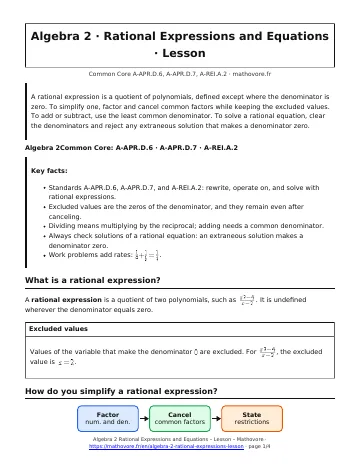
A rational expression is a quotient of polynomials, defined except where the denominator is zero. To simplify one, factor and cancel common factors while keeping the excluded values. To add or subtract, use the least common denominator. To solve a rational equation, clear the denominators and reject any extraneous solution that makes a denominator zero.
Algebra 2 Rational Expressions Lesson: key facts
- Standards A-APR.D.6, A-APR.D.7, and A-REI.A.2: rewrite, operate on, and solve with rational expressions.
- Excluded values are the zeros of the denominator, and they remain even after canceling.
- Dividing means multiplying by the reciprocal; adding needs a common denominator.
- Always check solutions of a rational equation: an extraneous solution makes a denominator zero.
- Work problems add rates: \(\frac{1}{a}+\frac{1}{b}=\frac{1}{t}\).
What is a rational expression?
A rational expression is a quotient of two polynomials, such as \(\frac{x^{2}-4}{x-2}\). It is undefined wherever the denominator equals zero.
Values of the variable that make the denominator \(0\) are excluded. For \(\frac{x^{2}-4}{x-2}\), the excluded value is \(x=2\).
How do you simplify a rational expression?
Factor \(x^{2}-4=(x-2)(x+2)\). The factor \(x-2\) cancels, so \(\frac{x^{2}-4}{x-2}=x+2\) for \(x\neq2\). The restriction stays even after the cancellation, which is why the graph has a hole at \((2,4)\).
How do you multiply, divide, add, and subtract?
- Multiply: factor everything, cancel, then multiply what is left.
- Divide: multiply by the reciprocal of the second fraction.
- Add or subtract: rewrite each fraction over the least common denominator (LCD), then combine the numerators.
Example: \(\frac{1}{x+1}+\frac{2}{x-3}\) has LCD \((x+1)(x-3)\). The sum is \(\frac{(x-3)+2(x+1)}{(x+1)(x-3)}=\frac{3x-1}{(x+1)(x-3)}\).
Long division also rewrites a quotient. Since \(x^{2}+3x+5=(x+1)(x+2)+3\), we get \(\frac{x^{2}+3x+5}{x+1}=x+2+\frac{3}{x+1}\).
How do you solve a rational equation?
- Find the LCD of all the fractions.
- Multiply both sides by the LCD to clear the denominators.
- Solve the resulting equation.
- Check every answer in the original equation and reject any that make a denominator \(0\).
Example: \(\frac{x^{2}}{x-2}=\frac{4}{x-2}\). Multiplying by \(x-2\) gives \(x^{2}=4\), so \(x=2\) or \(x=-2\). The value \(x=2\) is extraneous because it makes the denominator \(0\). Only \(x=-2\) works.
How do work and rate problems use rational equations?
A worker who finishes a job in \(h\) hours does \(\frac{1}{h}\) of the job per hour. If Maya paints a fence in \(6\) hours and Jamal in \(3\) hours, then together \(\frac{1}{6}+\frac{1}{3}=\frac{1}{t}\). This gives \(\frac{1}{2}=\frac{1}{t}\), so \(t=2\) hours.
Rational Expressions and Equations: frequently asked questions
Why must you state excluded values?
The original expression is undefined where its denominator is zero, and canceling does not change that. For \(\frac{x^{2}-4}{x-2}\), \(x=2\) stays excluded even though the simplified form \(x+2\) is defined there.
Can you cancel terms that are added?
No. Only common factors cancel. In \(\frac{x+3}{x}\) the \(x\) is a term, not a factor, so it cannot be canceled. Factor first, then cancel.
What is the least common denominator?
The LCD is the simplest expression that every denominator divides evenly. For \(x-2\) and \(x^{2}-4\), the LCD is \(x^{2}-4=(x-2)(x+2)\), because \(x-2\) is a factor of \(x^{2}-4\).
What is an extraneous solution?
It is a value that comes out of the algebra but does not satisfy the original equation. In rational equations it is usually a value that makes a denominator zero, so it must be rejected.
How do you set up a work problem?
Write each person’s rate as one job divided by the time alone, add the rates, and set the sum equal to one job divided by the time together. For \(4\) and \(12\) hours, \(\frac{1}{4}+\frac{1}{12}=\frac{1}{3}\), so the job takes \(3\) hours together.
How to use this algebra 2 rational expressions lesson
Use this algebra 2 rational expressions lesson before the worksheet, then check what you learned with the quiz.

See every chapter on the Algebra 2 math page.