
Key takeaway: This algebra 2 expressions equations models quiz has 10 multiple-choice questions with one correct option each and a short explanation. It checks factoring with structure, the Binomial Theorem, rearranging formulas, graph solutions and modeling. Standards A-SSE, A-CED, A-REI.D.11, A-APR.C.5 and N-CN.C.8–9 apply. Set a timer for 15 minutes. After you answer, read every explanation, because the wrong choices show the usual mistakes.
Ten multiple-choice questions check interpreting expressions, factoring with structure, the Binomial Theorem, rearranging formulas, graphical solutions and modeling. Exactly one option is correct in each question, and the explanation points out the usual mistake.
Question 1
Question 2
Question 3
Question 4
Question 5
Question 6
Question 7
Question 8
Question 9
Question 10
🎉 Quiz complete!
Remember:
- Standards A-SSE.A.1, A-SSE.A.2, A-CED.A.1–4, A-REI.D.11, A-APR.C.5 and N-CN.C.8–9 on expressions and modeling.
- A difference of squares can hide inside higher powers: \(x^{4}-y^{4}=(x^{2}+y^{2})(x+y)(x-y)\).
- The solutions of \(f(x)=g(x)\) are the \(x\)-coordinates where the two graphs cross.
- Row \(n\) of Pascal’s triangle gives the coefficients of \((a+b)^{n}\).
- Over the complex numbers, \(x^{2}+4=(x+2i)(x-2i)\), and every quadratic has exactly two zeros.
Which quiz questions test factoring and complex numbers?
Question 2 asks you to factor \(x^{4}-1\) over the real numbers. The answer keeps \(x^{2}+1\) as one factor. Question 3 then asks for \(x^{2}+36\) over the complex numbers, which gives \((x+6i)(x-6i)\). Notice the contrast: the same sum of squares is stuck over the reals but splits with \(i\).
How do Pascal’s triangle questions work?
Question 4 asks for the coefficient of \(x^{2}y^{3}\) in \((x+y)^{5}\). Row 5 lists 1, 5, 10, 10, 5, 1. The entry for \(x^{2}y^{3}\) is 10. Question 5 expands \((x+2)^{3}\) with row 3, which is 1, 3, 3, 1. Multiply each entry by the matching power of 2. As a result, you get \(x^{3}+6x^{2}+12x+8\). Wrong options usually forget the powers of 2.
What do the model questions ask?
Question 1 asks what the factor 1.08 means in \(P(t)=250(1.08)^{t}\). The population grows by 8% each period. Question 8 sets \(w(w+4)=45\), and question 9 finds the greatest whole number of batches, which is 21. Question 10 solves \(x^{2}-6x+13=0\) and gives \(x=3\pm 2i\). Finally, question 7 reads two graph crossings at \(x=-1\) and \(x=2\).
What should you review after the quiz?
Count your correct answers, then list the topics behind each miss. A score under 8 means you should return to the worksheet. Start with the factoring set, and then do the formula problems. With 9 or 10 correct, you are ready for the chapter test.

Printable PDF · Quiz
Algebra 2 Structure of Expressions and Modeling with Equations quiz
Download the PDF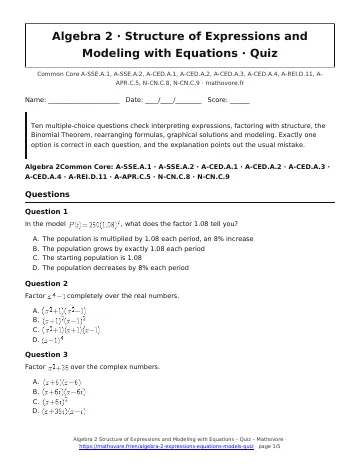
See every chapter on the Algebra 2 math page.