Key takeaway: This grade 7 probability test answer key pairs each of the eight questions with a full solution and a point value, 20 points in all. Award one point per part, and accept fractions, decimals, or percents that are equal. Students should show the count of favorable outcomes and the total, so that you can see their method.
Look for a correct denominator and a clear comparison between predicted and observed counts. A correct number with no work earns reduced credit.
Use this key to grade the 20-point probability test. Each solution shows the full work, and the scoring note tells how points are earned. Give partial credit when the method is right but one calculation is wrong, and accept equivalent fractions or decimals.
Grade 7 Probability Test Answer Key: questions 1–5
1. Likelihood (2 points)
(a) No marble is blue, so \(P(\text{blue}) = \frac{0}{10} = 0\). The event is impossible.
(b) Every marble is red, so \(P(\text{red}) = \frac{10}{10} = 1\). The event is certain.
Scoring: 1 point for each part (probability and the matching word).
2. Spinner probabilities (3 points)
(a) Green is on 3 of 6 sectors: \(P = \frac{3}{6} = \frac{1}{2}\).
(b) Red is on 2 of 6 sectors: \(P = \frac{2}{6} = \frac{1}{3}\).
(c) Blue is on 1 sector, so \(P(\text{not blue}) = \frac{5}{6}\).
Scoring: 1 point for each part.
3. Spinner experiment (3 points)
(a) \(\frac{20}{40} = \frac{1}{2} = 0.5\).
(b) \(\frac{14}{40} = \frac{7}{20} = 0.35\).
(c) Blue: \(\frac{6}{40} = 0.15\), and \(0.15 \times 200 = 30\). About 30 blues.
Scoring: 1 point for each part. In (c) give the point for 0.15 times 200.
4. Fair cube (2 points)
(a) Faces greater than 4: 5 and 6. So \(P = \frac{2}{6} = \frac{1}{3}\).
(b) Odd faces: 1, 3, 5. So \(P = \frac{3}{6} = \frac{1}{2}\).
Scoring: 1 point for each part (fraction need not be simplified if correct).
5. Missing probability (3 points)
(a) The probabilities add to 1: \(0.5 + 0.25 + 0.15 = 0.9\), so \(P(D) = 1 – 0.9 = 0.1\).
(b) \(P(C \text{ or } D) = 0.15 + 0.1 = 0.25\).
(c) \(0.25 \times 200 = 50\). About 50 times .
Scoring: 1 point for each part.
Grade 7 Probability Test Answer Key: questions 6–8
6. Fair or not (3 points)
(a) The expected count is \(\frac{1}{6} \times 30 = 5\) for each face.
(b) Differences: face 1: -2; face 2: +1; face 3: 0; face 4: -1; face 5: +2; face 6: 0. Faces 1 and 5 differ the most, by 2 each.
(c) Yes. Every count is within 2 of 5, which is normal variation for only 30 rolls.
Scoring: 1 point for 5; 1 point for faces 1 and 5 with the difference 2; 1 point for a reasonable conclusion with a reason.
7. Tossing a cup (2 points)
(a) Up: \(\frac{12}{80} = 0.15\). Down: \(\frac{36}{80} = 0.45\). Side: \(\frac{32}{80} = 0.4\). Check: \(0.15 + 0.45 + 0.4 = 1\).
(b) \(0.4 \times 300 = 120\). About 120 side landings.
Scoring: 1 point for the model; 1 point for the prediction.
8. Bus schedule (2 points)
(a) \(1 – \frac{3}{20} = \frac{17}{20}\). The probability of being on time is \(\frac{17}{20}\).
(b) \(\frac{3}{20} \times 40 = 6\). She should expect about 6 late days.
Scoring: 1 point for each part.
Scoring summary
20 points: add the points of every question of this grade 7 probability test answer key.
How does the grade 7 probability test answer key mark the opening questions?
In Question 1, the probability of red is 1 and the probability of blue is 0. Next, Question 4 asks for a number greater than 4 on a fair cube, so the answer is 2 out of 6, or one third. Give one point for the fraction and one for the simplification. Likewise, the spinner questions follow the same count over equal sectors.
What is the answer pattern for experiments and fairness?
Question 6 expects 5 of each face in 30 rolls. Then students compare actual counts with 5, and a gap of one or two is ordinary. For the paper cup, the estimates are 12 out of 80, 36 out of 80, and 32 out of 80. In lowest terms, these become three twentieths, nine twentieths, and two fifths.
Which answers involve a missing probability?
For Question 5, first add the three known probabilities. Next, subtract the sum from 1, because the result is the fourth probability. Allow one point for the sum, one for taking it from 1, and one for noting that a model totals 1. Finally, in the bus question, 1 minus three twentieths is seventeen twentieths.
Reteach with the totals
Check whether lost points came from counting, simplifying, or the sum of 1. Then give a short table of three outcomes and ask groups to fix the missing entry. Afterward, rerun a few questions as a quiz to see the improvement.

Printable PDF · Test Answer Key
Grade 7 Probability and Probability Models test answer key
Download the PDF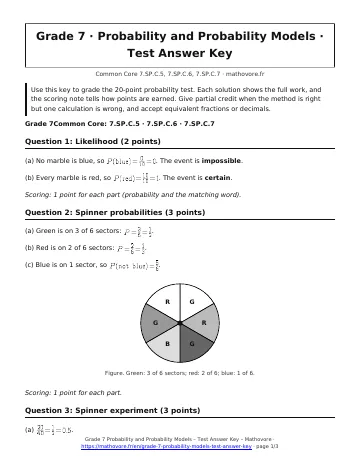
See every chapter on the Grade 7 math page.