


Each solution below shows the formula, the substitution, and the final answer with cubic units. Compare your work step by step, and look especially at whether you halved a diameter before squaring or cubing the radius.
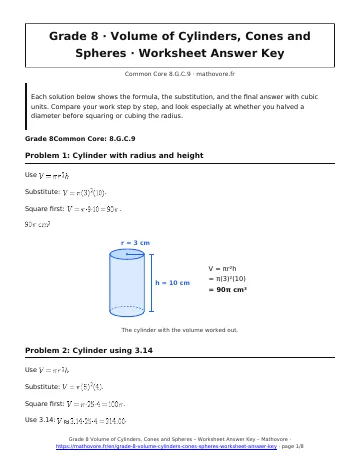
Problem 1: Cylinder with radius and height
Use \(V=\pi r^{2}h\).
Substitute: \(V=\pi(3)^{2}(10)\).
Square first: \(V=\pi\cdot 9\cdot 10=90\pi\).
\(90\pi\text{ cm}^{3}\)
Problem 2: Cylinder using 3.14
Use \(V=\pi r^{2}h\).
Substitute: \(V=\pi(5)^{2}(4)\).
Square first: \(V=\pi\cdot 25\cdot 4=100\pi\).
Use 3.14: \(V\approx 3.14\cdot 25\cdot 4=314.00\).
\(V\approx 314.00\text{ in}^{3}\)
Problem 3: Cylinder from the diameter
The radius is half the diameter: \(r=12: 2=6\text{ ft}\).
Use \(V=\pi r^{2}h\).
Substitute: \(V=\pi(6)^{2}(7)\).
Square first: \(V=\pi\cdot 36\cdot 7=252\pi\).
\(252\pi\text{ ft}^{3}\)
Problem 4: Cone with radius and height
Use \(V=\frac{1}{3}\pi r^{2}h\).
Substitute: \(V=\frac{1}{3}\pi(3)^{2}(7)\).
Multiply, then divide by 3: \(V=\frac{1}{3}\pi\cdot 63=21\pi\).
\(21\pi\text{ in}^{3}\)
Problem 5: Cone using 3.14
Use \(V=\frac{1}{3}\pi r^{2}h\).
Substitute: \(V=\frac{1}{3}\pi(6)^{2}(9)\).
Multiply, then divide by 3: \(V=\frac{1}{3}\pi\cdot 324=108\pi\).
Use 3.14: \(V\approx 3.14\cdot 108=339.12\).
\(V\approx 339.12\text{ cm}^{3}\)
Problem 6: Cone from the diameter
The radius is half the diameter: \(r=10: 2=5\text{ m}\).
Use \(V=\frac{1}{3}\pi r^{2}h\).
Substitute: \(V=\frac{1}{3}\pi(5)^{2}(12)\).
Multiply, then divide by 3: \(V=\frac{1}{3}\pi\cdot 300=100\pi\).
\(100\pi\text{ m}^{3}\)
Problem 7: Sphere with a given radius
Use \(V=\frac{4}{3}\pi r^{3}\).
Substitute: \(V=\frac{4}{3}\pi(3)^{3}\).
Cube first: \(V=\frac{4}{3}\pi\cdot 27=36\pi\).
\(36\pi\text{ cm}^{3}\)
Problem 8: Sphere using 3.14
Use \(V=\frac{4}{3}\pi r^{3}\).
Substitute: \(V=\frac{4}{3}\pi(6)^{3}\).
Cube first: \(V=\frac{4}{3}\pi\cdot 216=288\pi\).
Use 3.14: \(V\approx\frac{4}{3}(3.14)(216)=904.32\).
\(V\approx 904.32\text{ in}^{3}\)
Problem 9: Sphere from the diameter
The radius is half the diameter: \(r=10: 2=5\text{ ft}\).
Use \(V=\frac{4}{3}\pi r^{3}\).
Substitute: \(V=\frac{4}{3}\pi(5)^{3}\).
Cube first: \(V=\frac{4}{3}\pi\cdot 125=\frac{500}{3}\pi\).
\(\frac{500}{3}\pi\text{ ft}^{3}\)
Use 3.14: \(V\approx\frac{4}{3}(3.14)(125)=523.33\).
\(V\approx 523.33\text{ ft}^{3}\)
Problem 10: Find the height of a cylinder
Use \(V=\pi r^{2}h\) and substitute: \(150\pi=\pi(5)^{2}h\), so \(150\pi=25\pi h\).
Divide both sides by \(25\pi\): \(h=150: 25=6\).
\(h=6\text{ cm}\)
Check: \(\pi(25)(6)=150\pi\).
Problem 11: Find the radius of a cylinder
Substitute into \(V=\pi r^{2}h\): \(245\pi=\pi r^{2}(5)\).
Divide both sides by \(5\pi\): \(r^{2}=49\).
Take the positive square root: \(r=7\text{ in}\).
Check: \(\pi(49)(5)=245\pi\).
Problem 12: Find the height of a cone
Substitute into \(V=\frac{1}{3}\pi r^{2}h\): \(96\pi=\frac{1}{3}\pi(6)^{2}h=12\pi h\).
Divide both sides by \(12\pi\): \(h=96: 12=8\).
\(h=8\text{ ft}\)
Check: \(\frac{1}{3}\pi(36)(8)=96\pi\).
Problem 13: Find the radius of a sphere
Substitute into \(V=\frac{4}{3}\pi r^{3}\): \(288\pi=\frac{4}{3}\pi r^{3}\).
Multiply both sides by \(\frac{3}{4}\) and divide by \(\pi\): \(r^{3}=288\cdot\frac{3}{4}=216\).
Since \(6\cdot 6\cdot 6=216\), \(r=6\text{ cm}\).
Problem 14: Cylinder versus cone
Cylinder: \(V=\pi(4)^{2}(9)=\pi\cdot 16\cdot 9=144\pi\text{ cm}^{3}\).
Cone: \(V=\frac{1}{3}\pi(4)^{2}(9)=\frac{1}{3}\pi\cdot 144=48\pi\text{ cm}^{3}\).
Cylinder: \(144\pi\text{ cm}^{3}\); cone: \(48\pi\text{ cm}^{3}\). Since \(144: 48=3\), the cylinder holds 3 times as much as the cone.
Problem 15: Volume of a hemisphere
First find the volume of the whole sphere: \(V=\frac{4}{3}\pi(9)^{3}=\frac{4}{3}\pi\cdot 729=972\pi\).
A hemisphere is half of that: \(972\pi: 2=486\pi\).
\(486\pi\text{ m}^{3}\)
Problem 16: Soup can
The radius is half the diameter: \(r=3: 2=1.5\text{ in}\).
Use \(V=\pi r^{2}h\).
Substitute: \(V=\pi(1.5)^{2}(4)\).
Square first: \(V=\pi\cdot 2.25\cdot 4=9\pi\).
Use 3.14: \(V\approx 3.14\cdot 2.25\cdot 4=28.26\).
\(V\approx 28.26\text{ in}^{3}\)
The can holds about 28.26 cubic inches of soup.
Problem 17: Water storage tank
(a) \(V=\pi(4)^{2}(10)=160\pi\approx 3.14\cdot 160=502.4\). The tank holds about \(502.4\text{ ft}^{3}\).
(b) Time \(=502.4: 40=12.56\), which rounds to 12.6 minutes.
Problem 18: Pile of sand
(a) \(V=\frac{1}{3}\pi(6)^{2}(5)=\frac{1}{3}\pi\cdot 180=60\pi\text{ ft}^{3}\).
(b) \(60\cdot 3.14=188.4\), so \(V\approx 188.4\text{ ft}^{3}\).
(c) \(188.4: 20=9.42\). Nine loads are not enough, so the truck needs 10 loads.
Problem 19: Ice cream cone with a scoop
Cone: \(\frac{1}{3}\pi(1)^{2}(4)=\frac{4}{3}\pi\).
Hemisphere: \(\frac{1}{2}\cdot\frac{4}{3}\pi(1)^{3}=\frac{2}{3}\pi\).
Total: \(\frac{4}{3}\pi+\frac{2}{3}\pi=\frac{6}{3}\pi=2\pi\). \(2\pi\text{ in}^{3}\).
With 3.14: \(2\cdot 3.14=6.28\), so about \(6.28\text{ in}^{3}\).
Problem 20: Basketball
The radius is half the diameter: \(r=9: 2=4.5\text{ in}\).
Use \(V=\frac{4}{3}\pi r^{3}\).
Substitute: \(V=\frac{4}{3}\pi(4.5)^{3}\).
Cube first: \(V=\frac{4}{3}\pi\cdot 91.125=\frac{243}{2}\pi\).
Use 3.14: \(V\approx\frac{4}{3}(3.14)(91.125)=381.51\).
\(V\approx 381.51\text{ in}^{3}\)
The basketball holds about 381.51 cubic inches of air.
Problem 21: Tennis ball can
Can: \(\pi(1.5)^{2}(9)=\pi\cdot 2.25\cdot 9=20.25\pi\).
One ball: \(\frac{4}{3}\pi(1.5)^{3}=\frac{4}{3}\pi\cdot 3.375=4.5\pi\). Three balls: \(13.5\pi\).
Empty space: \(20.25\pi-13.5\pi=6.75\pi\text{ in}^{3}\).
With 3.14: \(6.75\cdot 3.14=21.195\), so about \(21.2\text{ in}^{3}\) of empty space.
Problem 22: Filling paper cups
Jug: \(\pi(3)^{2}(8)=72\pi\text{ in}^{3}\).
Cup: \(\frac{1}{3}\pi(2)^{2}(3)=4\pi\text{ in}^{3}\).
Number of cups: \(72\pi: 4\pi=18\). 18 cups.
Problem 23: Reshaping a ball of clay
Ball: \(\frac{4}{3}\pi(3)^{3}=36\pi\text{ cm}^{3}\).
Cylinder with the same volume: \(\pi(3)^{2}h=9\pi h=36\pi\), so \(h=36: 9=4\).
The cylinder is 4 cm tall.
See every chapter on the Grade 8 math page.