



Use this key to score the test out of 20 points. Each solution shows the work, and the scoring note says how the points are awarded, including partial credit where it applies.
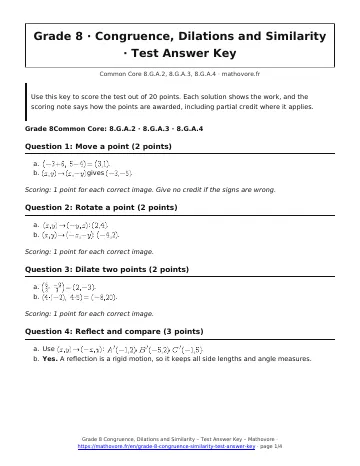
Question 1: Move a point (2 points)
- \((-3+6,\ 5-4)=\) \((3,1)\).
- \((x,y)\to(x,-y)\) gives \((-3,-5)\).
Scoring: 1 point for each correct image. Give no credit if the signs are wrong.
Question 2: Rotate a point (2 points)
- \((x,y)\to(-y,x)\): \((2,4)\).
- \((x,y)\to(-x,-y)\): \((-4,2)\).
Scoring: 1 point for each correct image.
Question 3: Dilate two points (2 points)
- \((\frac{6}{3},\ \frac{-9}{3})=\) \((2,-3)\).
- \((4\cdot(-2),\ 4\cdot5)=\) \((-8,20)\).
Scoring: 1 point for each correct image.
Question 4: Reflect and compare (3 points)
- Use \((x,y)\to(-x,y)\): \(A^{\prime}(-1,2)\), \(B^{\prime}(-5,2)\), \(C^{\prime}(-1,5)\).
- Yes. A reflection is a rigid motion, so it keeps all side lengths and angle measures.
Scoring: part (a) 2 points, 1 point if two of three vertices are correct; part (b) 1 point for yes with a reason that names rigid motions or preserved lengths and angles.
Question 5: Dilation of a triangle (2 points)
- \(5\cdot3=15\), \(12\cdot3=36\), \(13\cdot3=39\): \(15\text{ ft}\), \(36\text{ ft}\), \(39\text{ ft}\).
- \(90^{\circ}\). A dilation does not change angle measures.
Scoring: 1 point for all three lengths (0 if only two are right); 1 point for \(90^{\circ}\) with the reason.
Question 6: Find a scale factor (2 points)
- \(12: 3=4\) and \(-8: (-2)=4\): \(k=4\).
- \((4\cdot(-5),\ 4\cdot6)=\) \(B^{\prime}(-20,24)\).
Scoring: 1 point for each part.
Question 7: Show similarity (3 points)
- Side \(AB=2\) and \(DE=4\), so \(k=2\). Dilating gives \((2,2)\), \((6,2)\), \((2,8)\). Reflecting across the \(x\)-axis gives \((2,-2)\), \((6,-2)\), \((2,-8)\). Dilate by 2, then reflect across the \(x\)-axis.
- Similar, not congruent. A dilation with \(k=2\) was needed, so the sizes differ.
Scoring: part (a) 1 point for the dilation with \(k=2\) and 1 point for the reflection across the \(x\)-axis; part (b) 1 point for similar and not congruent with a reason.
Question 8: Similar rectangles (2 points)
- \(8: 6=\frac{4}{3}\) and \(12: 9=\frac{4}{3}\). Yes, the scale factor is \(\frac{4}{3}\).
- \(10: 6=\frac{5}{3}\) but \(16: 9=\frac{16}{9}\). No, the ratios are different.
Scoring: 1 point for each part (correct answer with ratios shown).
Question 9: Two rigid motions (2 points)
- After the translation: \((-1,-1)\), \((2,-1)\), \((2,3)\). After the reflection: \((1,-1)\), \((-2,-1)\), \((-2,3)\).
- 5 units. Both moves are rigid motions, so lengths do not change.
Scoring: 1 point for the three final vertices (partial credit not given); 1 point for 5 with the reason.
20 points
See every chapter on the Grade 8 math page.