


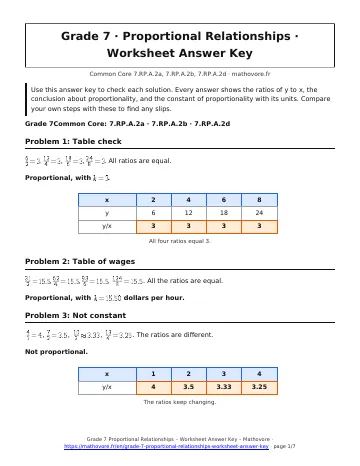
Problem 1: Table check
\(\frac{6}{2}=3\), \(\frac{12}{4}=3\), \(\frac{18}{6}=3\), \(\frac{24}{8}=3\). All ratios are equal.
Proportional, with \(k=3\).
Problem 2: Table of wages
\(\frac{31}{2}=15.5\), \(\frac{62}{4}=15.5\), \(\frac{93}{6}=15.5\), \(\frac{124}{8}=15.5\). All the ratios are equal.
Proportional, with \(k=15.50\) dollars per hour.
Problem 3: Not constant
\(\frac{4}{1}=4\), \(\frac{7}{2}=3.5\), \(\frac{10}{3}\approx 3.33\), \(\frac{13}{4}=3.25\). The ratios are different.
Not proportional.
Problem 4: Ratios that differ
\(\frac{8}{3}\approx2.67\), \(\frac{15}{6}=2.5\), \(\frac{22}{9}\approx2.44\), \(\frac{29}{12}\approx2.42\). The ratios are different.
Not proportional. The \(y\)-values rise by 7 each time, but a constant difference does not make a relationship proportional.
Problem 5: Cost of gasoline
\(\frac{7.00}{2}=3.50\), \(\frac{14.00}{4}=3.50\), \(\frac{21.00}{6}=3.50\). All ratios are equal, so the cost is proportional to the gallons.
\(k=\$3.50\) per gallon. It is the price of 1 gallon of gasoline.
Problem 6: Reading speed graph
The graph is a straight line through the origin, and \(\frac{6}{4}=\frac{12}{8}=\frac{18}{12}=1.5\).
Proportional, with \(k=1.5\) pages per minute.
Problem 7: Graph through the origin
The line passes through the origin, and \(\frac{2}{1}=\frac{4}{2}=\frac{6}{3}=\frac{8}{4}=2\).
Proportional, with \(k=2\). The point \((1,2)\) shows the unit rate.
Problem 8: Graph that misses the origin
The line crosses the \(y\)-axis at \((0,3)\), not at the origin \((0,0)\). The ratios are also different: \(\frac{5}{1}=5\), \(\frac{7}{2}=3.5\), \(\frac{9}{3}=3\).
It is not proportional because the line does not pass through \((0,0)\).
Problem 9: Miles per gallon
\(\frac{150}{6}=25\) and \(\frac{225}{9}=25\). The ratios are equal, so the distance is proportional to the gas used.
\(k=25\) miles per gallon.
Problem 10: Earnings number line
\(\frac{26}{2}=13\), \(\frac{52}{4}=13\), \(\frac{78}{6}=13\). The ratios are equal, so the earnings are proportional to the hours, with \(k=13\) dollars per hour.
For 10 hours: \(13\times 10=130\).
Proportional; \(k=13\) dollars per hour; $130 for 10 hours.
Problem 11: Notebook bar model
\(k=\frac{24}{4}=6\). One notebook costs $6.
For 7 notebooks: \(6\times 7=42\). \(k=\$6\) per notebook; 7 notebooks cost $42.
Problem 12: Meaning of the points
(a) \(k=\frac{5}{2}=2.5\). \(k=2.50\) dollars per pound
(b) \((1,2.50)\): 1 pound of grapes costs $2.50.
(c) \((0,0)\): 0 pounds of grapes cost $0.
Problem 13: Points on a graph
(a) \(k=\frac{12}{3}=4\). \(k=4\) dollars per bag.
(b) \((1,4)\): 1 bag of oranges costs $4. This is the unit rate.
(c) \(y=4\times 5=20\), so the point is \((5,20)\): 5 bags cost $20.
Problem 14: Missing table values
\(k=\frac{9}{2}=4.5\). Check with the other known pair: \(\frac{27}{6}=4.5\).
For \(x=4\): \(y=4.5\times 4=18\). For \(x=10\): \(y=4.5\times 10=45\).
\(k=4.5\); the missing values are 18 and 45.
Problem 15: Two gym plans
Gym A: \(\frac{60}{1}=60\), \(\frac{120}{2}=60\), \(\frac{180}{3}=60\), \(\frac{240}{4}=60\). The ratios are equal, so Gym A is proportional with \(k=60\) dollars per month.
Gym B: \(\frac{85}{1}=85\), \(\frac{110}{2}=55\), \(\frac{135}{3}=45\), \(\frac{160}{4}=40\). The ratios are different, so Gym B is not proportional.
Gym B costs $25 per month plus a $60 sign-up fee, so zero months would still cost $60, not $0.
Gym A is proportional; Gym B is not.
Problem 16: Three riders
- Liam: \(\frac{5}{1}=\frac{10}{2}=\frac{15}{3}=5\), proportional. Sofia: \(\frac{6}{1}=6\), \(\frac{11}{2}=5.5\), \(\frac{16}{3}\approx5.33\), not proportional. Noah: \(\frac{4.5}{1}=\frac{9}{2}=\frac{13.5}{3}=4.5\), proportional.
- Liam: \(k=5\) miles per hour. Noah: \(k=4.5\) miles per hour.
- Liam is faster by \(5-4.5=0.5\) miles per hour.
Answers: (a) Liam and Noah; (b) 5 and 4.5 miles per hour; (c) Liam, by 0.5 miles per hour.
Problem 17: Bake sale table
(a) \(\frac{7.50}{3}=2.50\), \(\frac{12.50}{5}=2.50\), \(\frac{20.00}{8}=2.50\), \(\frac{30.00}{12}=2.50\). All ratios equal, so it is proportional. \(k=2.50\)
(b) \(2.50\times 20=50\). $50.00
Problem 18: Straight line error
A proportional relationship needs equal ratios and a graph that passes through the origin. Compare the ratios: \(\frac{6}{2}=3\) and \(\frac{10}{4}=2.5\). They are not equal.
The line through the two points rises 4 for every 2 across, so each step of 1 in \(x\) adds 2 to \(y\). Going back from \((2,6)\) by 2 steps gives \((0,2)\), so the line crosses the \(y\)-axis at 2, not at the origin.
Ethan is incorrect: a straight line is proportional only when it passes through (0, 0).
Problem 19: Find the error
Liam is not correct. A constant difference does not make a relationship proportional. The ratios are: for \(x=2\), \(\frac{9}{2}=4.5\); for \(x=4\), \(\frac{13}{4}=3.25\); for \(x=6\), \(\frac{17}{6}\approx 2.83\). They are not equal.
Also, \(x=0\) goes with \(y=5\), not \(y=0\). The relationship is not proportional.
Problem 20: Cheese at two stores
- Store A: \(k=\frac{26}{4}=6.5\) dollars per pound. Store B: \(k=\frac{31.25}{5}=6.25\) dollars per pound.
- Store B is cheaper by \(6.5-6.25=0.25\) dollars per pound.
- \(0.25\times 12=3\), or check: Store A \(6.5\times 12=78\) and Store B \(6.25\times 12=75\), a difference of $3.
Answers: (a) $6.50 and $6.25 per pound; (b) Store B, by $0.25 per pound; (c) $3.00.
See every chapter on the Grade 7 math page.