



Problem 1: Repeated Addition
- Four jumps of \(-3\): \(4 \times (-3) = -3 + (-3) + (-3) + (-3) = -12\).
- \(5 \times (-2) = (-2) + (-2) + (-2) + (-2) + (-2) = -10\).
Answers: \(-12\), \(-10\).
Problem 2: Jumps of Negative Three
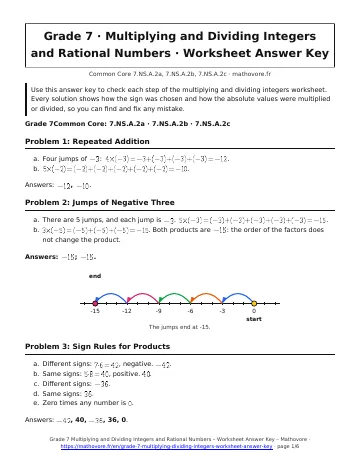
- There are 5 jumps, and each jump is \(-3\). \(5 \times (-3) = (-3) + (-3) + (-3) + (-3) + (-3) = -15\).
- \(3 \times (-5) = (-5) + (-5) + (-5) = -15\). Both products are \(-15\): the order of the factors does not change the product.
Answers: \(-15\); \(-15\).
Problem 3: Sign Rules for Products
- Different signs: \(7 \cdot 6 = 42\), negative. \(-42\).
- Same signs: \(5 \cdot 8 = 40\), positive. \(40\).
- Different signs: \(-36\).
- Same signs: \(36\).
- Zero times any number is \(0\).
Answers: \(-42\), 40, \(-36\), 36, 0.
Problem 4: Count the Negative Factors
- Three negative factors, so the product is negative. \(2 \times 3 \times 4 = 24\). \(-24\)
- Four negative factors, so the product is positive. \(1\)
- Two negative factors, so the product is positive. \(5 \times 2 \times 3 = 30\). \(30\)
- Five negative factors, so the product is negative. \(2 \times 2 \times 2 \times 2 \times 2 = 32\). \(-32\)
Problem 5: A Pattern of Products
The products go up by \(4\) each time the factor goes down by \(1\).
- \((-4)(-1) = 4\) and \((-4)(-2) = 8\).
- Each product increases by \(4\). The pattern continues into positive values, so a negative times a negative is positive.
Problem 6: Find the Missing Number
- \(56 : (-7) = -8\). Check: \(-7 \times (-8) = 56\). \(-8\)
- \(9 \times (-4) = -36\). Check: \(-36 : (-4) = 9\). \(-36\)
- \(-45 : 9 = -5\). Check: \(-45 : (-5) = 9\). \(-5\)
- \(-54 : (-6) = 9\). Check: \(-6 \times 9 = -54\). \(9\)
Problem 7: Dividing Integers
- Different signs: \(48 : 6 = 8\), so \(-8\).
- Same signs: \(45 : 9 = 5\), so \(5\).
- Different signs: \(-8\).
- Zero divided by a nonzero number is \(0\).
- Same signs: \(90 : 15 = 6\), so \(6\).
Answers: \(-8\), 5, \(-8\), 0, 6.
Problem 8: Tape Diagram for Division
- \(-56 : 8 = -7\), so each part is \(-7\).
- \(8 \times (-7) = -56\). It checks.
- \(-56 : (-7) = 8\). It tells how many parts of size \(-7\) fit in \(-56\): 8 parts.
Problem 9: Division as Equal Parts
- \(-24 : 6 = -4\), so each part is \(-4\).
- \(6 \times (-4) = -24\). It checks.
- \(-35 : 5 = -7\) because \(5 \times (-7) = -35\).
Answers: \(-4\), checks, \(-7\).
Problem 10: Division by Zero
- \(0 : 8 = 0\) because \(8 \cdot 0 = 0\).
- \(8 : 0 = r\) would mean \(0 \cdot r = 8\). Zero times any number is \(0\), so no number works. The quotient is undefined.
- The rule holds only when the divisor is nonzero. Dividing by \(0\) is never allowed, so \(0 : 0\) is also undefined.
Problem 11: Decimal Products and Quotients
- Different signs, so negative. \(0.6 \times 0.9 = 0.54\). \(-0.54\)
- Same signs, so positive. \(1.5 \times 4 = 6\). \(6\)
- Same signs, so positive. \(72 : 8 = 9\). \(9\)
- Different signs, so negative. \(45 : 9 = 5\). \(-5\)
Problem 12: Signs in Fractions
- \(-\frac{12}{4} = -3\), \(\frac{-12}{4} = -3\), \(\frac{12}{-4} = -3\). All three are equal.
- \(-\frac{-10}{2} = -(-5) = 5\) and \(\frac{10}{2} = 5\).
- \(\frac{20}{-5} = \frac{-20}{5} = -\frac{20}{5} = -4\).
Answers: \(-3\) (all three), 5 and 5, \(-4\).
Problem 13: Fraction Products and Quotients
- Same signs, so positive. \(\frac{5}{6} \times \frac{3}{10} = \frac{15}{60} = \frac{1}{4}\). \(\frac{1}{4}\)
- Different signs, so negative. \(\frac{2}{3} \times \frac{9}{4} = \frac{18}{12} = \frac{3}{2}\). \(-\frac{3}{2}\)
- Same signs, so positive. \(\frac{3}{4} \times \frac{8}{3} = \frac{24}{12} = 2\). \(2\)
Problem 14: Powers and Order of Operations
- \((-2)(-2)(-2) = 4 \times (-2) = -8\). \(-8\)
- \((-3)^{2} = (-3)(-3) = 9\). \(-(3^{2}) = -(9) = -9\). In the first, the base is \(-3\); in the second, only 3 is squared and the negative sign is applied afterward. \(9\) and \(-9\)
- Parentheses: \(4 – 9 = -5\). Multiply and divide left to right: \(-3(-5) = 15\) and \(-20 : 5 = -4\). Add: \(15 + (-4) = 11\). \(11\)
Problem 15: Falling Temperatures
- \(5 \times (-3) = -15\). The total change is \(-15^{\circ}\text{F}\).
- \(4 + (-15) = -11\). The temperature at 7 p.m. is \(-11^{\circ}\text{F}\).
Problem 16: Submarine Dive
- The depth changes by \(-15\) feet each minute: \(7 \times (-15) = -105\) feet.
- \(-40 + (-105) = -145\), so the depth is \(-145\) feet.
- The change needed is \(-190 – (-40) = -150\) feet. \(-150 : (-15) = 10\), so it takes 10 minutes.
Problem 17: Weekly Fees
- \(6 \times (-15) = -90\), a change of \(-\$90\).
- \(120 + (-90) = 30\), so \(\$30\).
- After \(8\) weeks: \(120 – 120 = 0\). After \(9\) weeks: \(120 – 135 = -15\). The balance first goes below \(\$0\) after 9 weeks.
Problem 18: Mean Temperature Change
(a) The sum is \((-6) + (-9) + (-12) + (-3) + (-10) = -40\). Divide by 5: \(-40 : 5 = -8\). The mean change is \(-8^{\circ}\text{F}\) per day.
(b) Five changes of \(-8\): \(5 \times (-8) = -40\). \(20 + (-40) = -20\), so the final temperature is \(-20^{\circ}\text{F}\).
(c) Five equal changes of the mean add up to the sum of the five actual changes, \(-40\), so both ways reach \(-20^{\circ}\text{F}\).
\(-8^{\circ}\text{F}\) per day; \(-20^{\circ}\text{F}\).
Problem 19: Stock Price Tracker
(a) \(5 \times (-4) + 5 \times 2 = -20 + 10 = -10\), so the total change is \(-\$10\).
(b) \(\$50 + (-\$10) = \$40\).
(c) \(-10 : 10 = -1\), so the price changes by \(-\$1\) per day on average.
Total change -$10; price $40; mean change -$1 per day.
Problem 20: Multi-Step Products and Quotients
- \((-6)(-4) = 24\). Then \(24 : (-8) = -3\).
- Way 1: \(-4(3) = -12\). Way 2: \(-4 \cdot 5 + (-4)(-2) = -20 + 8 = -12\). Both give \(-12\).
- \(\frac{-3 \cdot 8}{4 \cdot 9} = \frac{-24}{36} = -\frac{2}{3}\).
Answers: \(-3\), \(-12\), \(-\frac{2}{3}\).
See every chapter on the Grade 7 math page.