Key takeaway: This grade 4 multiplication worksheet answer key lists every partial product for the 24 problems. Each solution adds the parts and shows the final total. Students can compare their own work line by line and spot which part went missing. In addition, the estimates give a quick way to see whether a total is reasonable. Parents can use the area model notes to explain each step without redoing the whole problem.
Every solution below lists the partial products, adds them, and gives the final answer in bold. Compare your own work with the key, and use the estimate or the area model to find where a missing partial product caused a different answer.
Grade 4 Multiplication Worksheet Answer Key: problems 1–5
1. Multiply with no regrouping
Partial products: \(3 \times 1{,}000 = 3{,}000\), \(3 \times 200 = 600\), \(3 \times 10 = 30\), \(3 \times 2 = 6\).
Add: \(3{,}000 + 600 + 30 + 6 = 3{,}636\).
Answer: 3,636
2. Two-digit by one-digit
Partial products: \(7 \times 30 = 210\), \(7 \times 6 = 42\).
Add: \(210 + 42 = 252\).
Answer: 252
3. Three-digit by one-digit
Partial products: \(8 \times 200 = 1{,}600\), \(8 \times 40 = 320\), \(8 \times 5 = 40\).
Add: \(1{,}600 + 320 + 40 = 1{,}960\).
Answer: 1,960
4. Four-digit by one-digit
Partial products: \(6 \times 3{,}000 = 18{,}000\), \(6 \times 400 = 2{,}400\), \(6 \times 10 = 60\), \(6 \times 7 = 42\).
Add: \(18{,}000 + 2{,}400 + 60 + 42 = 20{,}502\).
Answer: 20,502
5. Multiply with a zero in the hundreds
Partial products: \(9 \times 6{,}000 = 54{,}000\), \(9 \times 500 = 4{,}500\), \(9 \times 8 = 72\).
Add: \(54{,}000 + 4{,}500 + 72 = 58{,}572\).
Answer: 58,572
Grade 4 Multiplication Worksheet Answer Key: problems 6–10
6. Multiply with a zero in the tens
Partial products: \(5 \times 7{,}000 = 35{,}000\), \(5 \times 90 = 450\).
Add: \(35{,}000 + 450 = 35{,}450\).
Answer: 35,450
7. Use the properties
\(4 \times 25 = 100\), so \(4 \times 7 \times 25 = 7 \times (4 \times 25) = 7 \times 100 = 700\).
Answer: 700
8. Break apart a factor
\(8 \times 47 = 8 \times 40 + 8 \times 7 = 320 + 56 = 376\).
Answer: 376
9. Two-digit by two-digit, small
Partial products: \(20 \times 10 = 200\), \(20 \times 5 = 100\), \(6 \times 10 = 60\), \(6 \times 5 = 30\).
Add: \(200 + 100 + 60 + 30 = 390\).
Answer: 390
10. Area model, 36 times 27
Partial products: \(30 \times 20 = 600\), \(30 \times 7 = 210\), \(6 \times 20 = 120\), \(6 \times 7 = 42\).
Add: \(600 + 210 + 120 + 42 = 972\).
Answer: 972
Grade 4 Multiplication Worksheet Answer Key: problems 11–15
11. Partial products, 48 times 65
Partial products: \(40 \times 60 = 2{,}400\), \(40 \times 5 = 200\), \(8 \times 60 = 480\), \(8 \times 5 = 40\).
Add: \(2{,}400 + 200 + 480 + 40 = 3{,}120\).
Answer: 3,120
12. Multiply 72 by 58
Partial products: \(70 \times 50 = 3{,}500\), \(70 \times 8 = 560\), \(2 \times 50 = 100\), \(2 \times 8 = 16\).
Add: \(3{,}500 + 560 + 100 + 16 = 4{,}176\).
Answer: 4,176
13. Multiply 99 by 43
Partial products: \(90 \times 40 = 3{,}600\), \(90 \times 3 = 270\), \(9 \times 40 = 360\), \(9 \times 3 = 27\).
Add: \(3{,}600 + 270 + 360 + 27 = 4{,}257\).
Answer: 4,257
14. Multiply by a multiple of ten
First \(4 \times 53 = 212\). Then multiply by 10: \(212 \times 10 = 2{,}120\).
Check: \(40 \times 50 = 2{,}000\) and \(40 \times 3 = 120\), total 2,120. Answer: 2,120
15. Fill in the partial products
\(20 \times 30 = 600\), \(20 \times 5 = 100\), \(4 \times 30 = 120\), \(4 \times 5 = 20\).
Total: \(600 + 100 + 120 + 20 = 840\). Answer: 840
Grade 4 Multiplication Worksheet Answer Key: problems 16–20
16. Write the equation from the model
The sides are \(40 + 5 = 45\) and \(30 + 2 = 32\), so the equation is \(45 \times 32\).
Partial products: \(40 \times 30 = 1{,}200\), \(40 \times 2 = 80\), \(5 \times 30 = 150\), \(5 \times 2 = 10\).
Add: \(1{,}200 + 80 + 150 + 10 = 1{,}440\).
Answer: 45 × 32 = 1,440
17. Estimate and then multiply
Estimate: \(50 \times 60 = 3{,}000\).
Partial products: \(40 \times 60 = 2{,}400\), \(40 \times 3 = 120\), \(7 \times 60 = 420\), \(7 \times 3 = 21\).
Add: \(2{,}400 + 120 + 420 + 21 = 2{,}961\).
The exact total is close to the estimate. Answer: estimate 3,000 pencils; exact 2,961 pencils
18. Find the mistake in multiplying
Mei used only two of the four partial products. She left out the products of the tens with the ones: 30 × 6 and 4 × 20.
Partial products: \(30 \times 20 = 600\), \(30 \times 6 = 180\), \(4 \times 20 = 80\), \(4 \times 6 = 24\).
Add: \(600 + 180 + 80 + 24 = 884\).
Answer: 884
19. Crates of apples
Partial products: \(6 \times 200 = 1{,}200\), \(6 \times 40 = 240\), \(6 \times 8 = 48\).
Add: \(1{,}200 + 240 + 48 = 1{,}488\).
Answer: 1,488 apples
20. Stadium sections
Partial products: \(9 \times 1{,}000 = 9{,}000\), \(9 \times 300 = 2{,}700\), \(9 \times 20 = 180\), \(9 \times 5 = 45\).
Add: \(9{,}000 + 2{,}700 + 180 + 45 = 11{,}925\).
Answer: 11,925 seats
Grade 4 Multiplication Worksheet Answer Key: problems 21–24
21. Rows of seats
Partial products: \(20 \times 30 = 600\), \(20 \times 6 = 120\), \(8 \times 30 = 240\), \(8 \times 6 = 48\).
Add: \(600 + 120 + 240 + 48 = 1{,}008\).
Answer: 1,008 seats
22. Road trip
Partial products: \(7 \times 400 = 2{,}800\), \(7 \times 70 = 490\), \(7 \times 5 = 35\).
Add: \(2{,}800 + 490 + 35 = 3{,}325\).
Answer: 3,325 miles
23. League fees
(a) \(24 \times 15 = 360\): partial products 200, 100, 40, 20 give 360.
(b) \(360 \times 8 = 2{,}880\) since \(300 \times 8 = 2{,}400\) and \(60 \times 8 = 480\).
Answer: (a) 360 players; (b) $2,880
24. Bake sale boxes
Aisha: \(48 \times 12 = 400 + 80 + 80 + 16 = 576\), so $576.
Noah: \(35 \times 15 = 300 + 150 + 50 + 25 = 525\), so $525.
Difference: \(576 – 525 = 51\). Answer: Aisha raised $51 more
What are the answers for one-digit factors?
Problem 1 gives 3,636, and problem 2 gives 252. Next, problem 3 gives 1,960, because 8 times 200, 40, and 5 makes 1,600, 320, and 40. Then problem 4 gives 20,502. Finally, problems 5 and 6 give 58,572 and 35,450, so the zeros stay in the right places.
How does the grade 4 multiplication worksheet answer key show two-digit products?
Problem 9 totals 390, and problem 10 totals 972. Meanwhile, problem 11 gives 3,120, and problem 12 gives 4,176. Problem 13 gives 4,257, while problem 14 gives 2,120. In problem 15, the partial products are 600, 120, 100, and 20, which add to 840. Each total sits close to its estimate.
What do the word problem answers reveal?
Problem 17 estimates 3,000 and finds 2,961 pencils. For problem 18, the correct product is 884, since Mei missed \(30 \times 6\) and \(4 \times 20\). Problem 19 gives 1,488 apples, and problem 20 gives 11,925 seats. Likewise, problem 22 gives 3,325 miles. In problem 24, Aisha raised $576 and Noah raised $525, so Aisha raised more.
If a total does not match
Start by counting your partial products. A two-digit pair needs four. Next, check each one against the model. Then add again from left to right. If the total still differs, compare it with the estimate and look for a lost zero.

Printable PDF · Worksheet Answer Key
Grade 4 Multi-Digit Multiplication worksheet answer key
Download the PDF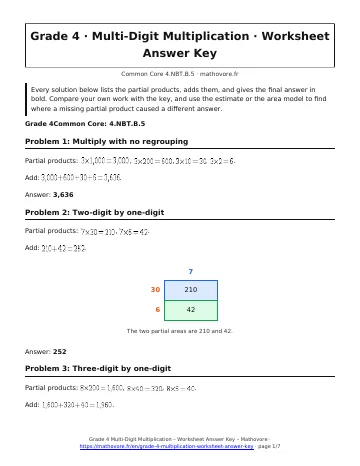
See every chapter on the Grade 4 math page.