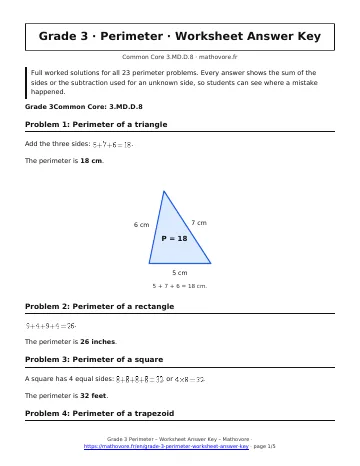
Key takeaway: Open this grade 3 perimeter worksheet answer key for worked solutions to all 23 problems. Each answer shows the sum of the sides or the subtraction for a missing side, so students can see where a slip began. Parents can match each step to the figure. In addition, the notes remind students to write units of length, because a bare number loses a point on most tests.
Full worked solutions for all 23 perimeter problems. Every answer shows the sum of the sides or the subtraction used for an unknown side, so students can see where a mistake happened.
Grade 3 Perimeter Worksheet Answer Key: problems 1–5
1. Perimeter of a triangle
Add the three sides: \(5 + 7 + 6 = 18\).
The perimeter is 18 cm.
2. Perimeter of a rectangle
\(9 + 4 + 9 + 4 = 26\).
The perimeter is 26 inches.
3. Perimeter of a square
A square has 4 equal sides: \(8 + 8 + 8 + 8 = 32\), or \(4 \times 8 = 32\).
The perimeter is 32 feet.
4. Perimeter of a trapezoid
\(5 + 5 + 8 + 4 = 22\).
The perimeter is 22 feet.
5. Perimeter of a pentagon
\(7 + 5 + 6 + 8 + 4 = 30\).
The perimeter is 30 cm.
Grade 3 Perimeter Worksheet Answer Key: problems 6–10
6. Regular hexagon
There are 6 equal sides: \(6 \times 4 = 24\).
The perimeter is 24 meters.
7. Rectangle from numbers
\(12 + 7 = 19\), and \(2 \times 19 = 38\).
The perimeter is 38 feet.
8. Equal sides
\(3 \times 10 = 30\).
The perimeter is 30 inches.
9. Count the units
Count the side lengths along the outside, starting at the top: 5, 2, 3, 2, 2, 4.
\(5 + 2 + 3 + 2 + 2 + 4 = 18\).
The perimeter is 18 cm.
10. Missing side of a triangle
Known sides: \(8 + 9 = 17\). Subtract: \(24 – 17 = 7\).
Check: \(8 + 9 + 7 = 24\).
The missing side is 7 meters.
Grade 3 Perimeter Worksheet Answer Key: problems 11–15
11. Missing width
Two lengths: \(9 + 9 = 18\). The two widths share \(30 – 18 = 12\), so one width is \(12 : 2 = 6\).
Check: \(9 + 6 + 9 + 6 = 30\).
The width is 6 feet.
12. Side of a square
Think: \(4 \times ? = 36\). Since \(4 \times 9 = 36\), each side is 9 inches.
Each side is 9 inches.
13. Missing side of a quadrilateral
\(11 + 9 + 12 = 32\). \(40 – 32 = 8\).
The fourth side is 8 cm.
14. Missing length
Two widths: \(8 + 8 = 16\). \(44 – 16 = 28\). Half of 28 is 14.
Check: \(14 + 8 + 14 + 8 = 44\).
The length is 14 feet.
15. Same perimeter
Perimeters: \(6 + 2 + 6 + 2 = 16\), \(5 + 3 + 5 + 3 = 16\), \(4 + 4 + 4 + 4 = 16\).
Areas: \(6 \times 2 = 12\), \(5 \times 3 = 15\), \(4 \times 4 = 16\).
All three have a perimeter of 16 units. The areas are 12, 15 and 16 square units.
Grade 3 Perimeter Worksheet Answer Key: problems 16–20
16. Compare two rectangles
A: \(8 + 2 + 8 + 2 = 20\). B: \(6 + 4 + 6 + 4 = 20\). The perimeters match.
Areas: \(8 \times 2 = 16\) and \(6 \times 4 = 24\).
Both perimeters are 20 cm. Rectangle B has the greater area (24 square cm compared with 16 square cm).
17. Same area, different perimeters
\(12 + 1 + 12 + 1 = 26\), \(6 + 2 + 6 + 2 = 16\), \(4 + 3 + 4 + 3 = 14\).
The perimeters are 26, 16 and 14 units. The shape closest to a square has the shortest distance around.
18. Fence for a yard
\(15 + 10 + 15 + 10 = 50\).
He needs 50 feet of fence.
19. Walk around the park
\(120 + 150 + 90 = 360\).
She walks 360 yards.
20. Ribbon for a frame
Perimeter: \(11 + 9 + 11 + 9 = 40\) inches.
She has 36 inches, and \(40 – 36 = 4\).
No, she needs 4 more inches of ribbon.
Grade 3 Perimeter Worksheet Answer Key: problems 21–23
21. Square pen
Four equal sides: \(48 : 4 = 12\).
Each side is 12 feet. Check: \(4 \times 12 = 48\).
22. Find the mistake
Liam added only one length and one width: \(8 + 5 = 13\). Perimeter is the distance around all four sides.
\(8 + 5 + 8 + 5 = 26\).
The correct perimeter is 26 inches.
23. Banner at the market
Two widths: \(7 + 7 = 14\). \(34 – 14 = 20\), and half of 20 is 10, so the length is 10 feet.
Going around twice: \(2 \times 34 = 68\).
The length is 10 feet, and 68 feet of rope go around it twice.
How do you check the sum of sides answers?
Problem 2 gives \(9 + 4 + 9 + 4 = 26\) inches. Next, problem 3 gives \(4 \times 8 = 32\) feet. After that, problem 5 adds 7, 5, 6, 8, and 4 for 30 cm. Also, problem 7 gives \(2 \times (12 + 7) = 38\) feet, and problem 8 gives \(3 \times 10 = 30\) inches.
What are the correct missing side answers?
Problem 12 gives 9 inches, since \(36 : 4 = 9\). Then problem 13 gives 8 cm, because \(40 – 32 = 8\). For problem 14, \(44 – 16 = 28\), and half of 28 is 14, so the length is 14 feet. Meanwhile, problem 11 gives a width of 5 feet.
How do you verify the comparing and story answers?
Problem 18 gives \(2 \times (15 + 10) = 50\) feet of fence. Problem 19 gives \(120 + 150 + 90 = 360\) yards. Next, problem 21 gives 12 feet per side, because \(48 : 4 = 12\). Finally, problem 23 gives a length of 10 feet, since \(34 : 2 = 17\) and \(17 – 7 = 10\).
What should a student redo first?
Start with any answer that has no unit or only half the sides added. Next, redraw the shape and label every edge. Then solve the problem again. Once the redone answers match the key, try the printable test to practice without the figures nearby.

See every chapter on the Grade 3 math page.