



This answer key gives complete solutions and a point-by-point scoring guide for the rigid transformations test. Accept any valid sequence for the open-ended questions and award partial credit as described.
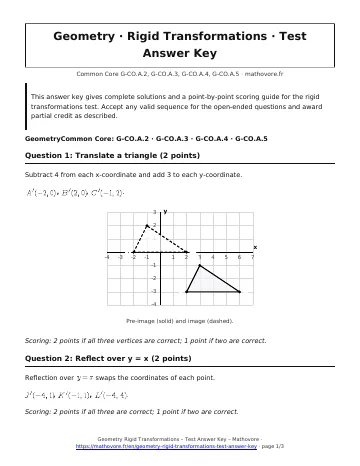
Question 1: Translate a triangle (2 points)
Subtract 4 from each x-coordinate and add 3 to each y-coordinate.
\(A^{\prime}(-2,\,0)\), \(B^{\prime}(2,\,0)\), \(C^{\prime}(-1,\,2)\).
Scoring: 2 points if all three vertices are correct; 1 point if two are correct.
Question 2: Reflect over y = x (2 points)
Reflection over \(y=x\) swaps the coordinates of each point.
\(J^{\prime}(-4,\,1)\), \(K^{\prime}(-1,\,1)\), \(L^{\prime}(-4,\,4)\).
Scoring: 2 points if all three are correct; 1 point if two are correct.
Question 3: Rotate clockwise (2 points)
A \(90^{\circ}\) clockwise rotation sends \((x,\,y)\) to \((y,\,-x)\).
- \((2,\,-3)\)
- \((5,\,4)\)
- \((-6,\,0)\)
Scoring: 1 point for two correct images; 2 points for all three.
Question 4: Sequence of transformations (3 points)
- Reflection over the y-axis: \(D^{\prime}(-1,\,2)\), \(E^{\prime}(-4,\,2)\), \(F^{\prime}(-1,\,6)\). Translation: \(D^{\prime\prime}(1,\,-1)\), \(E^{\prime\prime}(-2,\,-1)\), \(F^{\prime\prime}(1,\,3)\).
- \(DE=4-1=3\) and \(D^{\prime\prime}E^{\prime\prime}=1-(-2)=3\). The lengths are equal, as expected for rigid transformations.
Scoring: Part (a): 1 point for the correct intermediate image, 1 point for the final image. Part (b): 1 point for both lengths.
Question 5: Identify the transformation (2 points)
Each point \((x,\,y)\) goes to \((-x,\,-y)\), for example \(A(1,\,1)\) to \(A^{\prime}(-1,\,-1)\).
The transformation is a rotation of \(180^{\circ}\) about the origin.
Scoring: 1 point for naming a rotation (a reflection over both axes in turn is also accepted); 1 point for the angle \(180^{\circ}\) and the center at the origin.
Question 6: Rigid or not rigid (2 points)
- \(AB=4-1=3\). The image endpoints are \(A^{\prime}(1,\,3)\) and \(B^{\prime}(1,\,12)\), so \(A^{\prime}B^{\prime}=12-3=9\).
- No. The length changed from 3 to 9, and rigid transformations preserve length.
Scoring: 1 point for both lengths; 1 point for the conclusion with the reason.
Question 7: Symmetry (3 points)
- 8 lines: a regular polygon with \(n\) sides has \(n\) lines.
- \(360 : 8=45\): \(45^{\circ}\).
- 2 lines, one through the midpoints of each pair of opposite sides.
Scoring: 1 point per correct part.
Question 8: Describe a sequence (2 points)
One answer: rotate \(180^{\circ}\) about the origin, then translate by \(\langle -1,\,4\rangle\).
Rotation: \(A^{\prime}(6,\,-1)\), \(B^{\prime}(2,\,-1)\), \(C^{\prime}(2,\,-3)\), \(D^{\prime}(6,\,-3)\). Translation: \(A^{\prime\prime}(5,\,3)\), \(B^{\prime\prime}(1,\,3)\), \(C^{\prime\prime}(1,\,1)\), \(D^{\prime\prime}(5,\,1)\), which match the image.
Scoring: 1 point for a correct first transformation; 1 point for a second transformation that completes the mapping. Other valid sequences earn full credit.
Question 9: Robot position (2 points)
Reflection over the x-axis: \((-3,\,4)\) becomes \((-3,\,-4)\).
Translation: \((-3+5,\,-4+2)\) = \((2,\,-2)\).
Scoring: 1 point for the reflected point; 1 point for the final position.
20 points
See every chapter on the Geometry math page.