
Key takeaway: This AP calculus differential equations test mixes eight questions into a 20-point exam. You will verify a solution, interpret a slope field, solve separable equations, state a domain, model bacteria and decay, and write an equation from a verbal rate. Show each separation step, and include the constant before you apply the starting value. The set targets the AB unit and rewards complete reasoning.
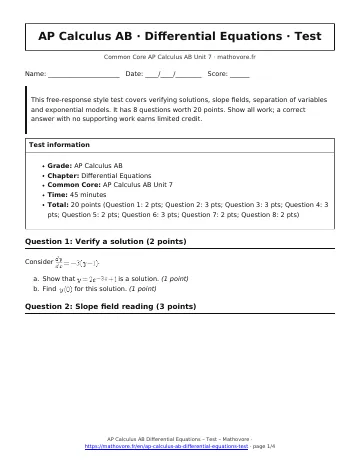
This free-response style test covers verifying solutions, slope fields, separation of variables and exponential models. It has 8 questions worth 20 points. Show all work; a correct answer with no supporting work earns limited credit.
- Grade: AP Calculus AB
- Chapter: Differential Equations
- Common Core: AP Calculus AB Unit 7
- Time: 45 minutes
- Total: 20 points (Question 1: 2 pts; Question 2: 3 pts; Question 3: 3 pts; Question 4: 3 pts; Question 5: 2 pts; Question 6: 3 pts; Question 7: 2 pts; Question 8: 2 pts)
AP Calculus Differential Equations Test: questions 1–5
1. Verify a solution (2 points)
Consider \(\frac{dy}{dx}=-3(y-1)\).
- Show that \(y=2e^{-3x}+1\) is a solution. (1 point)
- Find \(y(0)\) for this solution. (1 point)
2. Slope field reading (3 points)
The slope field shown is for \(\frac{dy}{dx}=x-y\). Let \(y=f(x)\) be the solution with \(f(0)=1\).
- Find the slope of the field at \((2,1)\) and at \((-1,2)\). (1 point)
- Write the tangent line to the graph of \(f\) at \(x=0\) and use it to estimate \(f(0.5)\). (1 point)
- Find \(\frac{d^{2}y}{dx^{2}}\) in terms of \(x\) and \(y\), and decide whether your estimate in part (b) is too large or too small. (1 point)
3. Separable equation (3 points)
Solve \(\frac{dy}{dx}=\frac{2x}{y^{2}}\) with \(y(0)=2\). Write \(y\) as a function of \(x\).
4. Bacteria model (3 points)
A bacteria culture grows so that \(\frac{dP}{dt}=kP\), where \(t\) is in hours. There are 400 bacteria at \(t=0\) and 1,600 bacteria at \(t=3\).
- Write \(P(t)\) in terms of \(k\). (1 point)
- Find the exact value of \(k\). (1 point)
- Find \(P(5)\) to the nearest whole bacterium. (1 point)
5. Write a differential equation (2 points)
The temperature \(T\) of a pie, in \(^{\circ}\text{F}\), changes at a rate proportional to the difference between \(T\) and the room temperature of \(72^{\circ}\text{F}\). The pie comes out of the oven at \(T(0)=350\).
- Write a differential equation for \(T\). (1 point)
- State the sign of the constant of proportionality and justify it. (1 point)
AP Calculus Differential Equations Test: questions 6–8
6. Solution and domain (3 points)
Let \(y=f(x)\) be the solution of \(\frac{dy}{dx}=xy^{2}\) with \(f(0)=1\).
- Find \(f(x)\). (2 points)
- State the largest open interval containing \(x=0\) on which \(f\) is defined. (1 point)
7. Radioactive decay (2 points)
An 80 g sample of an isotope decays so that \(\frac{dm}{dt}=km\), with a half-life of 30 years. Find the number of years until 10 g remain.
8. Identify an equation (2 points)
A slope field is shown. Which of these could be its differential equation: \(\frac{dy}{dx}=x\), \(\frac{dy}{dx}=\frac{y}{2}\) or \(\frac{dy}{dx}=-\frac{y}{2}\)? Justify, then state \(\lim_{x\to\infty}f(x)\) for the solution with \(f(0)=1\).

Where are the heavy questions?
Questions 2, 3, 4 and 6 are worth three points each. Question 3 asks for \(y\) as a function of \(x\) after separation, while question 6 adds a domain statement. Therefore reserve time for algebra and for a final check.
What does question 3 require?
The equation \(\frac{dy}{dx}=\frac{2x}{y^2}\) separates into \(y^2\,dy=2x\,dx\). Integrating gives \(\frac{y^3}{3}=x^2+C\). With \(y(0)=2\), the constant is \(\frac{8}{3}\), so \(y=\sqrt[3]{3x^2+8}\).
How does an AP calculus differential equations test handle the domain question?
For \(\frac{dy}{dx}=xy^2\) with \(f(0)=1\), the solution is \(f(x)=\frac{2}{2-x^2}\). The denominator vanishes at \(\pm\sqrt{2}\), so the interval containing 0 is \((-\sqrt{2},\sqrt{2})\). State the interval in words as well.
Which wording trap appears in question 5?
A rate proportional to the difference between pie temperature and room temperature gives \(\frac{dT}{dt}=k(T-T_{\text{room}})\). The sign of \(k\) matters, because a cooling pie has a negative constant when written this way.
How can you learn from the finished test?
Sort lost points into setup, constant and domain. Next, redo the most costly question on a clean page. Finally, create a new separable equation whose solution has a restricted domain, and check that your interval is the largest one.

See every chapter on the AP Calculus AB math page.