
Key takeaway: This AP calculus applications integration worksheet gives you 24 printable problems that cover average value, particle motion, area between curves, cross sections, solids of revolution and accumulation. Problems start with a plain polynomial and end with a leaking tank and a greenhouse temperature. Show the integral before you evaluate it, because setup earns most of the credit. A separate answer key explains each result, and the final problems use units in every answer.
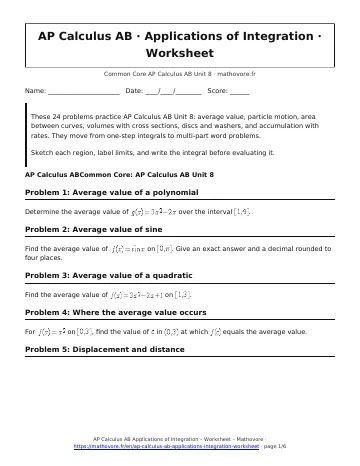
These 24 problems practice AP Calculus AB Unit 8: average value, particle motion, area between curves, volumes with cross sections, discs and washers, and accumulation with rates. They move from one-step integrals to multi-part word problems.
Sketch each region, label limits, and write the integral before evaluating it.
AP Calculus Applications Integration Worksheet: problems 1–5
1. Average value of a polynomial
Determine the average value of \(g(x)=3x^{2}-2x\) over the interval \([1,4]\).
2. Average value of sine
Find the average value of \(f(x)=\sin x\) on \([0,\pi]\). Give an exact answer and a decimal rounded to four places.
3. Average value of a quadratic
Find the average value of \(f(x)=3x^{2}-2x+1\) on \([1,3]\).
4. Where the average value occurs
For \(f(x)=x^{2}\) on \([0,3]\), find the value of \(c\) in \((0,3)\) at which \(f(c)\) equals the average value.
5. Displacement and distance
A particle moves along a line with velocity \(v(t)=t^{2}-4t+3\) for \(0\le t\le 4\). Find the displacement and the total distance traveled.
AP Calculus Applications Integration Worksheet: problems 6–10
6. Final position
A particle has velocity \(v(t)=3t^{2}-6t\) and position \(s(0)=2\). Find \(s(2)\).
7. Cosine motion
A particle has velocity \(v(t)=\cos t\) for \(0\le t\le\pi\). Find the displacement and the total distance.
8. Area between a parabola and a line
Find the area of the region enclosed by the line \(y=3x+4\) and the parabola \(y=x^{2}\).
9. Area with two intersection points
Find the area of the region bounded by \(y=x+2\) and \(y=x^{2}\), shown above.
10. Area between exponentials
Find the area between \(y=e^{x}\) and \(y=e^{-x}\) for \(0\le x\le\ln 3\).
AP Calculus Applications Integration Worksheet: problems 11–15
11. Area using y
Find the area of the region bounded by \(x=y^{2}\) and \(x=2y\) by integrating with respect to \(y\).
12. Three intersection points
Find the total area enclosed by \(y=x^{3}\) and \(y=x\).
13. Sine and cosine area
Find the area enclosed by \(y=\sin x\) and \(y=\cos x\) between consecutive intersections at \(x=\frac{\pi}{4}\) and \(x=\frac{5\pi}{4}\).
14. Square cross sections
The base of a solid is the region between \(y=\sqrt{x}\) and \(y=\frac{x}{2}\). Cross sections perpendicular to the \(x\)-axis are squares. Find the volume.
15. Semicircle cross sections
The base of a solid is the region bounded by \(y=\sqrt{x}\), the \(x\)-axis and \(x=4\). Cross sections perpendicular to the \(x\)-axis are semicircles whose diameters lie in the base. Find the volume.
AP Calculus Applications Integration Worksheet: problems 16–20
16. Triangle cross sections
The base of a solid is the region between \(y=6x-x^{2}\) and the \(x\)-axis. Cross sections perpendicular to the \(x\)-axis are equilateral triangles with a side in the base. Find the volume.
17. Disc method about the x-axis
The region bounded by \(y=\sqrt{x}\), the \(x\)-axis and \(x=4\) is revolved about the \(x\)-axis. Find the volume.
18. Disc method about the y-axis
The region bounded by \(y=x^{2}\), the \(y\)-axis and \(y=4\) is revolved about the \(y\)-axis. Find the volume.
19. Washer about the x-axis
The region between \(y=x\) and \(y=x^{3}\) in the first quadrant is revolved about the \(x\)-axis. Find the volume.
20. Washer about a horizontal line
The region between \(y=x\) and \(y=x^{2}\) is revolved about the line \(y=-1\). Find the volume.
AP Calculus Applications Integration Worksheet: problems 21–24
21. Rotation about a vertical line
The region bounded by \(y=\sqrt{x}\), the \(x\)-axis and \(x=4\) is revolved about the line \(x=4\). Find the volume.
22. Water in a tank
A tank holds 100 gallons at \(t=0\). Water flows in at \(5+2t\) gallons per minute and out at 9 gallons per minute for \(0\le t\le 6\). Find the amount at \(t=6\), and find when the amount is least.
23. Oil leak
Oil leaks from a tank at a rate of \(12e^{-0.2t}\) gallons per hour. How many gallons leak during the first 5 hours? Round to the nearest hundredth.
24. Average temperature
The temperature in a greenhouse is \(T(t)=60+10\sin(\frac{\pi t}{12})\) degrees Fahrenheit, \(0\le t\le 12\), where \(t\) is in hours after 6 a.m. Find the average temperature on this interval, to the nearest tenth of a degree.

Which average value problems start the set?
Problem 1 averages \(3x^2-2x\) on \([1,4]\) and gives 16. Next, \(3x^2-2x+1\) on \([1,3]\) in problem 3 averages 10. After that, problem 4 asks where \(x^2\) reaches its average of 3 on \([0,3]\), so solve \(c^2=3\) and keep only the value inside the interval.
How do the area problems 8 to 13 differ?
In problem 8, the line \(y=3x+4\) meets \(y=x^2\) at \(-1\) and 4. Problem 11 reverses the roles and integrates in \(y\) for \(x=y^2\) and \(x=2y\). Problem 12 has three intersection points, so split the area at the middle one. Otherwise positive and negative pieces cancel.
What does an AP calculus applications integration worksheet ask about volume?
Problems 14 to 16 build solids from square, semicircle and triangle cross sections. Then \(y=\sqrt{x}\) spins about the \(x\)-axis in problem 17 for \(8\pi\). Washers are needed in problem 19, since the region between \(y=x\) and \(y=x^3\) leaves a hole. Finally, a spin about \(x=4\) in problem 21 makes the radius \(4-x\).
How are the rate problems framed?
Problem 22 starts a tank at 100 gallons and adds inflow minus outflow. Problem 23 integrates \(12e^{-0.2t}\) over five hours, which gives about 37.9 gallons. Remember that net change plus the starting amount gives the final amount.
How can you divide these 24 problems into manageable sets?
Finish average value and motion first, because the setups are short. After a break, do the area and cross-section problems. Save the washer and rate problems for a final session. Then compare each setup, not only each answer, with the key.

See every chapter on the AP Calculus AB math page.