


This ap calculus differential test answer key gives the full solution and the scoring guide for each of the 8 test questions on differential equations.
Full solutions and a scoring guide for the differential equations test. Points are awarded the way an AP reader would: separate setup, antiderivative, constant and final answer each earn their own point.
AP Calculus Differential Test Answer Key: questions 1–5
Question 1: Verify a solution (2 points)
- \(\frac{dy}{dx}=-6e^{-3x}\). Also \(-3(y-1)=-3(2e^{-3x})=-6e^{-3x}\). The sides are equal.
- \(y(0)=2e^{0}+1=3\).
(b) \(y(0)=3\)
Scoring: 1 point for differentiating and substituting to show equality; 1 point for \(y(0)=3\).
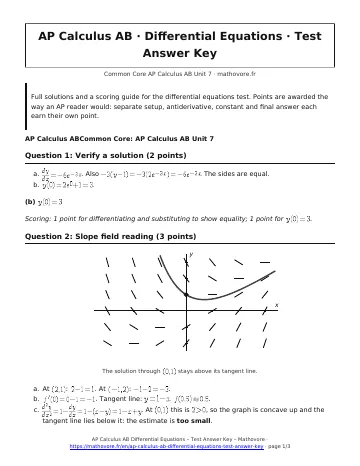
Question 2: Slope field reading (3 points)
- At \((2,1)\): \(2-1=1\). At \((-1,2)\): \(-1-2=-3\).
- \(f^{\prime}(0)=0-1=-1\). Tangent line: \(y=1-x\). \(f(0.5)\approx 0.5\).
- \(\frac{d^{2}y}{dx^{2}}=1-\frac{dy}{dx}=1-(x-y)=1-x+y\). At \((0,1)\) this is \(2>0\), so the graph is concave up and the tangent line lies below it: the estimate is too small.
Scoring: 1 point for both slopes (\(1\) and \(-3\)); 1 point for the tangent line and \(0.5\); 1 point for \(\frac{d^{2}y}{dx^{2}}=1-x+y\) with the correct conclusion.
Question 3: Separable equation (3 points)
\(y^{2}\,dy=2x\,dx\), so \(\frac{y^{3}}{3}=x^{2}+C\).
\(y(0)=2\): \(\frac{8}{3}=C\). Then \(y^{3}=3x^{2}+8\).
\(y=(3x^{2}+8)^{1/3}\)
Scoring: 1 point for separating the variables; 1 point for both antiderivatives (with \(C\)); 1 point for \(C=\frac{8}{3}\) and the final function.
Question 4: Bacteria model (3 points)
- \(P(t)=400e^{kt}\).
- \(400e^{3k}=1600\), so \(e^{3k}=4\) and \(k=\frac{\ln 4}{3}\) (about \(0.4621\)).
- \(P(5)=400\cdot 4^{5/3}\approx 400(10.0794)\approx 4032\).
(c) about 4,032 bacteria
Scoring: 1 point for \(P=400e^{kt}\); 1 point for \(k=\frac{\ln 4}{3}\); 1 point for \(4032\).
Question 5: Write a differential equation (2 points)
- \(\frac{dT}{dt}=k(T-72)\).
- The pie is hotter than the room, so \(T-72>0\), but its temperature falls, so \(\frac{dT}{dt}<0\). Therefore \(k<0\).
\(\frac{dT}{dt}=k(T-72)\) with \(k<0\)
Scoring: 1 point for the equation; 1 point for \(k<0\) with the reason.
AP Calculus Differential Test Answer Key: questions 6–8
Question 6: Solution and domain (3 points)
- \(y^{-2}\,dy=x\,dx\), so \(-\frac{1}{y}=\frac{x^{2}}{2}+C\). With \(f(0)=1\), \(C=-1\). Then \(\frac{1}{y}=1-\frac{x^{2}}{2}\) and \(f(x)=\frac{2}{2-x^{2}}\).
- The denominator is zero when \(x=\pm\sqrt{2}\), so the interval is \(-\sqrt{2}< x<\sqrt{2}\).
(a) \(f(x)=\frac{2}{2-x^{2}}\); (b) \((-\sqrt{2},\sqrt{2})\)
Scoring: part (a) 1 point for separation and antiderivatives, 1 point for \(C\) and \(f\); part (b) 1 point.
Question 7: Radioactive decay (2 points)
Half-life 30 years: 80 g becomes 40 g, 20 g, then 10 g after three half-lives. Equivalently \(80\cdot 2^{-t/30}=10\) gives \(2^{-t/30}=\frac{1}{8}\), so \(t=90\).
90 years
Scoring: 1 point for a correct model such as \(m=80\cdot 2^{-t/30}\) (or \(k=-\frac{\ln 2}{30}\)); 1 point for \(t=90\).
Question 8: Identify an equation (2 points)
Segments are parallel along each horizontal row, so the slope depends only on \(y\). The slope is positive above the \(x\)-axis and negative below it, so the equation is \(\frac{dy}{dx}=\frac{y}{2}\) (not \(-\frac{y}{2}\), which has the opposite signs).
The solution through \((0,1)\) is \(f(x)=e^{x/2}\), so \(\lim_{x\to\infty}f(x)=\infty\).
\(\frac{dy}{dx}=\frac{y}{2}\); the limit is \(\infty\).
Scoring: 1 point for the equation with a valid reason; 1 point for the limit.
Scoring summary
20 points: add the points of every question of this ap calculus differential test answer key.
How to use this ap calculus differential test answer key
Use this ap calculus differential test answer key to score the test fairly and to see which skills need more practice.

See every chapter on the AP Calculus AB math page.