



This ap calculus analyzing functions quiz asks 10 multiple-choice questions on analyzing functions with derivatives, and each answer comes with a short explanation.
Ten multiple-choice questions check the core ideas of AP Calculus AB Unit 5: critical numbers, graphs of derivatives, the Second Derivative Test, inflection points, the Mean Value Theorem, absolute extrema and implicit differentiation. Pick the single best answer for each question.
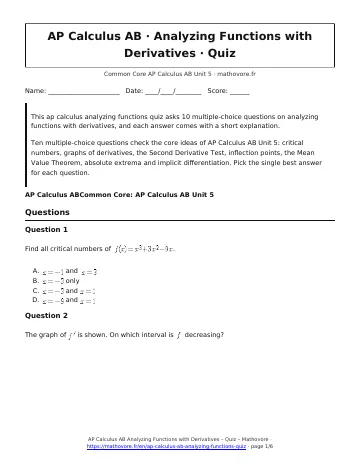
Find all critical numbers of \(f(x)=x^{3}+3x^{2}-9x\).
The graph of \(f^{\prime}\) is shown. On which interval is \(f\) decreasing?
Suppose \(f^{\prime}(3)=0\) and \(f^{\prime\prime}(3)=-4\). What does the Second Derivative Test conclude about \(f\) at \(x=3\)?
Where does \(f(x)=x^{3}-6x^{2}+2x\) have a point of inflection?
The Mean Value Theorem is applied to \(f(x)=x^{3}\) on \([0,2]\). What is \(c\)?
The graph of \(f(x)=x^{2}-6x+4\) on \([0,5]\) is shown. What is the absolute maximum value of \(f\) on this interval?
A rectangle has perimeter 40 inches. What is its greatest possible area?
The graph of \(f^{\prime\prime}\) is shown. For which values of \(x\) is the graph of \(f\) concave up?
For the circle \(x^{2}+y^{2}=25\), what is \(\frac{dy}{dx}\) at the point \((3,4)\)?
On which function and interval does the Mean Value Theorem apply?
🎉 Quiz complete!
How does this quiz work?
Read each question, choose one answer among A, B, C and D, then check it: a short explanation appears after every answer. Your score out of 10 is shown at the end, and you can restart the quiz as often as you like.
What should you review before the quiz?
Reread the key facts of the lesson and the worked example. If a question is hard, go back to the matching part of the lesson, then try the quiz again. Write your work on scrap paper: most mistakes come from skipping a step, not from the idea itself.
Remember:
- AP Calculus AB Unit 5: use \(f^{\prime}\) and \(f^{\prime\prime}\) to describe increasing, decreasing, concavity, extrema and inflection points.
- Candidates Test: on \([a,b]\), compare \(f\) at critical numbers and at both endpoints.
- Mean Value Theorem: continuous on \([a,b]\) and differentiable on \((a,b)\) guarantees \(f^{\prime}(c)=\frac{f(b)-f(a)}{b-a}\) for some \(c\).
- Second Derivative Test: if \(f^{\prime}(c)=0\), then \(f^{\prime\prime}(c) < 0\) means a local maximum and \(f^{\prime\prime}(c) > 0\) means a local minimum.
How to use this ap calculus analyzing functions quiz
Retake this ap calculus analyzing functions quiz until every answer is right, then move on to the worksheet and the test.

See every chapter on the AP Calculus AB math page.