

Key takeaway: This AP calculus integration worksheet offers 26 printable problems on antiderivatives, Riemann sums, definite integrals, accumulation functions and substitution. You will compare four estimates for \(x^2\), use geometry for a semicircle, evaluate with the Fundamental Theorem, and finish with tanks, customers, leaks and savings. A separate key explains every answer, and the set follows AP Calculus AB Unit 6.
These 26 problems practice AP Calculus AB Unit 6: antiderivatives, Riemann sums, definite integral properties, the Fundamental Theorem of Calculus, accumulation functions, and u-substitution, long division and completing the square.
Problems move from basic antiderivatives to applied accumulation questions. Show every antiderivative and every substitution before you evaluate limits.
AP Calculus Integration Worksheet: problems 1–5
1. Power rule antiderivative
Find \(\displaystyle\int (6x^{2}-4x+5)\,dx\).
2. Fractional and negative powers
Find \(\displaystyle\int (3\sqrt{x}-\frac{2}{x^{2}})dx\).
3. Trigonometric and exponential
Find \(\displaystyle\int (4\cos x-3e^{x}+\frac{1}{x})dx\) for \(x > 0\).
4. Initial value problem
The function \(f\) satisfies \(f^{\prime}(x)=6x^{2}-2x\) and \(f(1)=4\). Find \(f(x)\).
5. Four Riemann sums
Let \(f(x)=x^{2}\) on \([0,4]\) with \(n=4\) equal subintervals. Find the left, right, midpoint and trapezoidal sums.
AP Calculus Integration Worksheet: problems 6–10
6. Sums from a table
Maya jogs and records her speed \(v(t)\) in feet per second.
| \(t\) (s) | \(0\) | \(2\) | \(5\) | \(9\) | \(10\) |
|---|---|---|---|---|---|
| \(v(t)\) | \(3\) | \(5\) | \(8\) | \(6\) | \(4\) |
- Use a left Riemann sum with the four subintervals to estimate the distance she jogs from \(t=0\) to \(t=10\).
- Use a right Riemann sum.
- Use a trapezoidal sum.
7. Overestimate or underestimate
For \(f(x)=\frac{1}{x}\) on \([1,5]\), which is decreasing and concave up, decide whether each estimate of \(\int_{1}^{5}\frac{1}{x}\,dx\) is an overestimate or an underestimate, and then compute the left sum with \(n=4\).
- Left sum
- Right sum
- Midpoint sum
- Trapezoidal sum
8. Properties of definite integrals
Suppose \(\int_{1}^{5} f(x)\,dx=7\), \(\int_{1}^{3} f(x)\,dx=2\) and \(\int_{1}^{5} g(x)\,dx=-3\). Find each value.
- \(\int_{3}^{5} f(x)\,dx\)
- \(\int_{1}^{5}(2f(x)-3g(x))dx\)
- \(\int_{5}^{1} f(x)\,dx\)
- \(\int_{1}^{5}(f(x)+4)dx\)
9. Integrals from geometry
The graph of \(f(x)=\sqrt{9-x^{2}}\) is a semicircle of radius 3. Use geometry to find each value.
- \(\int_{-3}^{3} f(x)\,dx\)
- \(\int_{0}^{3} f(x)\,dx\)
- \(\int_{-3}^{3}(f(x)+2)dx\)
10. Evaluate with the Fundamental Theorem
Evaluate \(\displaystyle\int_{1}^{3}(4x^{3}-6x)\,dx\).
AP Calculus Integration Worksheet: problems 11–15
11. Trigonometric definite integral
Evaluate \(\displaystyle\int_{0}^{\pi/2}(3\sin x+2\cos x)\,dx\).
12. Logarithmic and exponential limits
Evaluate each integral.
- \(\displaystyle\int_{1}^{e^{2}}\frac{3}{x}\,dx\)
- \(\displaystyle\int_{0}^{\ln 3}4e^{x}\,dx\)
13. Derivatives of accumulation functions
Find each derivative.
- \(\dfrac{d}{dx}\displaystyle\int_{2}^{x}\sqrt{t^{3}+1}\,dt\)
- \(\dfrac{d}{dx}\displaystyle\int_{1}^{x^{2}}\sin t\,dt\)
- \(\dfrac{d}{dx}\displaystyle\int_{x}^{5}\ln(t^{2}+1)\,dt\)
14. Accumulation from a graph
The graph of \(f\) consists of line segments through \((0,0)\), \((2,4)\), \((4,0)\), \((6,-3)\) and \((8,0)\). Let \(g(x)=\int_{0}^{x} f(t)\,dt\).
- Find \(g(2)\), \(g(4)\), \(g(6)\) and \(g(8)\).
- Find \(g^{\prime}(6)\).
- On \([0,8]\), at what \(x\) does \(g\) have its maximum value, and what is it?
- On what interval is the graph of \(g\) concave down?
15. Substitution with a power
Find \(\displaystyle\int 6x(3x^{2}+1)^{4}\,dx\).
AP Calculus Integration Worksheet: problems 16–20
16. Substitution with cosine
Find \(\displaystyle\int x^{2}\cos(x^{3})dx\).
17. Substitution giving a logarithm
Find \(\displaystyle\int \frac{x}{x^{2}+4}\,dx\).
18. Definite substitution
Evaluate \(\displaystyle\int_{0}^{2}3x^{2}\sqrt{x^{3}+1}\,dx\).
19. Substitution with changed limits
Evaluate \(\displaystyle\int_{0}^{\pi/2}\sin x\cos^{2}x\,dx\).
20. Long division first
Find \(\displaystyle\int \frac{x^{2}+3x+5}{x+1}\,dx\).
AP Calculus Integration Worksheet: problems 21–25
21. Completing the square
Find \(\displaystyle\int \frac{1}{x^{2}-6x+25}\,dx\).
22. Water in a tank
A tank holds 40 gallons at \(t=0\) minutes. Water flows in at the rate \(r(t)=20-2t\) gallons per minute for \(0\le t\le 8\). How many gallons are in the tank at \(t=8\)?
23. Customers entering a store
Customers enter a store at the rate \(E(t)=100\sin(\frac{\pi t}{12})\) customers per hour for \(0\le t\le 12\), where \(t\) is hours after opening. Find the total number of customers who enter, to the nearest whole number.
24. Leaking water
Water leaks from a pipe at the rate \(L(t)=6e^{-0.5t}\) gallons per hour. Find the exact amount that leaks during the first 4 hours, then round to the nearest hundredth.
25. Saving for a bike
Ethan has $200 saved and deposits money at the rate \(D(t)=40+6t\) dollars per week for 10 weeks. Find his total savings after 10 weeks.
AP Calculus Integration Worksheet: problems 26–26
26. Analyzing an accumulation function
Let \(F(x)=\int_{0}^{x}(t^{2}-2t)\,dt\).
- Find \(F^{\prime}(x)\).
- Find a formula for \(F(x)\) and evaluate \(F(3)\).
- Find the critical numbers of \(F\) and classify each using \(F^{\prime\prime}\).

What happens in problems 1 to 7?
Problems 1 to 4 find antiderivatives, so remember the constant. In problem 4, the condition \(f(1)=4\) gives \(f(x)=2x^3-x^2+3\). Next, problem 5 builds four sums for \(x^2\) on \([0,4]\), with values 14, 30, 21 and 22. Problem 7 asks which estimates are high for \(\frac{1}{x}\).
How do problems 8 to 14 use properties and the theorem?
Problem 8 splits and reverses limits, so a sign flips when the bounds swap. In problem 9, a semicircle of radius 3 has area \(\frac{9\pi}{2}\). Then \(\int_1^3(4x^3-6x)\,dx=56\) in problem 10. Finally, a variable upper limit in problem 13 calls for the chain rule.
How does an AP calculus integration worksheet teach substitution?
Problems 15 to 19 each hide a function and its derivative. In problem 18, \(u=x^3+1\) changes the limits to 1 and 9, which gives \(\frac{52}{3}\). Problem 19 uses \(u=\cos x\) and ends at \(\frac{1}{3}\). Problems 20 and 21 need long division and completing the square first.
Which contexts close the worksheet?
A tank starts at 40 gallons in problem 22 and gains \(r(t)=20-2t\). Next, problem 25 saves from 200 dollars with a deposit rate \(40+6t\), reaching 900 dollars in 10 weeks. Finally, problem 26 builds \(F(x)=\frac{x^3}{3}-x^2\) from an accumulation integral.
How should you divide up these 26 problems?
Treat antiderivatives and sums as the first block, then the theorem and properties, then substitution. Do the contexts last. When you finish a block, check one answer by differentiating it, since differentiation verifies any antiderivative.

Printable PDF · Worksheet
AP Calculus AB Integration and Accumulation of Change worksheet
Download the PDF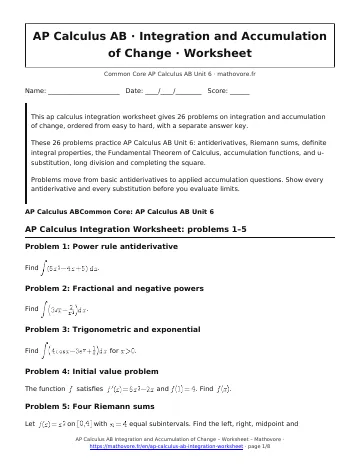
See every chapter on the AP Calculus AB math page.